
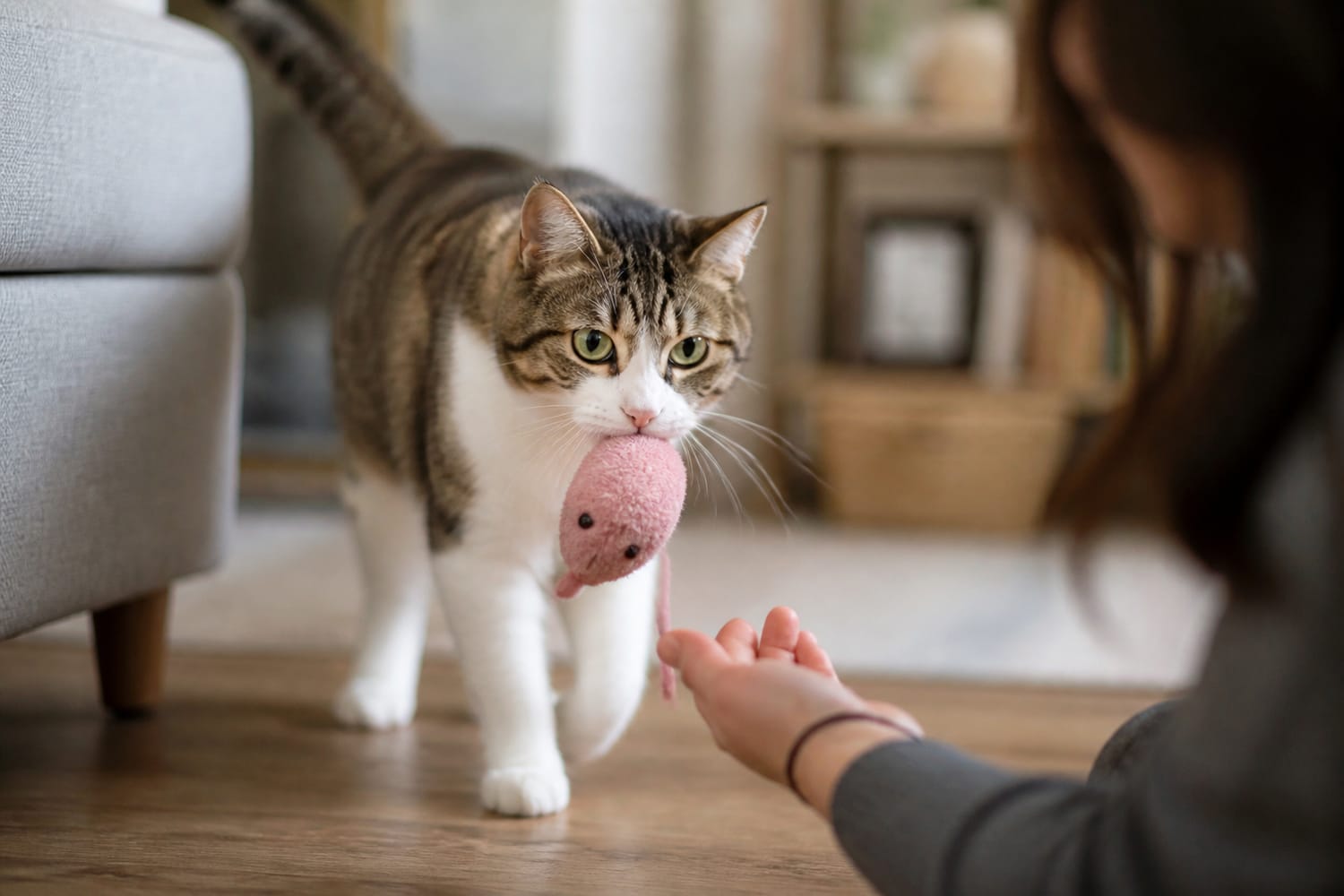
Your cat drops a toy mouse beside your chair, looks up, and meows. Is it a present, a request, or a report of a successful hunt? It could be any of those things—but we can’t know exactly what a cat intends from one toy delivery. The best clues are what your cat does next and what usually happens when you respond.
That little mouse might be tucked against your foot while you work, deposited proudly in the hallway, or carried into your bedroom at night. However it arrives, it’s an opportunity to notice something lovely about your cat: they’ve made you part of a moment that matters to them.
A Toy Can Be a Tiny “Catch”
Cats don’t need to be hungry to enjoy hunting-like activities. Stalking, chasing, pouncing, grabbing, and carrying are all part of their natural behavior, and a toy gives an indoor cat a safe way to practice those moves. Veterinary behavior specialists note that many cats enjoy toys they can pursue and carry, especially small objects that move or resemble prey.
Imagine your cat spotting a soft mouse under the sofa. They crouch, spring forward, scoop it up—and trot off with it. Bringing it into the room where you’re sitting may simply be the last step in an exciting game. Cats that catch real prey may carry it back to a familiar, safer place; with a toy, your living room can serve as that comfortable destination.
“Will You Play With Me?”
Sometimes the message is wonderfully direct. If your cat drops a toy at your feet, watches your hand, and chases it when you toss it, you may have received an invitation to play.
Try rolling the toy a short distance and see what happens. Does your cat race after it and bring it back? Some cats enjoy a version of fetch, though others would rather have you move a wand toy while they do the chasing. Research on fetching cats suggests there’s plenty of individual variation—and still more to learn about why cats choose to retrieve objects.
You don’t need to turn every delivery into a long game. A few minutes of play, with chances to stalk and catch the toy, can make the interaction rewarding. If your cat seems ready for more activity, Petspiration’s guide to keeping your indoor cat active and healthy offers other ways to add variety to their day.
Is It Really a Gift?
Calling a toy a “gift” is a charming way to describe the moment. It’s fine to enjoy it as one! But it’s harder to say that a cat is giving a present in the way a person would.
A cat might bring an object near you because that’s where they feel comfortable, because they want a game, or because they’ve learned that arriving with a toy gets your attention. More than one explanation may fit the same cat. Even the familiar idea that cats bring toys to teach their humans to hunt is best treated as a playful theory, not a proven explanation for every delivery. Veterinary accounts describe several possible reasons cats bring prey or toys home rather than a single settled answer.
The nice part? You don’t have to solve the mystery to appreciate it. You can say hello, watch what your cat chooses to do, and respond in a way they seem to enjoy.
Why the Toy Comes With a Meow
A muffled meow around a stuffed mouse can sound surprisingly dramatic. If your cat carries a toy while vocalizing, look at the whole scene before deciding what they need. Are they approaching you, dropping the toy, and waiting? Are they still wandering around with it? Or do they settle down as soon as the toy reaches a favorite spot?
Your response may become part of a familiar routine. For example, a cat who regularly gets a game after carrying a toy to the kitchen may keep making that trip. One who delivers a mouse to your bedroom but doesn’t seek play may simply be carrying it to a place they like. These are possibilities to test by observing your own cat—not universal translations of a meow.
If the delivery happens at night, remember that many cats are especially active around dawn and dusk. A predictable play session in the evening may help give your cat an outlet before you go to bed, though it won’t necessarily end a nighttime toy parade. You can enjoy the silliness while still keeping nighttime responses calm if you’d rather not start a 2 a.m. game.
Read the Cat, Not Just the Toy
The quickest way to understand a toy delivery is to pay attention to what follows it. Rather than assigning one meaning to every stuffed mouse or crinkle ball, ask:
- Do they stay and watch you? Offer a gentle toss or a short game and see whether they join in.
- Do they keep the toy or move away? Let them have it. They may be enjoying a solo hunt.
- Do they bring back the same toy repeatedly? It may be a particular favorite, or your shared routine may have become fun.
- Do they seem relaxed and choose to re-engage? Follow their lead instead of insisting on more play.
Your cat’s preferences may change with age, health, and mood. If you’re curious which games they genuinely enjoy, Petspiration’s guide to discovering your pet’s favorite activities has ideas for noticing those small but useful clues.
Make the Next Delivery More Fun—and Safe
When your cat invites you to play, let the toy act like something worth pursuing. Move a wand lure along the floor, pause it behind a chair leg, then let your cat pounce and catch it. A ball can skitter across an open floor; a soft mouse can disappear briefly behind a cushion. Try different movements and notice which ones bring out your cat’s curiosity. Veterinary play guidance recommends toys cats can successfully catch rather than games that offer only an endless chase.
For solo play, choose toys suited to your cat’s size and habits, and inspect them for loose parts or damage. Put wand toys with long strings or elastic away when you’re finished supervising; swallowed string can cause a serious medical emergency. Petspiration’s toy rotation guide suggests leaving a frequently carried favorite available while rotating other toys for variety.
When to Look Beyond Play
Occasionally carrying toys is generally an ordinary feline behavior. A new pattern, though, deserves a little attention if it comes alongside other changes. If your cat suddenly vocalizes much more than usual, seems unsettled, loses interest in food, changes litter-box habits, or becomes less active, contact your veterinarian. Cats can show illness through subtle shifts in behavior, so it’s worth looking at the whole picture rather than focusing only on the toy.
Most of the time, that small arrival beside your slippers is simply a delightful part of life with a cat. Maybe it leads to a game; maybe your cat picks the toy back up and strolls away. Either way, pause and pay attention. The more you learn about your cat’s habits, the easier it becomes to meet their invitations with the play, space, or quiet companionship they’re looking for.