
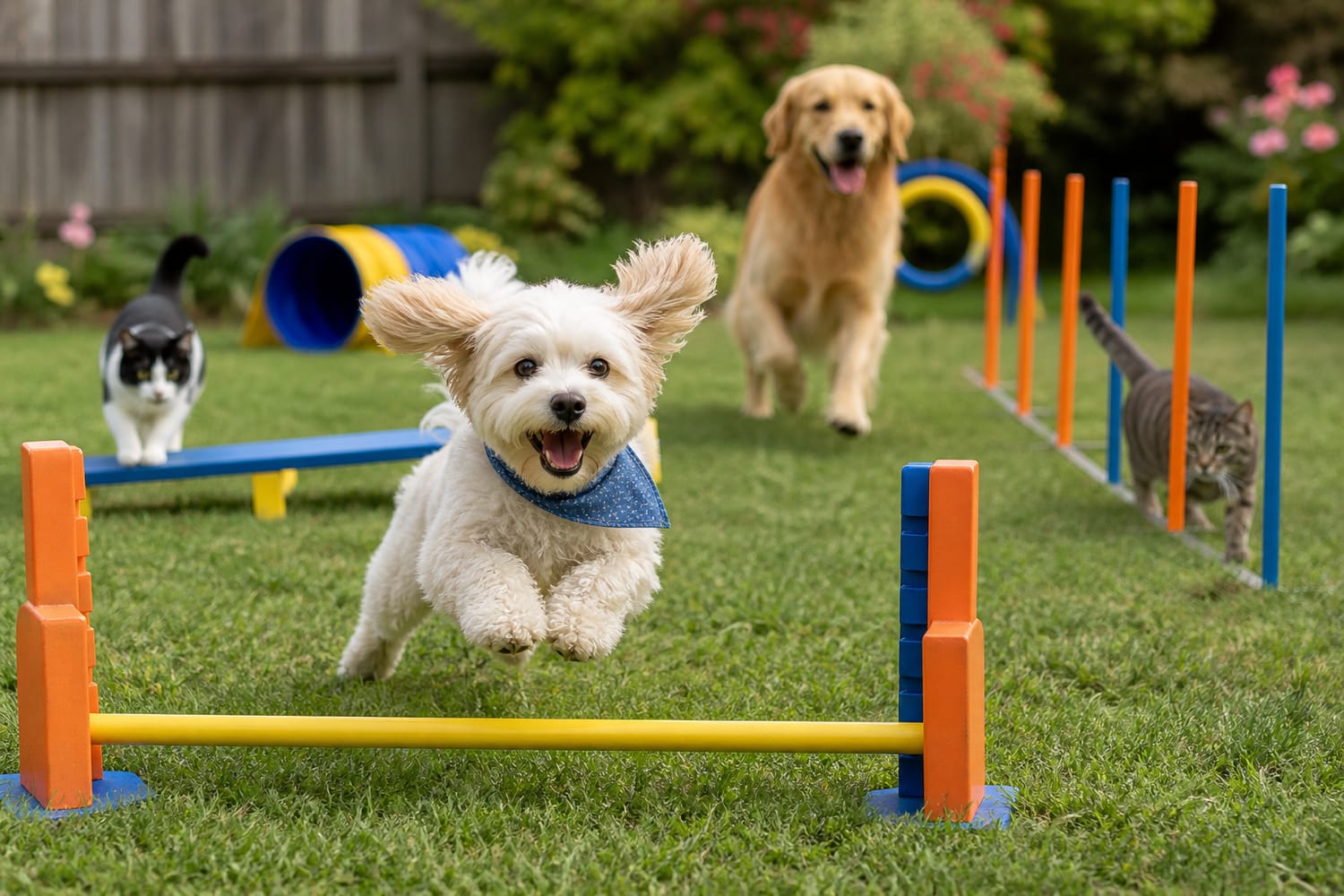
Let the Games Begin
A Pet Olympics doesn’t need a stadium, a stopwatch, or a pet who follows every instruction. It needs a little floor space, a few familiar toys, and games that let your dog or cat do what they enjoy: sniffing, exploring, thinking, chasing, or simply investigating a new box.
The best event is one your pet chooses to play. A dog might race through a course while a cat studies it from the starting line. Both deserve applause. Think of these eight games as a menu, not a schedule: pick a few favorites, keep the mood light, and let your athlete decide when to retire to the sofa.
Set Up a Pet-Friendly Arena
Choose a quiet room with enough space to move without bumping into furniture. Move breakables, secure loose cords, and put down a rug if the floor is slippery. Gather species-appropriate toys, a few cardboard boxes, and small rewards your pet can safely eat. You can also set aside part of their usual meal for the food-based events.
If you have both a dog and a cat, give each their own turn unless you know they are relaxed playing near one another. Keep water available and leave a clear route to a resting spot. Puppies, kittens, older pets, and animals with mobility or health concerns can participate at their own pace; low-effort games count just as much as active ones. For more ways to match activities to individual preferences, see Petspiration’s guide to discovering your pet’s favorite activities.
Eight Events for Your Home Pet Olympics
1. The Sniff Safari
Best for: Dogs who love using their noses—and curious cats willing to search for a snack.
Start easy. Let your pet watch as you place a few pieces of kibble around one room. For a dog, say “find it” and celebrate each discovery. For a cat, place a piece near a familiar toy or just inside the opening of a box. As your pet gets the idea, make the hiding places a little less obvious, but keep food where they can safely reach it.
This is an excellent opening event because it doesn’t ask anyone to run or jump. The ASPCA’s canine enrichment ideas include scent games that begin with an easy-to-find treat before becoming more challenging.
2. The Living-Room Obstacle Course
Best for: Pets who enjoy exploring a changing space.
Arrange a short route using cushions to walk around, a low obstacle to step over, and a stable box to pass through or beside. Invite your dog along the route with a toy or reward; don’t pull or push them through. For a cat, make it an exploration course: place a toy beside each “checkpoint” and allow them to choose their path.
Keep everything low and steady. Skip jumps, tight turns, and wobbly structures, especially for pets who are older, very young, or uncomfortable moving. A curious sniff at the first cushion is a successful first round.
3. The Cardboard Tunnel Dash
Best for: Cats who like hiding places and dogs who enjoy investigating boxes.
Open both ends of a large cardboard box to make a short tunnel. Check that it won’t tip, that the openings are comfortably wide, and that no staples or sharp edges remain. Toss a suitable toy through, or place a reward near the far end.
Some pets will hurry through. Others will peek in, walk around, or settle inside as though they’ve won a private clubhouse. Let them! The ASPCA’s feline enrichment guide suggests cardboard houses, tunnels, and mazes as ways to add variety to a cat’s environment. Supervise cardboard play, particularly if your pet tries to eat pieces of the box.
4. The Gentle Fetch-or-Roll Relay
Best for: Pets who enjoy chasing a toy across the floor.
Roll a soft, appropriately sized toy a short distance. If your dog brings it back, wonderful. If they prefer to chase and then inspect their prize, that’s fun too. Some cats enjoy fetching, but many would rather bat a toy, chase it once, or carry it somewhere else.
Try a few short turns, then pause and see whether your pet asks for another. A cat who returns a toy may be inviting a replay; a cat who walks away with it may be enjoying the catch. Petspiration explores those different possibilities in why cats bring you their toys.
5. The Target-Touch Challenge
Best for: Pets who like a puzzle they can solve with you.
Hold out your hand a short distance from your pet’s nose. When they choose to sniff or touch it, immediately offer praise and a small reward. After a few successful turns, present your hand a little to the left or right. You can also use a pet-safe target, such as a large, smooth object that you hold.
The goal is not to make your pet perform on command. It’s to help them discover, “When I touch that, something nice happens.” Keep the first attempts easy enough to succeed. If your pet loses interest, take a break rather than repeating the invitation.
6. The Cup-Shuffle Puzzle
Best for: Careful investigators with a taste for treats.
Place a piece of your pet’s food under one lightweight, unbreakable cup while they watch. Leave the cup partly tipped so they can reach the food easily. Once they understand the game, try two cups, with the reward under just one. Your pet can point with a nose or paw; you can lift the cup for them.
Avoid a fast magician’s shuffle. The pleasure here is in working out where the reward went, not in making it impossible to find. Use cups your pet cannot swallow or break, and put the game away if they start chewing the equipment.
7. The Find-Your-Person Event
Best for: Dogs who enjoy searching for family members and cats who like coming to a familiar voice.
Have one person stay with your dog while another steps behind an open doorway. Call the dog once in a cheerful voice and reward them when they arrive. Gradually try another easy hiding place. For a cat, begin closer: sit where they can partly see you, call softly, and offer a reward if they choose to approach.
Don’t turn this into a startling game of popping out or shouting. If your pet seems uncertain, make yourself easy to find. The sweetest version ends with your pet discovering someone they’re happy to see.
8. The Toy-Chase Finale
Best for: Pets ready for a little movement before the closing ceremony.
For cats, move a wand toy along the floor as though it were small prey. Let it pause behind a cushion, then give your cat plenty of chances to pounce and catch it. For dogs, gently move a favorite toy a short distance along the ground, or offer a brief game of tug if your dog already enjoys it and releases the toy comfortably.
Keep toys away from hands and faces, and wind the pace down before your pet is exhausted. VCA Animal Hospitals’ guidance on cat play recommends giving cats chances to catch their “prey” and putting wand toys away after supervised play because strings can be dangerous if swallowed or become tangled.
Give Everyone a Gold Medal
Your Pet Olympics can last ten minutes or become a series of short events across the day. Watch your pet rather than the clock. If they wander off, hide, seem tired, or stop accepting a game they usually enjoy, let them rest. If they appear unwell or struggle to move, skip the games and check with your veterinarian.
There’s no need to rank the competitors. Award imaginary medals for “most determined sniffer,” “best cardboard-box inspection,” or “finest nap after a sporting event.” The real prize is a little shared time, shaped around the animal in front of you. And if your champion’s favorite event turns out to be watching you set up the course from a comfortable chair? That’s a perfectly respectable Olympic specialty.