
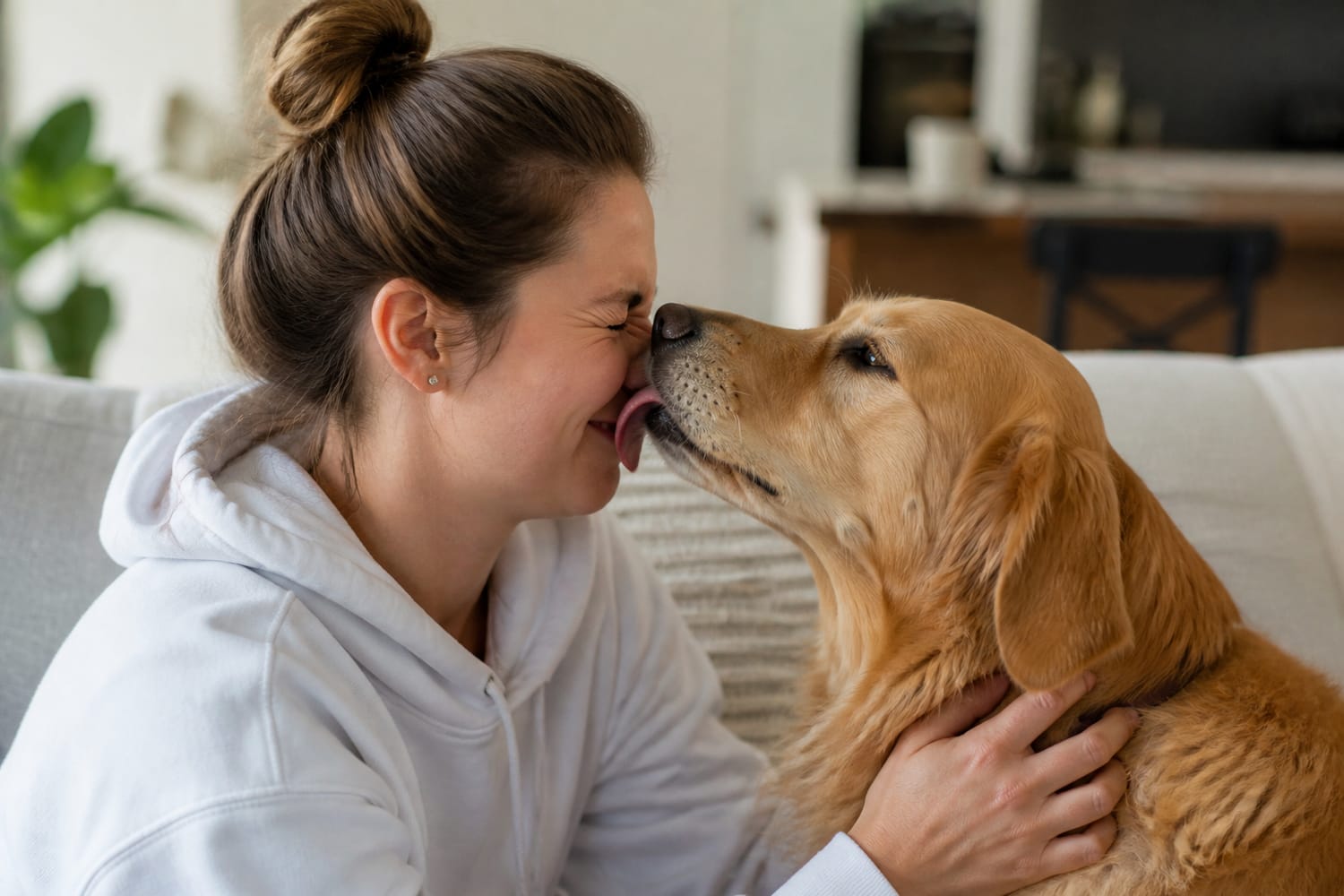
Why Your Dog Licks You
Your dog might lick you to greet you, get your attention, explore an interesting taste, or enjoy a familiar interaction. Sometimes licking can also signal stress or discomfort. There isn’t one universal meaning: the best clue is what’s happening around your dog, how the rest of their body looks, and whether the licking seems easy to interrupt.
A lick on the hand when you come home may feel like a tiny celebration. A determined attempt to lick your chin while you’re eating dinner may be less welcome. You can appreciate your dog’s enthusiasm and teach them another way to be close. Gentle boundaries aren’t a rejection of affection—they give both of you a way to enjoy it.
What’s Behind Those Slobbery Greetings?
Dogs investigate the world with their noses and mouths, and people offer plenty to investigate. Skin can taste salty after a walk or workout. Your hands may smell like a snack you prepared. Licking may also be part of a friendly greeting or a way to seek interaction.
Then there’s what happens after the lick. If your dog licks your hand and you laugh, talk, or reach down to pet them, they may learn that licking starts a conversation. Even “Hey, stop that!” can be rewarding attention for a dog who wants you to engage. That doesn’t mean you’ve done anything wrong; it means your dog has noticed what works.
Licking can have more than one purpose at once. Picture a dog who greets you after school or work, notices the smell of your lunch on your fingers, and gets a delighted scratch behind the ears. Greeting, curiosity, and a learned reward can all play a part. Rather than trying to decode every lick perfectly, look for patterns: When does it happen? What does your dog seem to want? What happens next?
Read the Whole Dog, Not Just the Tongue
A relaxed dog who approaches voluntarily, has a loose body, and can easily turn to a toy or another activity may simply be looking for friendly contact. But licking alone cannot tell you how a dog feels. Watch their posture, eyes, ears, movement, and the situation. Petspiration’s guide to understanding pet body language offers a helpful starting point for noticing those signals together.
It also helps to distinguish licking you from licking their own lips. Repeated lip-licking when there’s no food around—especially alongside turning away, stiffening, or trying to leave—can be a sign of discomfort. If your dog looks uneasy while someone hugs or leans over them, give them space rather than asking them to stay for more affection.
Context matters for you, too. It’s fine if one person enjoys an occasional lick on the hand and another prefers none at all. The kindest goal isn’t to make everyone tolerate licking. It’s to help your dog understand how to greet each person comfortably.
Set a Boundary Your Dog Can Understand
“Don’t lick” tells your dog what you dislike, but it doesn’t show them what to do instead. Pick an alternative that fits the moment: four paws on the floor for greetings, a sit before petting, a nose touch, or settling on a mat while you relax. Reward-based training works by making the behavior you do want worthwhile for your dog.
Try this simple sequence when your dog approaches for attention:
- Get ready before the lick. Have a few small treats or a favorite toy nearby. If possible, ask for a familiar behavior while your dog is still approaching.
- Reward the alternative. When your dog sits, keeps their paws on the floor, or gently touches your offered hand with their nose, respond with something they enjoy—perhaps a treat, play, or petting.
- Pause if licking starts. Calmly move your hand or face away and briefly stop the interaction. Avoid scolding or turning it into a game of dodging licks.
- Invite another try. Offer the same easy cue and reward your dog when they respond. Keep practice short and upbeat.
The timing is important. If you wait for a lick, then immediately produce a toy or treat every time, your dog may learn that licking is the first step toward getting the good stuff. Look for chances to reward the polite approach before licking begins. VCA Animal Hospitals’ guide to using predictable rewards in dog training explains why teaching an acceptable alternative is often more effective than responding only to the behavior you want to change.
A nose touch can be especially useful when you want a friendly greeting without a lick. Once your dog knows the cue, you can offer your palm at a comfortable distance, reward the gentle nose bump, and move on together. Petspiration’s guide to teaching the “touch” cue walks through the skill step by step.
Make Room for Everyone’s Comfort
A boundary is easier for a dog to learn when the household responds consistently. If face licking is off-limits, ask everyone to avoid encouraging it. Guests who enjoy dogs but not slobber can offer a toy, ask for a sit, or simply greet your dog from a little distance.
Children need especially clear guidance. Teach them to keep their faces away from a dog’s face, avoid grabbing or hugging, and let the dog move away when they want space. An adult should supervise young children with dogs, including familiar family pets. A dog and child can have a wonderful friendship without face-to-face kisses.
There’s a hygiene reason for setting limits, too. It’s sensible to discourage licking around mouths and open cuts, and to wash hands after contact with dog saliva, especially before eating. Most contact with dogs does not make people sick, but dog saliva can carry germs that cause problems if it gets into a wound. The CDC’s guidance on staying healthy around dogs covers everyday precautions without asking families to give up closeness with their pets.
When Licking Deserves a Closer Look
A few affectionate licks are usually different from licking that seems relentless or hard to interrupt. If your dog’s behavior changes suddenly, repeatedly licks themselves or objects, or seems distressed, talk with your veterinarian. Excessive licking can be associated with concerns such as discomfort, anxiety, or an itchy skin condition; a veterinary check can help identify what needs attention.
In the meantime, note what you’re seeing. Does the licking happen during noisy gatherings? Is your dog focused on one paw? Do they seem unable to settle? These details can help you describe the behavior clearly. If licking seems connected to worry, focus on helping your dog feel safe rather than merely stopping the visible habit. For low-pressure ideas, Petspiration’s article on simple pattern games for anxious pets explores predictable routines that can support calmer interactions.
Affection Can Take Many Forms
Your dog doesn’t need to lick your face to know they belong with you. A quiet walk, a cheerful training game, a favorite toy, or a place beside you on the couch can all be ways to spend time together. And if you welcome an occasional lick on the hand? That can be your choice, too.
The heart of a gentle boundary is simple: notice what your dog is communicating, make the behavior you prefer easy to learn, and leave room for both of you to feel comfortable. That’s a loving conversation—slobber optional.