
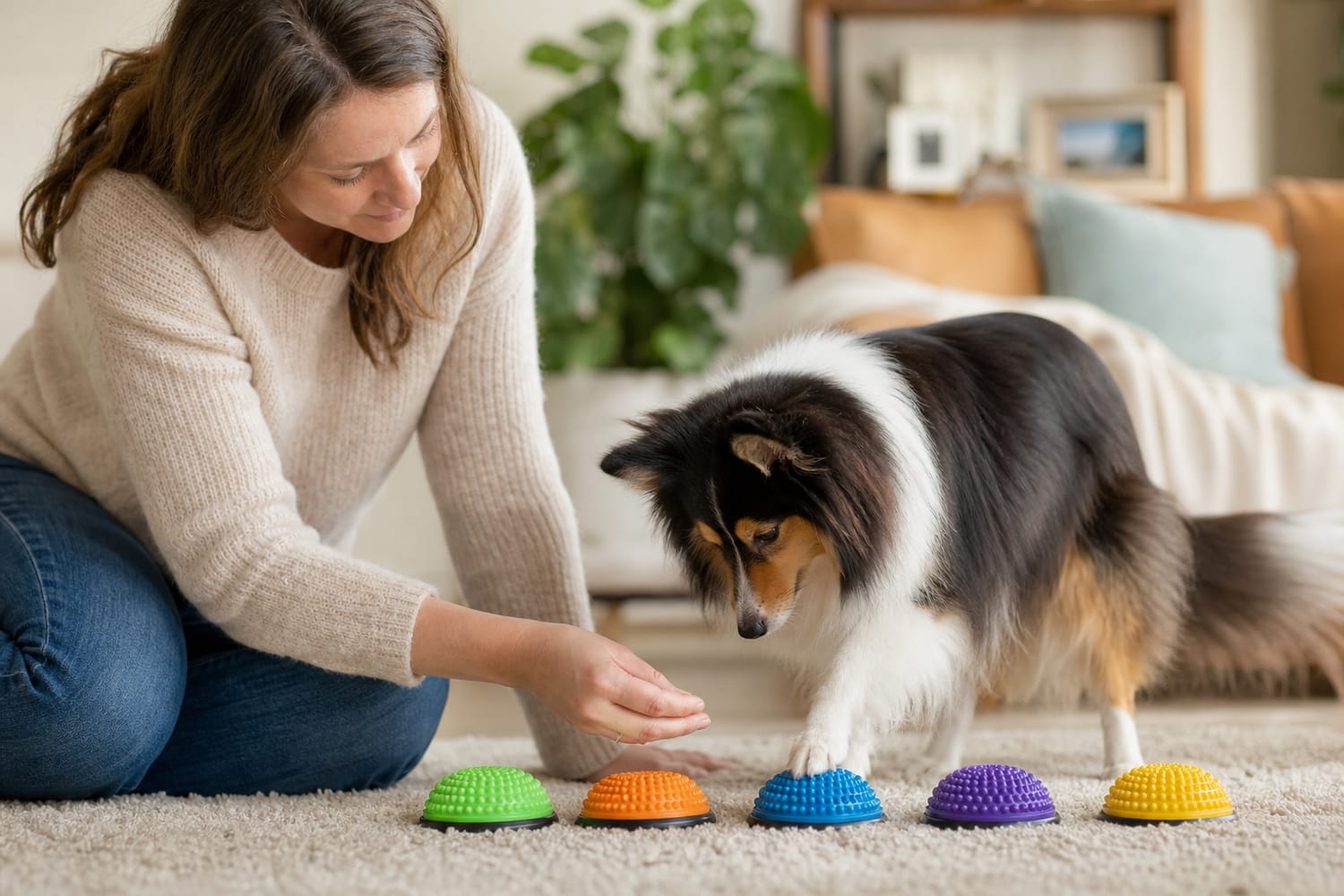
Why Patterns Help Anxious Pets Feel Safe
An anxious pet is not “being dramatic,” “stubborn,” or “naughty.” Anxiety is a real emotional state, and when pets feel worried, their brains and bodies shift into survival mode. A dog may bark, lunge, freeze, pace, hide, or refuse treats. A cat may flatten their ears, flee under the bed, swat, hiss, overgroom, or avoid the litter box. Even rabbits, birds, and other companion animals can show stress through changes in appetite, posture, movement, or social behavior.
Pattern games are simple, predictable routines that help pets understand what comes next. When the world feels confusing or scary, patterns offer structure. They say, “You know this. You can do this. Something good happens next.”
Many pattern games used in modern reward-based training were popularized in dog training by trainer and author Leslie McDevitt through her Control Unleashed work, but the basic idea applies beautifully across species: predictable actions, repeated gently, can support confidence and calm.
Think about how humans use patterns. We take deep breaths before a speech, follow a bedtime routine, make tea when we need comfort, or listen to a favorite song on a hard day. Pets also benefit from small rituals that bring a sense of safety.
Pattern games are not about forcing a pet to “get over it.” They are about giving them a familiar path through uncertainty.
What Makes a Pattern Game Different from Regular Training?
Traditional training often focuses on cues and behaviors: “sit,” “stay,” “come,” “go to mat.” Pattern games are a little different. They usually involve a repeated sequence that is easy for the pet to predict.
For example:
- You say a cheerful marker word like “yes.”
- You place a treat on the ground.
- Your pet eats it.
- They look back at you.
- You mark and place another treat.
The power is in the rhythm. The pet learns, “When I do this simple thing, a good thing happens in a way I can predict.”
For anxious pets, predictability is golden. A nervous dog walking past a noisy truck, a shy cat learning to come out when guests are present, or a rescue pet adjusting to a new home may all benefit from low-pressure, patterned interactions.
A good pattern game should be:
- Easy to understand
- Repetitive without being boring
- Reward-based
- Flexible
- Short and successful
- Stopped before the pet becomes overwhelmed
The Science Behind Calm Confidence
Animals learn best when they feel safe. Stress affects attention, memory, digestion, and decision-making. When a pet is highly anxious, the “thinking” part of the brain has a harder time doing its job. This is why a dog who knows “sit” at home may seem to forget it near a barking dog, or a cat who normally enjoys treats may ignore them during a thunderstorm.
Pattern games can help by creating a bridge between emotion and behavior. They give the pet something familiar to do, which may reduce uncertainty. They can also help change emotional associations over time. If a mild trigger—such as a distant skateboard, a visitor’s voice, or a grooming brush—repeatedly appears while the pet is engaged in a safe, rewarding pattern, the trigger may begin to predict good things rather than fear.
This process should always happen at the pet’s pace. If the scary thing is too close, too loud, or too intense, the game may not work. The goal is not to push the pet into panic and reward them afterward. The goal is to set them up where they can notice the world and still feel capable.
That is where confidence grows: not from pressure, but from repeated success.
Game One: The “Find It” Reset
“Find it” is one of the simplest and most useful pattern games. It works especially well for dogs, but many cats and other food-motivated pets can enjoy a version of it too.
Start in a quiet room. Say “find it” in a happy voice, then place or toss a treat on the floor close to your pet. Let them eat it. Repeat several times.
Once your pet understands the pattern, you can use it in mildly distracting situations. For a dog, this might mean during a quiet walk when they notice something interesting in the distance. For a cat, it might mean when a household noise happens in another room. For a shy pet, it may simply be a way to encourage gentle exploration.
Why it helps:
- Sniffing can be naturally calming for many dogs.
- Looking for food gives the pet a job.
- The treat appears in a predictable place.
- The pet can disengage from a worry without being pulled or scolded.
Keep the game light. You are not commanding your pet to ignore their fear. You are offering an easy activity that helps them shift focus.
Game Two: One-Two-Three Treat
The “one-two-three” game is wonderfully rhythmic. Begin somewhere peaceful. Count out loud in a warm, steady tone: “One, two, three!” On “three,” give your pet a treat.
Repeat: “One, two, three!” Treat.
After enough repetitions, your pet learns that “three” predicts something lovely. The counting itself becomes a comforting pattern. For dogs, this can be used while walking past mild distractions at a safe distance. For cats, it can help create a predictable routine around handling, carrier training, or entering a room where something new has appeared.
The key is to practice when nothing scary is happening first. You want the pattern to become familiar before using it in real-life moments.
Imagine a dog who is worried about passing a neighbor’s yard. If the dog is still able to eat and think, the guardian might calmly count, treat on three, take a few steps, count again, treat again. The dog is not being dragged past the yard; they are being supported through it with a known rhythm.
For pets who are noise-sensitive, you might also use the pattern during low-level background sounds, such as a distant garbage truck or soft recorded thunder, always staying well below panic level.
Game Three: Up-Down for Focus and Flow
The “up-down” game teaches a pet to move their attention between you and the floor. It is simple, tidy, and excellent for building engagement.
Here is how it works for a dog:
- Stand or sit with treats ready.
- Place a treat on the ground.
- When your dog eats it and looks back up at you, mark with “yes.”
- Place another treat on the ground.
- Repeat.
Soon, the dog learns the pattern: treat down, look up, treat down, look up.
For cats, you can adapt this by placing a treat on a mat or low surface, then rewarding when they glance back toward you. For very shy pets, even a tiny head turn or relaxed posture can be enough to continue.
This game can be especially helpful because it does not require the pet to hold still for a long time. Many anxious animals find stillness difficult. Up-down creates movement, but it is controlled and predictable.
You can play it near a window, in a yard, in a training class, or during a calm moment at the vet clinic parking lot—always far enough from stressors that your pet can remain comfortable.
Game Four: Treat-and-Retreat for Shy Pets
Some pets want connection but feel conflicted. They may approach a person, then dart away. They may sniff a guest’s shoe but panic if the guest reaches toward them. Treat-and-retreat is a gentle pattern that respects the pet’s need for space.
Instead of luring the pet closer and closer, which can accidentally pressure them, the treat is tossed away from the person after the pet notices or approaches. This allows the pet to retreat and feel relief.
For example, a guest might sit sideways, avoid staring, and toss a treat behind the dog or cat. The pet moves away to get it. If they choose to come back, another treat is tossed away again.
This creates a powerful message: “You are allowed to move away. No one will trap you.”
Over time, many pets become braver because they are not being forced. They learn that people can predict good things and that distance is always available.
This game is excellent for newly adopted pets, undersocialized animals, and pets who are nervous around visitors. It should be done calmly, with no reaching, chasing, or coaxing. Let the pet choose.
Using Pattern Games in Everyday Life
Pattern games are not only for big training sessions. They can become part of daily care.
You might use them:
- Before putting on a harness
- During gentle brushing
- When visitors arrive
- Near the car before travel
- In the waiting room at the veterinary clinic
- During walks in busy neighborhoods
- Around household sounds like vacuums or doorbells
- When introducing a new object, such as a carrier or grooming tool
For example, if your cat is wary of the carrier, place the carrier in the room with the door open. Play a simple treat pattern near it, then gradually closer to it over many short sessions. Eventually, treats can appear just inside the carrier. There is no rushing, no stuffing the cat inside, and no surprise door-closing in the early stages.
If your dog is worried about the harness, you might use one-two-three treats while the harness appears across the room. Later, the harness moves closer. Later still, the dog voluntarily sniffs it, then places their head near it, then through it. The pattern gives predictability to a process that might otherwise feel suspicious.
Reading Your Pet’s Body Language
Pattern games work best when we listen to what pets are telling us. Calm confidence does not always look like perfect obedience. It may look like softer eyes, a loose body, normal eating, sniffing, curiosity, or the ability to look at a trigger and then look away.
Signs your pet may be coping well include:
- Taking treats gently
- Loose muscles
- Normal breathing
- Ears and tail in a natural position for that species
- Ability to move freely
- Curiosity
- Re-engaging with you after noticing something
Signs the situation may be too hard include:
- Refusing food
- Trembling
- Panting when not hot
- Pacing
- Hiding
- Freezing
- Growling, hissing, barking, or lunging
- Trying to escape
- Dilated pupils
- Tucked tail or flattened ears
If your pet shows stress, make the game easier. Increase distance, lower the intensity, shorten the session, or return to a familiar environment. This is not failure. It is good teamwork.
When to Get Extra Help
Pattern games are useful, but they are not a replacement for veterinary care or professional behavior support when anxiety is severe. If your pet is injuring themselves, unable to settle, showing aggression, panicking when left alone, eliminating from fear, or experiencing sudden behavior changes, speak with your veterinarian. Pain, illness, hormonal changes, sensory decline, and neurological issues can all affect behavior.
A qualified reward-based trainer, certified behavior consultant, or veterinary behaviorist can help you create a plan that fits your pet’s needs. In some cases, behavior medication may be recommended by a veterinarian. Medication is not a “last resort” or a sign of failure; for some pets, it lowers anxiety enough for learning and quality of life to improve.
Building a Braver Life, One Pattern at a Time
The beauty of pattern games is their simplicity. You do not need expensive equipment or advanced training skills. You need patience, kindness, rewards your pet enjoys, and a willingness to go slowly.
For anxious pets, confidence is rarely built in one dramatic breakthrough. It grows in tiny moments: one treat found on the floor, one calm glance at a visitor, one step toward the carrier, one relaxed breath after a noise outside.
These moments matter.
When we offer our pets predictable routines, we become a source of safety. We stop asking, “Why can’t you just be normal?” and start asking, “How can I help you feel safe enough to try?”
That question changes everything.
Pattern games remind us that training is not about control—it is about communication. It is about telling our pets, again and again, “You are not alone. We can do this together.”
And for an anxious animal, that may be the most comforting pattern of all.