
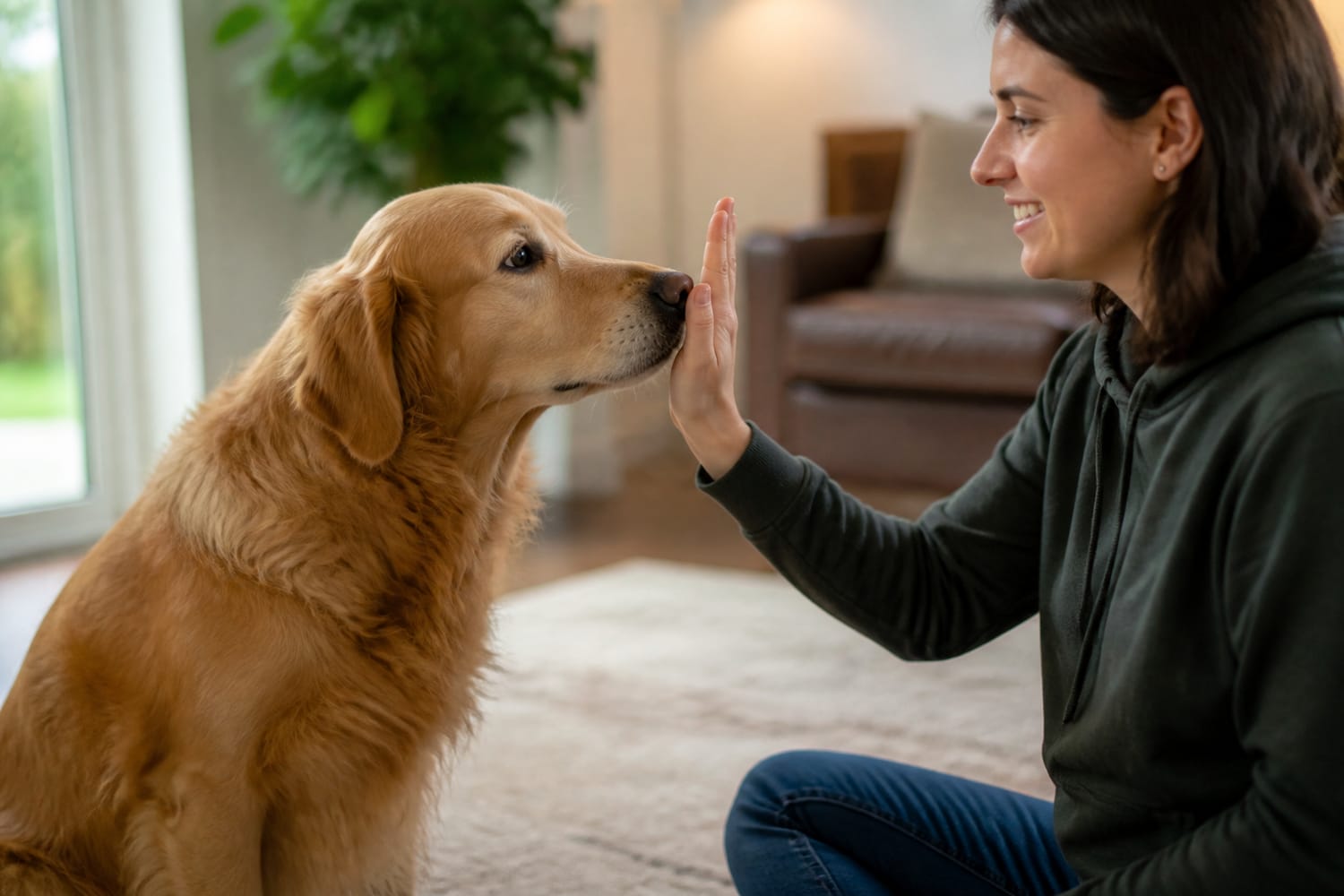
A Small Cue With Big Possibilities
The “touch” cue teaches a pet to gently place their nose against your open hand or another target. It is simple to practice, enjoyable for many dogs and cats, and surprisingly useful. Once learned, touch can help you guide movement, redirect attention, encourage cooperation, and build more advanced behaviors without pushing or pulling your pet.
Often called hand targeting or nose targeting, touch gives your pet a clear, achievable task: “Move toward this target and make contact.” Because an animal’s body tends to follow their nose, you can use your hand to guide them into useful positions while keeping training positive.
It is also an excellent beginner skill. Puppies, adult dogs, senior pets, and many cats can learn it, provided they are comfortable approaching a hand. If you are new to feline training, Petspiration’s guide to making cat training possible and fun offers a helpful introduction.
Why Touch Makes Everyday Training Easier
Touch is valuable because it creates movement without physical force. Instead of pulling a dog into position by the collar or picking up a reluctant cat, you can invite the animal to follow a familiar target.
With practice, touch may help you:
- Position your dog beside you before attaching a leash.
- Guide a pet onto a scale or training mat.
- Turn your dog away from a mild distraction.
- Encourage movement through a doorway.
- Help your pet enter a carrier or crate voluntarily.
- Teach spins, leg weaves, bell ringing, and other tricks.
- Create a positive focus game in distracting environments.
- Build foundations for cooperative grooming and veterinary care.
The cue can also strengthen communication. Pets are remarkably attentive to our gestures and emotions, as explored in Petspiration’s article about how dogs read us and deepen the human-animal bond. Touch turns that natural awareness into a predictable conversation: you offer your hand, your pet responds, and something good follows.
Reward-based training is important here. The American Veterinary Society of Animal Behavior recommends reward-based methods rather than techniques involving fear, pain, or intimidation. Touch should always feel like an invitation—not a demand your pet cannot safely refuse.
What You Will Need
You do not need special equipment. Gather:
- Small, high-value treats your pet enjoys
- A quiet, familiar training area
- An optional clicker
- A marker word such as “yes” or “good”
- A little patience and a cheerful attitude
Choose tiny treats so your pet can enjoy several repetitions without becoming full. For pets on calorie-controlled diets, you may use part of their normal meal, provided the food is motivating enough. Rewards do not always have to be edible; some pets enjoy toys, play, praise, or access to a favorite activity. The best reward is whatever your individual pet genuinely values.
Your marker word or clicker identifies the exact action that earned the reward. Timing matters: mark the instant your pet’s nose touches the target, then provide the treat.
How to Teach the Touch Cue Step by Step
1. Present Your Hand
Hold one hand open with your palm facing your pet. Place it only an inch or two from their nose. Keep your fingers relaxed and do not move your hand into their face.
Most dogs will naturally lean forward to investigate. Many cats will sniff an unfamiliar hand as well. The moment your pet’s nose makes contact, mark the behavior with a click or a short word such as “yes.”
2. Reward Immediately
Give your pet a treat right after marking the touch. Delivering the reward near the target can make the lesson clearer.
Repeat several times. At this stage, do not say “touch” yet. Your pet is still discovering that bumping the open palm produces a rewarding result.
3. Look for Intentional Touches
After a few successful repetitions, your pet may begin moving toward your palm deliberately. You might notice a quicker response, a firmer nose bump, or an eager expression.
Once the action appears purposeful and predictable, you are ready to name it.
4. Add the Verbal Cue
Say “touch” just before presenting your hand. When your pet makes contact, mark and reward.
Use the cue only once. Repeating “touch, touch, touch” can teach your pet that the first word is not important. If there is no response, calmly reset, move your hand closer, or make the situation easier.
5. Add Distance Gradually
Begin moving your palm a few inches farther away. Over multiple sessions, practice with your hand:
- To the left or right
- Slightly above or below nose level
- Near your knee
- One or two steps away
- In different rooms
Change only one challenge at a time. If you increase distance, keep distractions low. If you move to a new environment, shorten the distance again.
The American Kennel Club’s guide to teaching nose targeting similarly recommends building distance and distractions gradually after the basic hand target is reliable.
Adapting the Lesson for Cats
Cats can be enthusiastic students when training is brief, voluntary, and rewarding. Some will investigate your fingers more readily than a broad palm, so begin with the target shape your cat finds least intimidating.
If your cat is hesitant, use a safe target stick, the rounded end of a wooden spoon, or a similar object instead of your hand. Present it at nose level and reward any interest at first—even a glance or small movement toward it. Gradually wait for closer approaches until your cat makes contact.
Cats Protection recommends introducing a target close to the cat and marking and rewarding when the cat touches it with their nose. Best Friends Animal Society also describes hand targeting as a useful starting point for feline clicker training.
Never chase your cat with the target. If they walk away, pause the session and try later. Choice is part of what makes training safe and confidence-building.
Putting Touch to Work in Daily Life
Once your pet understands the cue in several quiet locations, begin using it for simple, practical tasks.
Leash and Doorway Manners
Ask for a touch before clipping on the leash or opening the door. This gives an excited dog something specific to do and can help create a calmer routine.
Touch should not replace secure equipment or essential safety cues. Keep your pet leashed where required, and never rely on hand targeting alone near traffic or other hazards.
Crates, Carriers, and Beds
Place your hand near the entrance of a crate or carrier and ask for a touch. Over time, position the target slightly farther inside. Reward each voluntary approach without closing the door too quickly.
For dogs still developing positive crate associations, review Petspiration’s advice on building a safe and comfortable crate space. Touch can complement that process, but it should never be used to trick a pet into confinement.
Redirecting Attention
A well-practiced touch can help redirect a dog from a manageable distraction, such as food on a counter or an approaching person at a comfortable distance. Ask for touch early, before your dog becomes too excited or worried to respond.
However, do not use it to force a fearful pet closer to something frightening. If your pet freezes, hides, growls, barks intensely, or tries to escape, increase the distance from the trigger and seek qualified guidance when needed.
Grooming and Cooperative Care
Touch can help position a pet beside you, turn their body, or approach a grooming station. You can also pair it with calm handling exercises, allowing your pet to take breaks.
If touching or movement appears painful, stop and contact your veterinarian. Behavioral changes during handling can sometimes be connected to discomfort; Petspiration’s guide to recognizing signs of pain in pets can help owners identify signals worth discussing with a veterinary professional.
Common Problems and Simple Solutions
Your pet only stares at your hand: Mark and reward smaller steps, such as looking at the palm or leaning toward it. Gradually require closer movement.
Your pet licks or mouths your hand: Reward only gentle nose contact. Present your palm briefly, mark the correct touch, and remove your hand before mouthing begins.
Your pet responds only when food is visible: Keep treats in a pocket or container rather than in the target hand. Present the empty hand first, then reward from the other hand.
Your pet loses interest: End the session, improve the reward, or practice in a less distracting location. Training should leave your pet wanting to play again.
The cue stops working outdoors: The environment has probably become too difficult. Return to a quieter area, reduce distance, and use a more valuable reward.
Celebrate the Conversation
Touch may look like a tiny trick, but it represents something much bigger: cooperation. Your pet learns that paying attention to you leads to safe, rewarding experiences, while you learn to communicate through clear cues and thoughtful reinforcement.
Practice with warmth, respect your pet’s comfort, and celebrate small successes. One gentle nose bump at a time, you are building a practical skill—and a happier, more trusting partnership.