
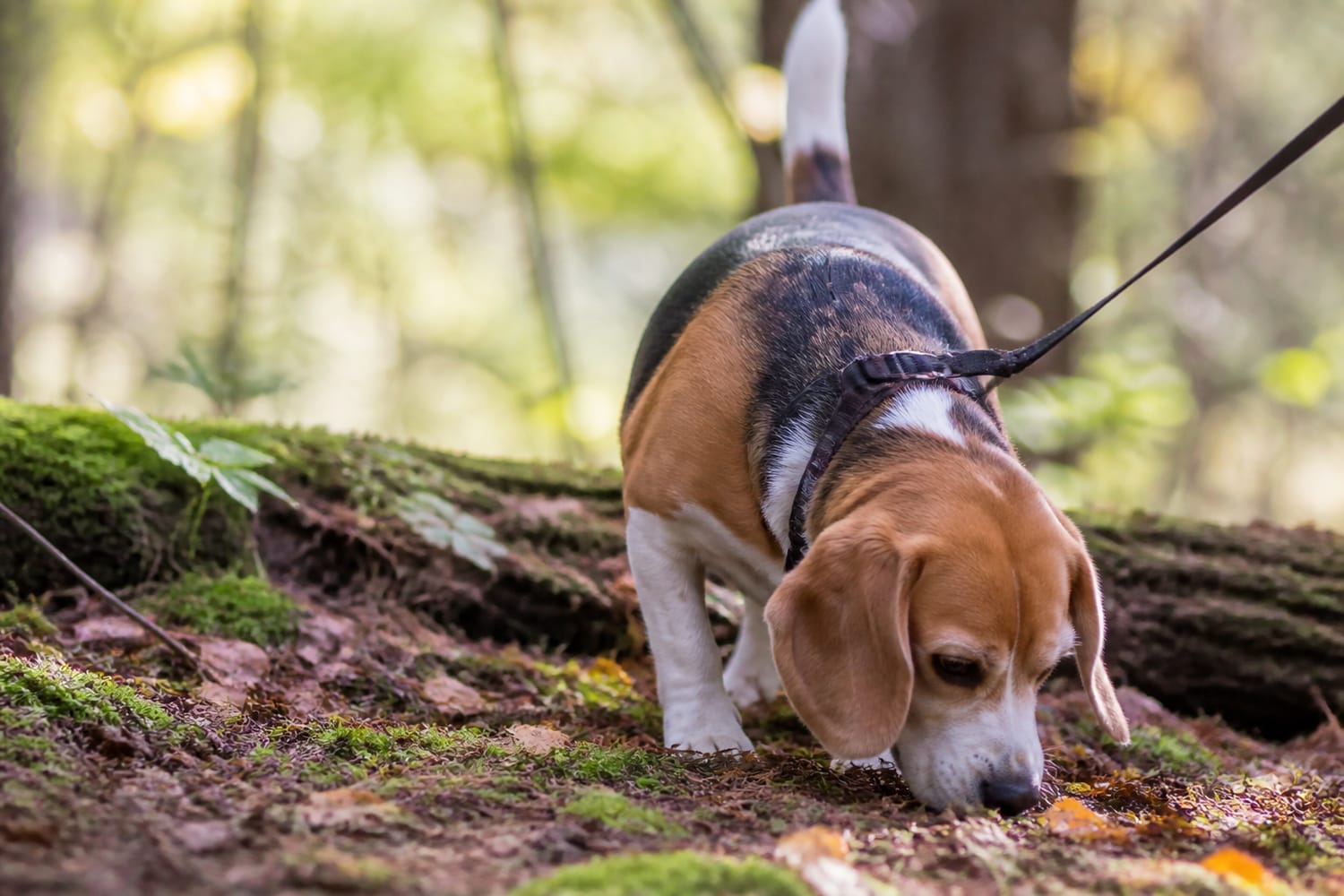
What Is a Sniffari?
A sniffari is a relaxed, scent-focused dog walk where exploration matters more than speed or distance. Instead of hurrying your dog from one block to the next, you give them time to investigate safe smells, choose directions when practical, and experience the neighborhood through their remarkable nose.
For humans, an ordinary sidewalk may look unchanged from yesterday. To a dog, it may contain a constantly updated collection of scent clues left by people, animals, plants, food, rain, wind, and countless other sources. Veterinarians and behavior professionals recognize sniffing as a valuable form of mental enrichment that helps dogs engage with their surroundings.
A sniffari does not need to replace every brisk walk, training outing, or physical exercise session. Think of it as another valuable ingredient in your dog’s enrichment routine—one that is easy, affordable, and available almost anywhere.
Why Sniffing Is So Important to Dogs
Dogs rely heavily on scent to gather information. When your dog pauses beside a tree, circles a patch of grass, or carefully examines a lamppost, they are not necessarily wasting time. They may be detecting which animals passed through, how recently they were there, and other details that are invisible to us.
Sniffing also gives dogs something meaningful to do. A scent-focused walk encourages curiosity, decision-making, and exploration rather than asking a dog to remain in constant step with a human. This can be especially valuable for dogs whose daily lives are highly structured around household schedules.
The result may be a dog who returns home pleasantly satisfied despite covering less distance than usual. Mental activity can be tiring, although there is no reliable universal formula claiming that a certain number of sniffing minutes equals a specific amount of physical exercise. Every dog differs according to age, health, breed, fitness, environment, and individual enthusiasm.
How to Prepare for Your First Sniffari
You do not need special scent-work equipment or professional training. A few sensible supplies will make the adventure safer and more enjoyable:
- A comfortable, properly fitted harness or collar
- A sturdy standard leash
- A longer fixed leash for suitable open areas
- Waste bags
- Fresh water in warm weather or on longer outings
- Small treats for check-ins and safety cues
- Visible or reflective gear in low light
A long line can offer additional freedom in a quiet, spacious location, but it requires attentive handling. Choose a fixed line rather than a retractable leash, keep it away from roads and crowds, and prevent it from wrapping around people, dogs, trees, or street furniture. The American Kennel Club’s guide to sniff-focused walks also recommends combining a well-fitting harness with a long line when the setting is appropriate.
Before visiting unfamiliar public spaces with a puppy, ask your veterinarian about vaccination timing and local disease risks. Puppies benefit from safe exposure to the world, but the safest approach can vary depending on their health and location.
Turn Your Regular Walk Into an Adventure
1. Choose a Calm Location
Start somewhere with interesting scents but manageable distractions. A quiet residential street, grassy park edge, familiar trail, or peaceful open space can work beautifully.
Busy festivals, crowded sidewalks, and noisy dog parks may be too overwhelming, particularly for puppies, newly adopted dogs, and dogs who are fearful or reactive. Adventure should feel interesting—not frightening.
2. Begin With a Loose Plan
Set aside 15 to 30 minutes, depending on your dog’s age, mobility, health, and routine. You can always finish sooner if your companion appears tired or uncomfortable.
Rather than choosing a strict destination, create a safe general boundary. Within that area, let your dog choose whether to examine the hedge, wander toward a tree, or follow a promising trail across the grass.
3. Slow Down
When your dog stops at a safe location, pause with them. Avoid immediately tightening the leash or repeating, “Come on!” Give them time to process what they have found.
You may be surprised by how slowly a true sniffari moves. That is part of its charm. While your dog investigates, look around, breathe deeply, and enjoy the shared pause.
4. Reward Check-Ins
Freedom works best when paired with communication. Whenever your dog voluntarily looks back at you, praise them or offer a small treat. These check-ins help you stay connected without interrupting every investigation.
You can also use sniffing itself as a reward. Ask for a simple behavior, such as eye contact or a few steps beside you, then cheerfully release your dog with a phrase such as “Go sniff!” This teaches them that cooperating with you can reopen access to the environment they love.
Reward-based training supports learning without relying on fear, pain, or force, as explained in the American Veterinary Society of Animal Behavior’s guidance on humane dog training.
5. Let Your Dog Help Choose the Route
Where it is safe, allow your dog to vote on which direction to take. They should not pull you into traffic, private property, dense undergrowth, or another dog’s personal space, but they can make small choices.
Would they rather turn left toward the grassy verge or right toward the trees? Do they want to investigate a new path or revisit a familiar corner? Offering controlled choices can make the walk more engaging without giving up necessary safety boundaries.
Add Simple Scent Games
Once your dog understands the relaxed pace, add a few easy games to make the outing even more stimulating.
Try a “Find It” Scatter
In clean grass, scatter several pieces of kibble or tiny treats and say, “Find it.” Begin with an easy, visible scatter before making the search more challenging.
Avoid scattering food near dog waste, chemically treated lawns, sharp objects, unknown plants, or areas where wildlife may be feeding. Remember to account for treats within your dog’s daily food allowance.
Create a Sniffing Trail
Drop treats a short distance apart to create a simple trail toward a final reward. Keep the first trail short and straightforward. As your dog gains confidence, add gentle turns or increase the space between treats.
Explore New Textures
Let your dog investigate safe natural surfaces such as grass, fallen leaves, tree bark, sand, or smooth stones. Do not force them onto a surface they dislike. Exploration should remain voluntary and comfortable.
You can continue the fun at home with cardboard-box searches, hidden toys, food puzzles, or a snuffle mat. Petspiration’s ideas for a special Pet Yes Day include gentle, choice-based enrichment for pets with different personalities and physical abilities.
Keep Curiosity Safe
A sniffari is not permission to investigate absolutely everything. Scan the path ahead for discarded food, broken glass, medication, mushrooms, animal waste, pesticides, sharp plant material, or wildlife.
A positively trained “leave it” cue can help your dog disengage before picking up something hazardous. Practice the skill at home before expecting it to work beside an irresistible sidewalk discovery. Petspiration’s guide to teaching a reliable “leave it” cue provides a gradual, reward-based approach.
Respect other walkers as well. Do not allow your dog to approach unfamiliar people or animals without permission. Shorten the leash near roads, cyclists, children, wildlife, and crowded areas, and follow local leash regulations.
Weather matters too. Avoid hot pavement, provide water when needed, and shorten outings during temperature extremes. Check paws after walks for cuts, irritation, burrs, or other debris.
Read Your Dog Along the Way
The ideal sniffari looks different for every dog. A confident young adult may eagerly explore a woodland trail, while a senior may prefer ten peaceful minutes around a familiar lawn. A shy rescue dog may initially feel safest sniffing close to home.
Watch for comfortable body language: a loose body, natural tail position, soft facial expression, easy breathing, and willingness to take treats or check in. Signs such as repeated freezing, trembling, a tightly tucked tail, frantic scanning, persistent panting, escape attempts, or refusal of favorite food may indicate stress.
If your dog stops moving, do not assume stubbornness or drag them forward. Pause, inspect their paws and equipment, look for possible triggers, and offer another direction. Petspiration’s guide to understanding why dogs freeze on walks can help you respond with patience.
Sudden reluctance to walk, limping, weakness, unusual fatigue, or repeated changes in mobility deserve veterinary attention. A sniffari should be adapted to medical needs and should never be used to push an uncomfortable dog beyond their limits.
Make Sniffaris Part of a Balanced Routine
Sniffaris provide mental enrichment, but dogs still need an appropriate balance of physical movement, rest, social interaction, training, play, and veterinary care. Some outings can be brisk exercise walks, while others can be slow sensory adventures. Many walks can include a little of both.
You might begin with five minutes of purposeful walking, spend fifteen minutes exploring, and finish with a calm return home. On a rushed morning, even one generous sniff break can make a routine bathroom outing more satisfying.
Most importantly, allow the experience to deepen your connection. A sniffari invites us to stop measuring every walk by human goals and start appreciating how our dogs experience the world. When we slow down, observe their choices, and follow their noses for a while, an ordinary path can become a joyful adventure—one fascinating scent at a time.