
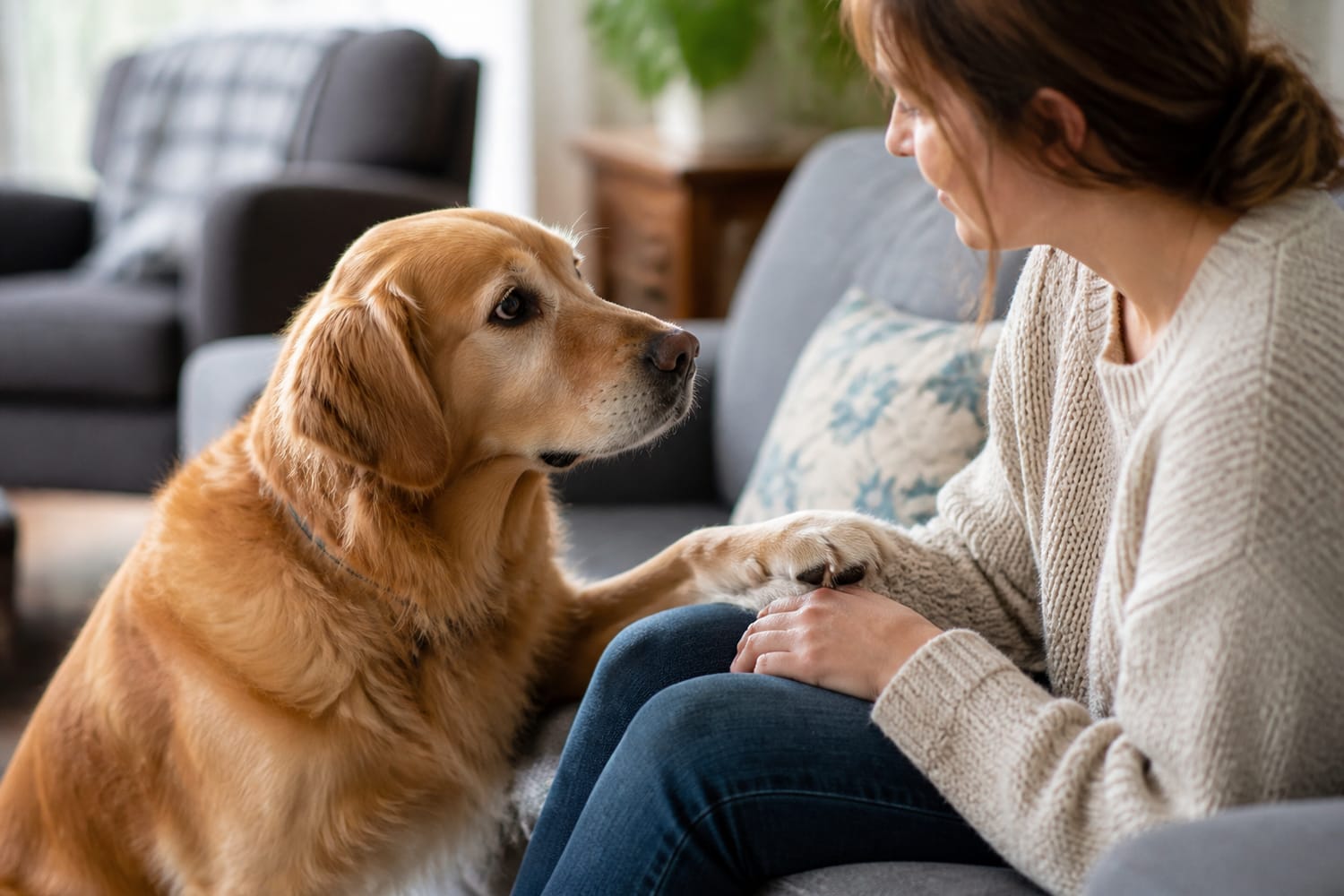
What Your Dog Is Really Saying With That Paw
When your dog places a paw on your arm, leg, or lap, they are communicating. They may want affection, food, play, help, reassurance, or a trip outside. The best response depends on the context: meet genuine needs, acknowledge emotional distress, and reward a calmer alternative when pawing has become a pushy demand.
That soft tap can feel wonderfully affectionate—until it becomes a muddy swipe, a scratch across bare skin, or a relentless drumbeat during dinner. Pawing is rarely mysterious or manipulative. It is simply one of the ways dogs learn to interact with the people around them.
Understanding the message behind the paw allows you to respond with kindness while still teaching good manners.
Why Dogs Paw at Their People
A dog’s paws are useful communication tools. Puppies begin using them early in life while interacting with their mother and littermates, and many dogs continue experimenting with paw-based communication as they grow.
Your dog may paw at you because they:
- Want petting, play, or attention
- Need to go outside
- Are expecting a meal or treat
- Want help reaching a toy
- Feel worried and are seeking reassurance
- Have learned to “shake” and are offering the familiar behavior
- Are excited or frustrated
- Are experiencing discomfort
Some dogs make light, gentle contact. Others deliver enthusiastic swats that can knock over a drink or scratch someone. Size, temperament, training history, and coordination all influence how a dog uses their paws.
To interpret the behavior accurately, look beyond the paw itself. Petspiration’s guide to understanding pet body language can help you notice the surrounding signals.
Read the Whole Dog
A loose body, soft eyes, relaxed mouth, and gently wagging tail often suggest a friendly request. Your dog may simply be saying, “Could I have a little attention?”
Pawing accompanied by panting, pacing, trembling, flattened ears, a tucked tail, or repeated attempts to stay close may point to stress. A dog who paws at you during thunder, fireworks, or an unfamiliar situation may be seeking safety rather than demanding entertainment.
Time and location provide clues, too. Pawing beside the back door may mean “I need to go out,” while pawing as you open a snack could mean “I would like some of that.”
How Innocent Pawing Becomes Demand Behavior
Dogs repeat actions that produce useful results. If your dog paws and you immediately pet them, throw a toy, share food, or begin talking, the behavior has worked. From the dog’s point of view, pawing is an effective button that makes a human respond.
Even pushing the paw away or saying, “Stop that!” can provide the attention the dog wanted. Eye contact, touch, laughter, and conversation may all function as rewards for a highly social dog.
This learning process does not mean your dog is trying to control the household. Demand behavior is better understood as a successfully practiced communication strategy. As the Cummings School of Veterinary Medicine explains, attention-seeking behaviors can be unintentionally reinforced by human reactions, but dogs can learn more appropriate alternatives.
The goal is not to stop your dog from communicating. It is to teach them a safer, calmer, and more polite way to ask.
First Check Whether Your Dog Has a Real Need
Before treating pawing as a training issue, run through a quick mental checklist:
- Does my dog need a bathroom break?
- Is it close to their usual mealtime or walk?
- Have they had suitable exercise and mental enrichment today?
- Are they frightened by something happening nearby?
- Could they be too hot, cold, thirsty, or uncomfortable?
- Is this behavior new, unusually intense, or accompanied by other changes?
A dog who genuinely needs to eliminate should not be ignored in the name of training. Calmly take them outside without turning the moment into an exciting play session. You can later teach a more suitable signal, such as standing by the door, sitting on a mat, or touching a potty bell.
Likewise, fearful pawing calls for support. You will not “reward fear” by helping your dog feel safe. Move them away from the trigger when possible, offer a comfortable retreat, and use calm reassurance without forcing physical contact.
Sudden changes deserve particular attention. New clinginess or pawing can sometimes accompany pain, reduced mobility, sensory changes, or illness. Veterinary guidance on behavior changes and possible medical causes emphasizes that discomfort and health conditions may contribute to behavior problems. Contact your veterinarian if the pawing begins abruptly or appears alongside limping, appetite changes, restlessness, sensitivity to touch, confusion, or unusual vocalization.
How to Respond Without Rewarding Pushy Pawing
Once you are confident that your dog is safe and their essential needs have been met, you can begin changing the pattern.
1. Make Pawing Unproductive
When your dog paws for attention, quietly withdraw your attention. Turn your body away, fold your arms, or stand up if necessary. Avoid scolding, laughing, petting, or repeatedly saying “no.”
The response should be calm rather than dramatic. You are not punishing or rejecting your dog; you are simply showing them that pawing does not open the door to attention.
If the behavior has worked many times before, your dog may initially paw harder, bark, nudge, or try another tactic. This temporary increase is common when a familiar strategy suddenly stops producing results. Stay patient and consistent, provided your dog is not distressed and has no unmet need.
2. Wait for Genuine Calm
Do not instantly reward the first half-second after the paw leaves your leg. Otherwise, your dog may learn a new sequence:
Paw → pause → receive attention.
Instead, wait for several moments of calm. Look for four paws on the floor, a sit, a relaxed stand, or a quiet lie-down. Then offer attention.
The timing matters. You want the reward to clearly follow the polite behavior—not the pawing that happened immediately before it.
3. Teach a Better Way to Ask
Dogs learn faster when we show them what to do instead. Choose an alternative that is easy, visible, and physically incompatible with pawing.
Good options include:
- Sitting in front of you
- Lying on a nearby mat
- Bringing a toy
- Resting the chin on your knee
- Standing quietly with all four paws down
- Making brief, relaxed eye contact
If your dog approaches and sits without pawing, warmly praise them and provide a little affection. With repetition, the sit can become their new way of saying, “Are you available?”
Petspiration’s introduction to positive reinforcement training offers more guidance on rewarding the behaviors you want to see again.
4. Put Affection on a Predictable Cue
You can teach a phrase such as “cuddle time” to signal that attention is available. Invite your dog over, enjoy a short petting session, and then use a gentle ending cue such as “all done.”
Afterward, offer a chew, toy, or comfortable resting place. Predictable beginnings and endings can help dogs understand that affection is plentiful, even though it is not available every second.
5. Make Sure Everyone Responds Consistently
If one person ignores pawing but another rewards it with treats, the behavior may become even more persistent. Unpredictable rewards can encourage a dog to keep trying because this attempt might be the one that works.
Agree on a simple household plan:
- Check for genuine needs.
- Avoid rewarding demand pawing.
- Ask for or wait for a calm alternative.
- Reward the alternative consistently.
- Use the same cues and expectations.
Children should receive age-appropriate guidance and adult supervision, especially around large or excitable dogs. They should not push, grab, or shout at a pawing dog.
Prevent Pawing by Meeting Your Dog Halfway
Training works best when a dog’s physical, social, and mental needs are being met. A bored dog may invent increasingly creative ways to start an interaction, while an overtired puppy may become just as demanding as an under-exercised one.
Build healthy outlets into the day through:
- Sniff-focused walks
- Short reward-based training sessions
- Food puzzles and scatter feeding
- Fetch, tug, or hide-and-seek
- Safe chewing opportunities
- Independent relaxation
- Regular one-on-one affection
If pawing usually happens while you work or eat, prepare an activity beforehand. A stuffed food toy, snuffle mat, or long-lasting chew can help your dog settle before frustration begins.
Teaching a designated relaxation spot can also be valuable. Petspiration’s guide to helping a dog settle calmly in different places can turn downtime into a rewarding skill rather than a daily struggle.
What Not to Do
Avoid hitting paws, stepping on toes, shouting, startling your dog, or using devices intended to cause pain or fear. These responses may suppress the pawing temporarily, but they do not teach a desirable alternative and may damage trust.
The American Veterinary Society of Animal Behavior recommends reward-based methods for dog training and behavior modification. Its humane dog training guidance emphasizes teaching appropriate responses through structure, management, and reinforcement rather than fear, intimidation, or pain.
Also avoid viewing every paw as disobedience. A senior dog asking for help, a frightened dog seeking closeness, and an energetic adolescent demanding a tennis ball require different responses.
When to Ask for Professional Help
Consult your veterinarian if the behavior is sudden, compulsive, difficult to interrupt, or associated with signs of pain or illness. Medical concerns should be ruled out before assuming a new behavior is purely a training problem.
A qualified reward-based trainer or veterinary behavior professional can help when pawing is accompanied by anxiety, aggression, guarding, destructive behavior, or severe frustration. Professional guidance is also wise if the dog’s paws could injure a child, older adult, or medically vulnerable family member.
Turn the Paw Into Better Communication
Your dog’s paw is not a declaration of dominance or a plot to rule the sofa. It is communication shaped by instinct, emotion, experience, and the responses that have worked in the past.
By checking for real needs, reading your dog’s body language, removing rewards for pushy pawing, and celebrating calm alternatives, you can create clearer communication without weakening your bond. In fact, thoughtful boundaries often make that bond stronger.
Your dog still gets to say, “I need you.” You simply help them learn a gentler, safer way to ask.