
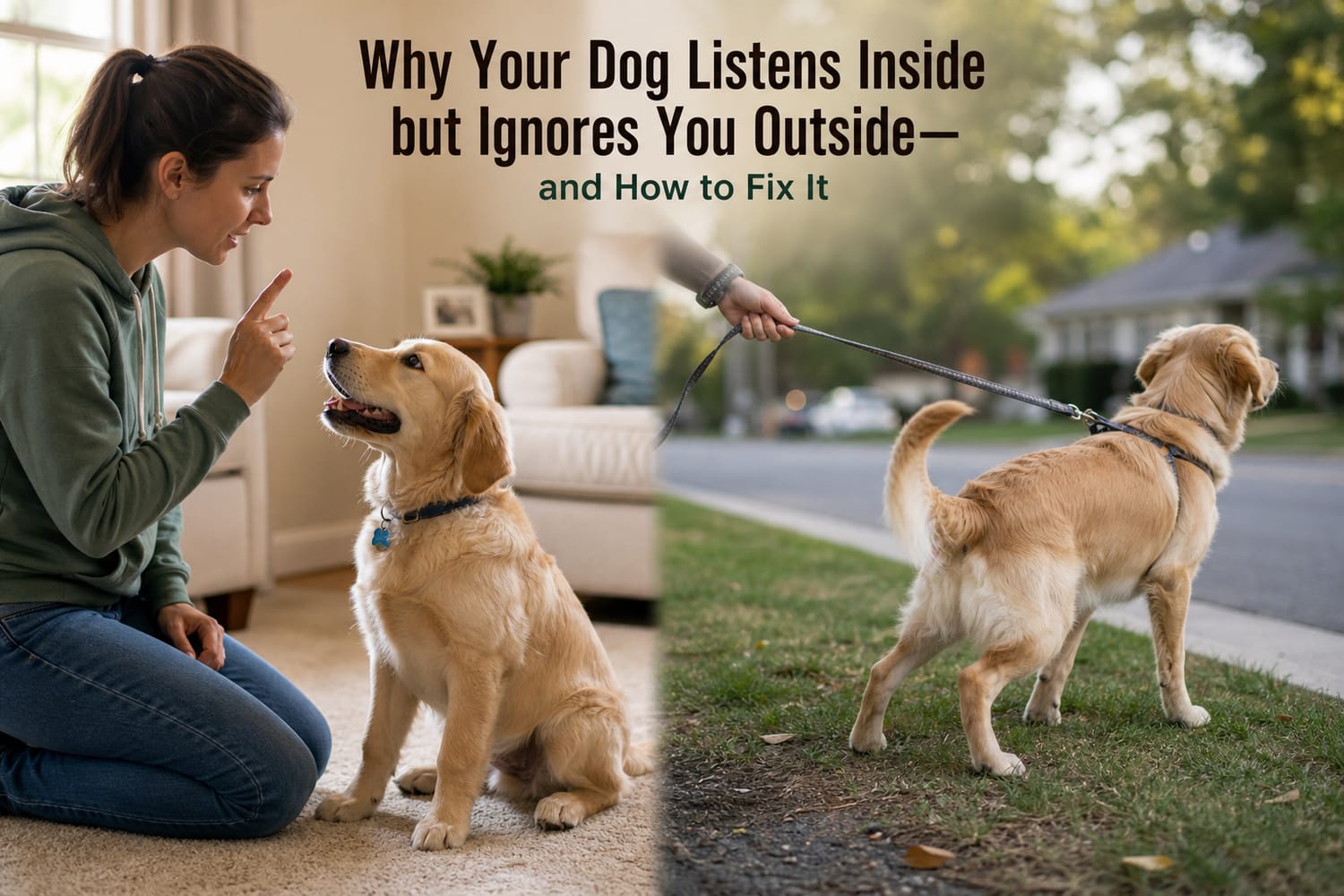
Your Dog Is Not Being “Stubborn”—They’re Being a Dog
It can feel a little heartbreaking: inside the house, your dog is a star student. They sit, stay, come when called, make eye contact, and seem to understand every word you say. Then you step outside and suddenly it’s as if they’ve never heard their name before. They pull toward squirrels, sniff every blade of grass, ignore your cues, and act like the backyard, sidewalk, or park is the most important place on Earth.
Here’s the good news: your dog is not trying to embarrass you. They are not “bad,” “dominant,” or purposely disobedient. They are simply overwhelmed by a world full of sounds, smells, movement, and excitement.
Dogs are incredibly environment-sensitive learners. A behavior that is easy in the living room may feel completely different to your dog in the driveway, at the park, or near other dogs. To us, “sit” means “put your bottom on the ground wherever we are.” To your dog, “sit in the kitchen while my person holds a treat” and “sit on a busy sidewalk while a skateboard rolls by” can feel like two very different tasks.
That means outdoor listening is not a character flaw. It is a training gap—and training gaps can be fixed with patience, practice, and the right plan.
The Outside World Is a Sensory Fireworks Show
Humans are visual creatures. Dogs experience the world largely through their noses. When your dog steps outside, they are walking into an invisible universe of information: where other dogs have been, what animals passed through overnight, who walked by, what food was dropped, and even emotional signals carried in scent.
A patch of grass may look boring to you, but to your dog it may read like a dramatic novel.
On top of that, outdoor environments are full of movement and sound. Cars pass. Leaves blow. Birds hop. Children run. Other dogs bark. Bikes appear suddenly. The wind carries smells from every direction. For some dogs, this is thrilling. For others, it can be stressful. Either way, it competes with your voice.
Inside your home, you are often the most interesting thing in the room. Outside, you may be competing with squirrels, smells, strangers, dogs, traffic, and adventure. That is a much harder classroom.
Why Treats Work Indoors but Not Outdoors
Many pet parents say, “My dog loves treats inside, but outside they won’t even take one!” This is an important clue.
If your dog refuses food outdoors, one of two things is often happening: the environment is too exciting, or the environment is too stressful. In both cases, your dog may be “over threshold,” meaning their brain is too activated to focus, learn, or respond normally.
Think of it like trying to solve a math problem in the middle of a concert. You may know how to do the math, but the noise and stimulation make it much harder. Dogs are similar. If the distractions are too intense, even familiar cues become difficult.
The solution is not to repeat the cue louder and louder. In fact, saying “come, come, COME!” while your dog ignores you can accidentally teach them that the word “come” does not matter. Instead, you need to make the situation easier and gradually build your dog’s ability to focus.
Start in calm outdoor spaces, such as your porch, yard, driveway, or a quiet section of sidewalk. Use extra-special rewards that your dog only gets during outdoor training: tiny pieces of chicken, cheese, freeze-dried meat, or a favorite toy. The reward needs to compete with the environment, so dry biscuits may not be exciting enough for many dogs outside.
Build a Bridge from Indoors to Outdoors
The biggest mistake many people make is jumping from “easy indoor practice” straight to “busy public place.” That is like asking a child who just learned addition to take a college exam.
Instead, build a training bridge. Move through levels gradually:
- Practice in a quiet room indoors.
- Practice near a window or open door.
- Practice at the doorway with the door open.
- Practice on the porch, balcony, or patio.
- Practice in the yard or driveway.
- Practice on a quiet street.
- Practice near mild distractions.
- Practice in busier environments.
At each level, ask for simple behaviors your dog already knows: name recognition, hand target, sit, down, eye contact, loose-leash walking, and recall. Keep sessions short and successful. Two to five minutes of focused practice is often better than a long session that ends in frustration.
Celebrate small wins. If your dog looks at you when a bird chirps, reward it. If they respond to their name near a passing car, reward it. If they choose to check in with you instead of pulling toward a smell, reward it generously.
You are teaching your dog a beautiful lesson: “The world is interesting, but paying attention to my person is also rewarding.”
Make Yourself Worth Listening To
Outside, your dog has many options. Sniffing, chasing, greeting, exploring, and watching the world are all naturally rewarding. If listening to you always means “fun is over,” your dog may become less motivated to respond.
For example, if you only call your dog to come when it is time to leave the park, they may learn that “come” predicts the end of fun. Instead, call them, reward them, and then release them back to sniff or play. This teaches them that coming to you does not always mean the adventure ends.
Use life rewards, too. Treats are helpful, but they are not the only reward. You can reward your dog with permission to sniff, go say hello when appropriate, run, play tug, chase a tossed treat, or continue walking. For many dogs, “go sniff” is an amazing paycheck.
Try this: when your dog looks at you on a walk, say “yes!” and then cue “go sniff” as you move toward an interesting patch of grass. Over time, your dog learns that checking in with you makes outdoor life even better.
Practice the Skills That Matter Most Outside
Some cues are especially useful outdoors because they help with safety, connection, and calm behavior. Focus on these foundation skills:
Name recognition: Say your dog’s name once. When they look at you, mark it with “yes!” or a clicker and reward. Practice until their name means, “Look at my person.”
Hand target: Teach your dog to touch their nose to your palm. This is great for redirecting attention, moving them away from distractions, and making recalls fun.
Recall: Use a cheerful voice and high-value rewards. Start close, then increase distance slowly. Outdoors, use a long line for safety until your dog is truly reliable.
Loose-leash walking: Reward your dog for being near you, checking in, and walking without tension on the leash. Do not wait for pulling to correct them—reward the behavior you want before pulling starts.
Leave it: Teach this indoors first with low-value items, then gradually practice outside. “Leave it” should mean, “Move away from that and come back to me for something better.”
Settle or relax: Some dogs need help learning that outdoors is not always go-go-go. Reward calm observation, relaxed body language, and quiet moments.
Training should feel like teamwork, not a battle. Your goal is not to control every second of your dog’s walk. Your goal is to create communication strong enough that your dog can enjoy the world safely with you.
Use Distance as Your Secret Training Tool
Distance is one of the most powerful tools in dog training. If your dog cannot listen near a distraction, move farther away. This is not failure—it is smart training.
If your dog barks at another dog from 10 feet away, try 50 feet. If they cannot take treats near a playground, cross the street or move to a quieter area. If squirrels send them into a frenzy, practice in places where squirrels are visible but not too close.
At the right distance, your dog can notice the distraction and still respond to you. That is the learning zone. Too close, and your dog may be too excited or worried to think. Too far, and they may not notice the distraction at all. Your job is to find the sweet spot.
When your dog succeeds, reward them. Over time, you can slowly decrease the distance. This process is called proofing or desensitization, depending on the goal and situation. It helps your dog build confidence and reliability without being overwhelmed.
Avoid Common Mistakes That Slow Progress
Even loving pet parents can accidentally make outdoor listening harder. Here are a few habits to watch for:
Repeating cues too many times: If your dog does not respond, they may not understand in that environment, or the distraction may be too hard. Make it easier rather than repeating the cue.
Using punishment when your dog is distracted: Scolding, leash jerks, or frustration can make outdoor spaces feel stressful. A stressed dog often listens less, not more.
Training only when you need control: Practice when nothing dramatic is happening. If you only train during emergencies, your dog will not have enough reinforcement history to succeed.
Expecting too much too soon: Reliability takes time. Dogs need repetition in many places with many distractions.
Forgetting to reward: Once dogs learn a cue, people often stop rewarding it. But outdoor listening is hard work. Keep paying your dog well, especially in challenging environments.
When Bigger Feelings Are Involved
Sometimes a dog who “ignores” cues outside is not simply distracted—they may be anxious, frustrated, fearful, or overexcited. Signs include intense barking, lunging, trembling, refusing food, scanning constantly, trying to flee, or being unable to settle.
If this sounds like your dog, they may need more than basic obedience practice. They may benefit from a behavior plan focused on emotional regulation and confidence-building. A certified professional dog trainer or veterinary behavior professional can help, especially if your dog reacts strongly to people, dogs, cars, or noises.
There is no shame in getting support. Just as humans may need coaches, teachers, or therapists, dogs sometimes need skilled guidance to feel safe and succeed.
Turn Walks into Conversations
A great walk is not about perfect heel position or constant obedience. It is a conversation. Your dog says, “That smell is fascinating!” You say, “Wonderful—check in with me first.” Your dog says, “That dog worries me.” You say, “I hear you—let’s create space.” Your dog says, “I want to explore!” You say, “Great idea—let’s do it safely together.”
When you approach training this way, everything changes. Walks become less about frustration and more about partnership. You begin to notice what your dog loves, what challenges them, and what helps them feel connected to you.
Your dog already has the ability to listen. Your job is to help that skill grow beyond the walls of your home. With gradual practice, better rewards, thoughtful distance, and plenty of encouragement, your dog can learn that listening outside is not only possible—it is fun.
The Petspiration Takeaway
If your dog listens beautifully inside but seems to forget everything outside, take heart. This is one of the most common training challenges dog lovers face. It does not mean your dog is naughty or that you have failed. It means the outside world is exciting, and your dog needs help learning how to focus there.
Start small. Reward generously. Practice in easy places before hard ones. Let your dog sniff, explore, and enjoy being a dog. Build attention through trust, not pressure.
Every check-in, every successful recall, every moment of eye contact on a busy walk is a little victory. And those little victories add up to something wonderful: a dog who wants to listen, a person who knows how to guide, and a bond that grows stronger with every adventure.