
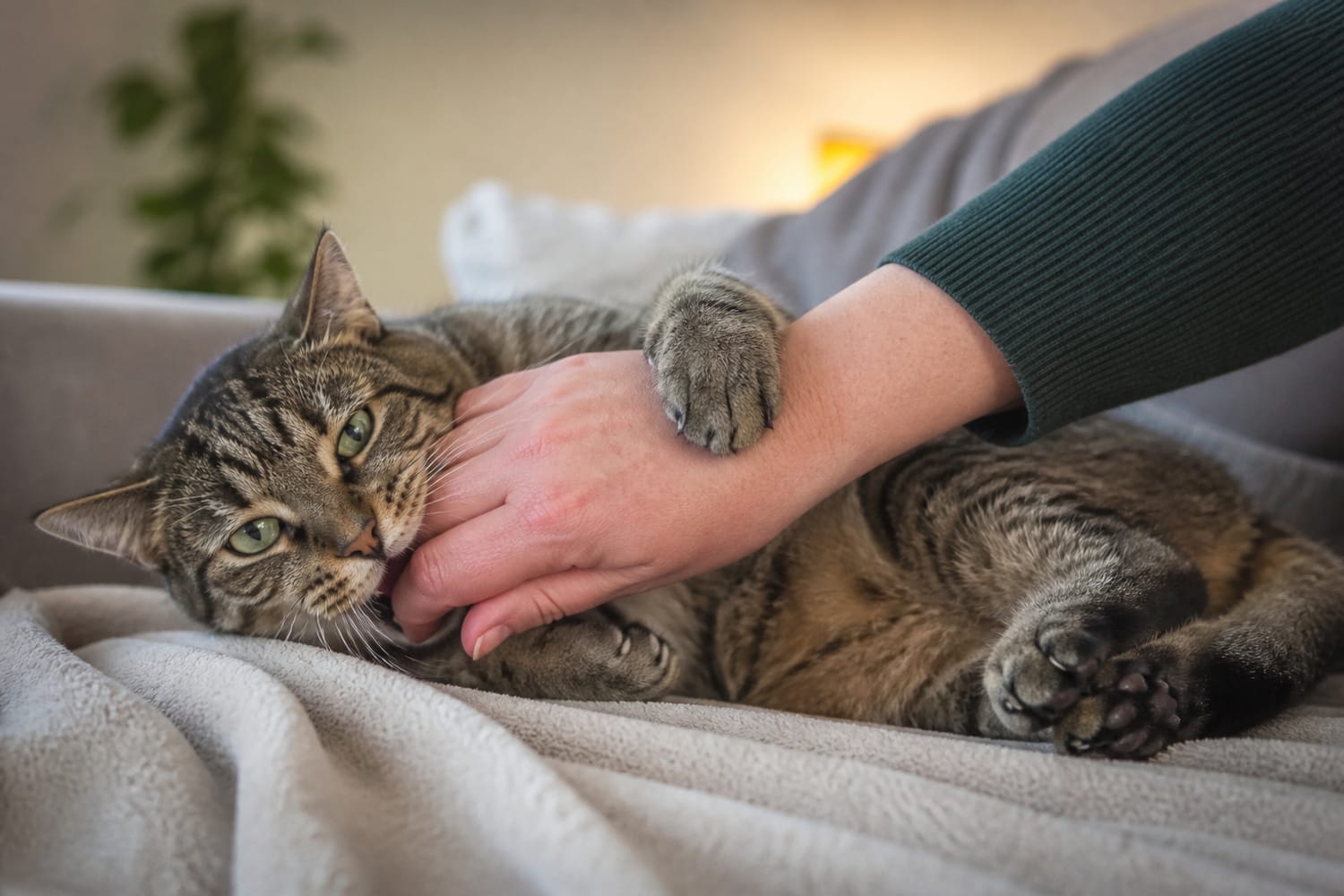
When Affection Suddenly Turns Into a Bite
A cat who bites during petting is usually not being spiteful or suddenly “mean.” The bite often signals that physical contact has become uncomfortable, irritating, frightening, or overwhelming. By recognizing your cat’s early warning signs, respecting their individual petting limit, and keeping interactions brief and voluntary, you can prevent many of these painful misunderstandings.
One moment, your cat is purring beside you as you stroke their silky fur. The next, their head whips around and their teeth meet your hand. It can feel like a dramatic change—but from your cat’s perspective, the interaction may have been building toward that moment for some time.
This behavior is commonly called petting-induced aggression or overstimulation biting. Although experts do not fully understand every case, repeated touch may become unpleasant after a cat reaches their sensory threshold. Some cats also bite to control when physical contact ends, particularly if their quieter requests for space have gone unnoticed.
The encouraging news is that these bites are often predictable. Learning to listen to your cat’s body can make petting safer, calmer, and more enjoyable for everyone.
Why Can Pleasant Petting Become Overwhelming?
Every cat has a different tolerance for touch. One may happily snooze through a long petting session, while another enjoys three chin scratches and then wants a break. Neither cat is more loving than the other—they simply have different preferences.
Repetitive Touch Can Become Irritating
Think about a gentle tap on your arm. The first few taps might be pleasant or barely noticeable, but dozens of taps in the same place could become irritating. Something similar may happen when a cat is stroked repeatedly.
Cats are highly sensitive to physical sensations. Once their personal threshold has been reached, a previously enjoyable stroke may begin to feel uncomfortable. The bite is their urgent way of saying, “That’s enough.”
Closeness Does Not Always Mean “Pet Me”
A cat may sit on your lap because they want warmth, security, or companionship—not necessarily continuous touching. Likewise, rubbing against your legs can be a greeting or scent-marking behavior rather than permission for a full-body cuddle.
Cats can enjoy being near us without wanting our hands on them. Recognizing this distinction is an important part of building a relationship based on trust.
Certain Areas May Feel Too Vulnerable
Many cats prefer gentle contact around the:
- Cheeks
- Chin
- Forehead
- Base of the ears
- Sides of the face
The belly, paws, legs, tail, lower back, and hindquarters are more sensitive for many cats. A cat exposing their belly may be showing trust, but that pose is not automatically an invitation for a belly rub.
The best petting map is your own cat’s response. Begin with commonly preferred areas and let their body language guide you.
The Warning Signs That Often Come Before a Bite
A petting bite may seem to appear “out of nowhere,” but cats frequently give subtle warnings first. These signals can be easy to miss while you are watching television, talking, or focusing on the purr rather than the rest of the cat.
Watch for:
- A tail tip beginning to twitch
- Faster or stronger tail swishing
- Ears rotating sideways or backward
- Skin rippling along the back
- Sudden muscle tension
- Dilated pupils
- Whiskers pulling back or pushing sharply forward
- A paw lifting toward your hand
- The cat turning to watch your hand
- Restlessness or repeated repositioning
- Purring that stops abruptly
- The head snapping toward the touched area
- Growling, grumbling, or a short meow
You can learn more about interpreting these signals in Petspiration’s guide to understanding pet body language.
Try to notice your cat’s earliest change rather than waiting for flattened ears, hissing, or swatting. The goal is to stop while your cat is still comfortable—not after they feel forced to defend their boundary. Veterinary behavior guidance similarly identifies tail lashing, backward ears, and dilated pupils as common warnings before petting-related aggression.
How to Prevent Overstimulation During Petting
Preventing a bite is not about making your cat tolerate more affection. It is about discovering what affection feels good to them and ending each interaction positively.
1. Let Your Cat Initiate Contact
Instead of reaching immediately, offer a relaxed hand at nose level and allow your cat to investigate. If they rub their cheek against you, try one or two gentle strokes in a preferred area.
Avoid following a cat who moves away. Walking off is a wonderfully polite “no thank you,” and respecting it teaches your cat that biting is unnecessary.
2. Keep Petting Sessions Short
If your cat usually bites after approximately ten strokes, stop at five or six. Ending below the threshold helps prevent the repeated pattern of irritation followed by biting.
Over time, some cats may become comfortable with slightly longer sessions. Others will always prefer short, frequent interactions—and that is perfectly fine. Cats Protection notes that brief, regular interactions often suit feline social preferences better than long, intense handling.
3. Pause Often
After a few strokes, remove your hand and observe. Your cat may:
- Lean toward you or head-bump your hand, requesting more
- Remain relaxed without seeking additional contact
- Turn away, groom, reposition, or leave
All three responses provide valuable information. A pause gives your cat an easy way to make a choice before discomfort grows.
4. Use Gentle, Predictable Movements
Fast pats, vigorous rubbing, long strokes down the entire body, and sudden reaches from above can be overwhelming. Use slow movements and light pressure, especially with a shy, newly adopted, older, or touch-sensitive cat.
The Cat Friendly Homes guidance on keeping cats calm also recommends paying attention to subtle body-language cues before a cat reaches their tipping point.
5. Reward Calm, Comfortable Interactions
If your cat accepts a few gentle strokes while remaining relaxed, stop and offer a small treat, praise, or a favorite toy. This creates a positive ending without pushing the session until your cat becomes uncomfortable.
For more ways to make handling cooperative rather than forced, explore Petspiration’s guide to teaching consent cues for grooming and handling.
What Not to Do When Your Cat Bites
Do not yell, hit, spray water, grab, scruff, or physically restrain your cat. Punishment can increase fear and teach the cat that hands are unpredictable or dangerous. It may also discourage early warnings, causing the cat to bite with less obvious notice in the future.
Instead:
- Stop moving your hand if it is safe to do so.
- Avoid pulling away violently, which may trigger grabbing or scratching.
- Calmly end the interaction.
- Give your cat space to settle.
- Think about the signals or circumstances that preceded the bite.
Do not immediately begin petting again to “show there are no hard feelings.” Your cat needs a genuine break. You can reconnect later through a calm voice, a tossed treat, play, or simply peaceful companionship.
Positive, reward-based learning is especially effective with cats. Pet lovers interested in strengthening communication can find more ideas in Petspiration’s introduction to fun cat training.
Could Pain or Illness Be Responsible?
Not every bite during touch is caused by ordinary overstimulation. Pain can dramatically reduce a cat’s tolerance, especially if the behavior appears suddenly or occurs whenever one specific area is touched.
Possible sources of discomfort include dental disease, ear problems, arthritis, skin irritation, injury, or pain involving the back, neck, limbs, or abdomen. Fear, anxiety, and redirected arousal can also contribute to a biting response.
Arrange a veterinary examination if:
- The behavior is new or becoming more intense
- Your cat reacts strongly when one area is touched
- They avoid jumping, climbing, grooming, or being picked up
- Their appetite, sleep, movement, or litter-box habits change
- Bites happen unpredictably or cause significant injury
- Your cat seems unusually withdrawn, restless, or irritable
A veterinarian can look for medical causes before recommending a qualified feline behavior professional. Cornell’s overview of feline aggression and petting-induced behavior offers additional guidance on warning signs and management.
Keeping Children and Guests Safe
Children may struggle to notice subtle tail flicks or ear movements, so an adult should supervise interactions with a cat who has bitten during petting. Teach children to use one or two gentle strokes on the head or cheeks, pause, and let the cat walk away.
Guests should also allow the cat to approach first. A friendly cat does not necessarily want to be picked up, hugged, or touched by an unfamiliar person.
If a bite breaks the skin, wash the wound promptly with soap and running water. Cat bites can create deep punctures and carry a risk of infection, so contact a healthcare professional for advice—particularly for wounds on the hand, face, feet, or near a joint, or if redness, swelling, warmth, worsening pain, or discharge develops.
Better Petting Begins With Listening
A cat’s boundaries are not a rejection of love. They are an invitation to love that cat as an individual.
When you notice the tiny tail twitch, pause before irritation builds, and allow your companion to choose whether contact continues, you show them that their communication matters. That sense of safety can transform your relationship.
Some cats adore long cuddles. Others express affection by sleeping nearby, following us between rooms, slow-blinking from the sofa, or sharing a playful five minutes with a wand toy. By appreciating the connection your cat freely offers, you create something more meaningful than unlimited petting: a bond built on understanding, choice, and trust.