
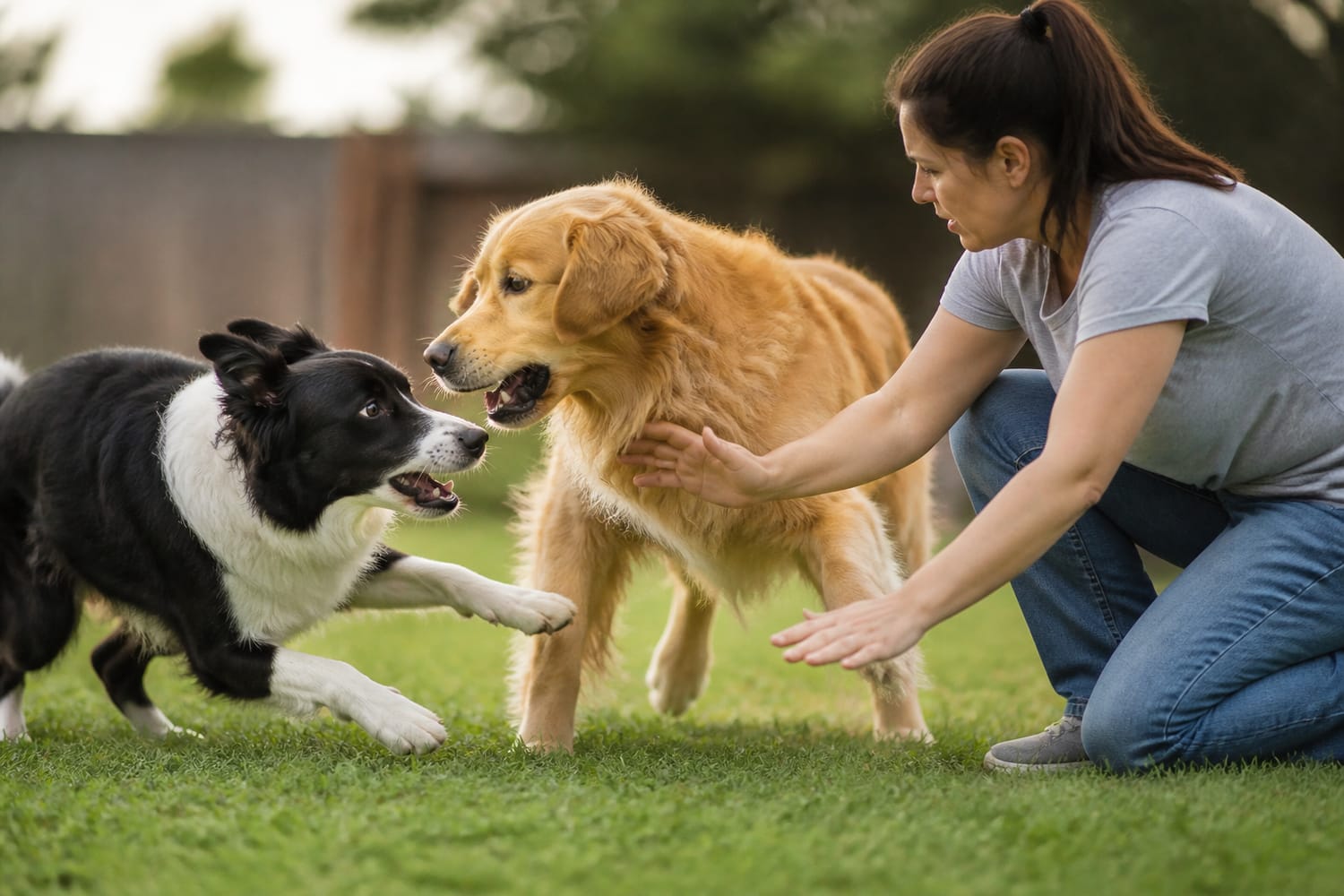
When Pet Play Gets Too Rough: How to Spot the Difference and Teach Safe Breaks
Playful wrestling, chasing, pouncing, and noisy growling can look dramatic without being dangerous. Healthy play is usually loose, balanced, and voluntary, with pauses and role changes. Step in when one pet repeatedly tries to escape, bodies become stiff, warnings are ignored, or the action continues without breaks.
Why Healthy Play Sometimes Looks Wild
Play allows pets to exercise, explore natural behaviors, practice communication, and strengthen social bonds. Dogs may chase, mouth, wrestle, bow, bark, or growl. Cats may stalk, pounce, swat, kick, and briefly pin one another.
That can make normal play look alarmingly similar to a fight. The difference is rarely one isolated action. A growl, swat, or chase must be interpreted alongside the pets’ posture, expressions, movement, and response to each other.
Learning to read the full picture is easier when you understand what your pet’s body language is saying. Instead of asking, “Did that dog growl?” or “Did that cat bite?” ask, “Are both pets comfortable, responsive, and choosing to continue?”
The Green Flags of Safe, Enjoyable Play
Good play has a bouncy, flexible quality. Even when pets are moving quickly, neither participant appears trapped or genuinely frightened.
Look for balance and cooperation
Signs of healthy play commonly include:
- Loose, wiggly bodies: Muscles and movements appear relaxed rather than rigid.
- Play invitations: Dogs may bow with their front legs lowered and rear raised. Cats may dart away, pause, and look back as if inviting pursuit.
- Role reversals: The chaser becomes the chased, or the pet on top later rolls underneath.
- Self-handicapping: A larger or stronger pet may slow down, lie down, or use gentler movements with a smaller companion.
- Natural pauses: Pets stop to shake, sniff, reposition, or catch their breath.
- Voluntary re-engagement: After a pause, both pets return rather than one hiding or leaving.
- Respect for signals: When one pet slows down or backs away, the other gives space.
Some pets are naturally vocal players. A dog may produce theatrical growls while remaining loose and playful, while another may play almost silently. Sound matters, but posture and context tell you much more.
The Red Flags That Mean Play Is Becoming Too Rough
Play becomes unsafe when it stops being mutual. One pet may still be having fun while the other has shifted into fear, frustration, pain, or defensive behavior.
Pause the interaction if you notice:
- One pet repeatedly attempting to escape, hide, climb away, or reach a person
- Continuous chasing with no role reversal
- Repeated pinning that prevents the other pet from getting up
- Stiff posture, freezing, or a prolonged hard stare
- A tucked tail, crouched body, flattened ears, or raised fur
- Escalating snarls, hissing, spitting, shrieking, or repeated yelps
- Bites that leave punctures or scratches that break the skin
- A large difference in size, strength, or stamina that is not being moderated
- One pet returning eagerly while the other avoids contact
- Warnings that are repeatedly ignored
For cats, normal play is often relatively quiet and includes frequent pauses. Persistent hissing, growling, flattened ears, defensive crouching, or desperate attempts to flee suggest that the interaction needs to stop. Cornell University’s guide to feline aggression and warning signals explains why posture, facial expression, and context are essential when distinguishing play from fear or aggression.
Age and health matter too. A young, energetic puppy may overwhelm an older dog with arthritis, while an enthusiastic kitten may continually ambush a quiet senior cat. A pet does not have to fight back to be uncomfortable.
Use a Simple Consent Check
When you are uncertain, conduct a brief “consent check.” Calmly interrupt the pet who is playing more intensely and create a little space for several seconds.
Then watch the other animal:
- Do they approach with a relaxed body?
- Do they offer another play invitation?
- Do they move away and choose a different activity?
- Do they remain behind you or seek a hiding place?
If the pet returns happily, play may resume under supervision. If they leave, hide, freeze, or avoid their playmate, honor that choice and end the session.
A consent check is not proof that every future moment will remain safe. Continue observing, because excitement can rise quickly. Veterinary guidance on dog play and exercise recommends avoiding interactions that create excessive arousal and watching for behaviors such as escalating barking, jumping, and nipping.
How to Teach a Safe Break Cue
A reliable break cue gives pets a predictable way to pause, calm down, and earn another opportunity to play. It should never sound like punishment.
1. Choose a cheerful cue
Use a short phrase such as “break,” “pause,” or “all done.” Keep your voice upbeat and consistent.
2. Practice away from exciting play
Begin in a quiet room. Say the cue, encourage your pet to come to you, and immediately offer a small treat or another valued reward. For cats, you might toss the treat a short distance toward a resting spot.
3. Add mild distractions
Practice while your pet is calmly exploring or playing with a toy. Reward them for disengaging and turning toward you.
4. Interrupt social play early
Do not wait until the pets are highly aroused. Call them apart during a natural lull, reward calm attention, and allow a short reset.
5. Reward calm behavior
Ask for an easy behavior the pet already knows, such as sitting, touching your hand, or settling on a mat. Cats can be rewarded simply for approaching calmly, following a target, or relaxing in a designated area.
6. Sometimes let play resume
If every break cue permanently ends the fun, pets may become reluctant to respond. When both animals remain comfortable, release them to play again after a brief pause. Returning to the game can itself become a powerful reward.
This approach follows the principles of positive reinforcement training, in which desirable choices earn outcomes the pet values.
Create Conditions for Better Play
Training works best when the environment helps pets succeed. Choose compatible playmates and consider each animal’s age, size, energy, health, and preferred style.
Keep initial sessions short and provide open escape routes. Remove food bowls, prized chews, and special toys if they create tension. Cats should have elevated resting areas and hiding spaces, while dogs benefit from enough room to move without being cornered.
Pets also need alternatives to social play. Walks, scent games, puzzle feeders, training, fetch, and appropriate solo toys can reduce pent-up energy. Pet parents managing especially social or dependent animals may also benefit from encouraging safe independent play.
When playing with people, use toys rather than hands and feet. Wand toys allow cats to stalk and pounce at a safe distance, while balls and tug toys give dogs an appropriate target. Avoid encouraging behaviors in a tiny puppy or kitten that could become painful or unsafe when the animal is fully grown.
What Not to Do During Rough Play
Do not yell, hit, pin, alpha-roll, spray, or otherwise frighten a pet. Punishment can increase fear and arousal without teaching the animal what to do instead. The American Veterinary Society of Animal Behavior recommends reward-based training methods for dog training and behavior modification.
Never punish a growl or hiss. These sounds provide valuable information that a pet is uncomfortable. Silencing the warning does not necessarily change the underlying emotion—and may leave you with less notice before a stronger reaction.
If a real fight begins, do not place your hands between the animals or grab near their mouths. Use distance, barriers, doors, or other safe separation methods whenever possible. Afterward, keep the pets apart until they are fully calm, and check carefully for injuries.
When to Seek Professional Help
Arrange a veterinary examination if roughness appears suddenly, one pet becomes sensitive to touch, or behavior changes without an obvious explanation. Pain and illness can reduce tolerance and contribute to defensive behavior.
Professional support is also important when:
- Injuries or puncture wounds occur
- Fights are becoming more frequent or intense
- One pet lives in ongoing fear of another
- You cannot safely interrupt the animals
- Aggression is directed toward people
- Careful management and reward-based training are not improving the situation
Start with your veterinarian, who can check for medical causes and refer you to a qualified behavior professional when needed.
Safe Play Begins With Listening
Our pets constantly tell us how they feel through movement, posture, sound, and choice. When we notice their quieter signals, we can step in before excitement turns into distress.
Safe breaks are not about spoiling the fun. They protect trust, teach self-control, and help every pet feel heard. With patient observation, thoughtful supervision, and positive training, playful chaos can remain exactly what it should be: joyful, enriching, and safe for everyone.