
The Tiny Window That Changes Everything
If you have ever asked your dog to “sit,” watched them do it beautifully, then fumbled in your pocket for a treat while they stood up, spun around, and sniffed the floor—you have met the challenge of training timing.
Pets learn by connecting actions with consequences. When something good happens right after a behavior, they are more likely to repeat that behavior. But “right after” is the key phrase. For many pets, especially dogs and cats, the strongest learning happens when the reward arrives within about three seconds of the behavior.
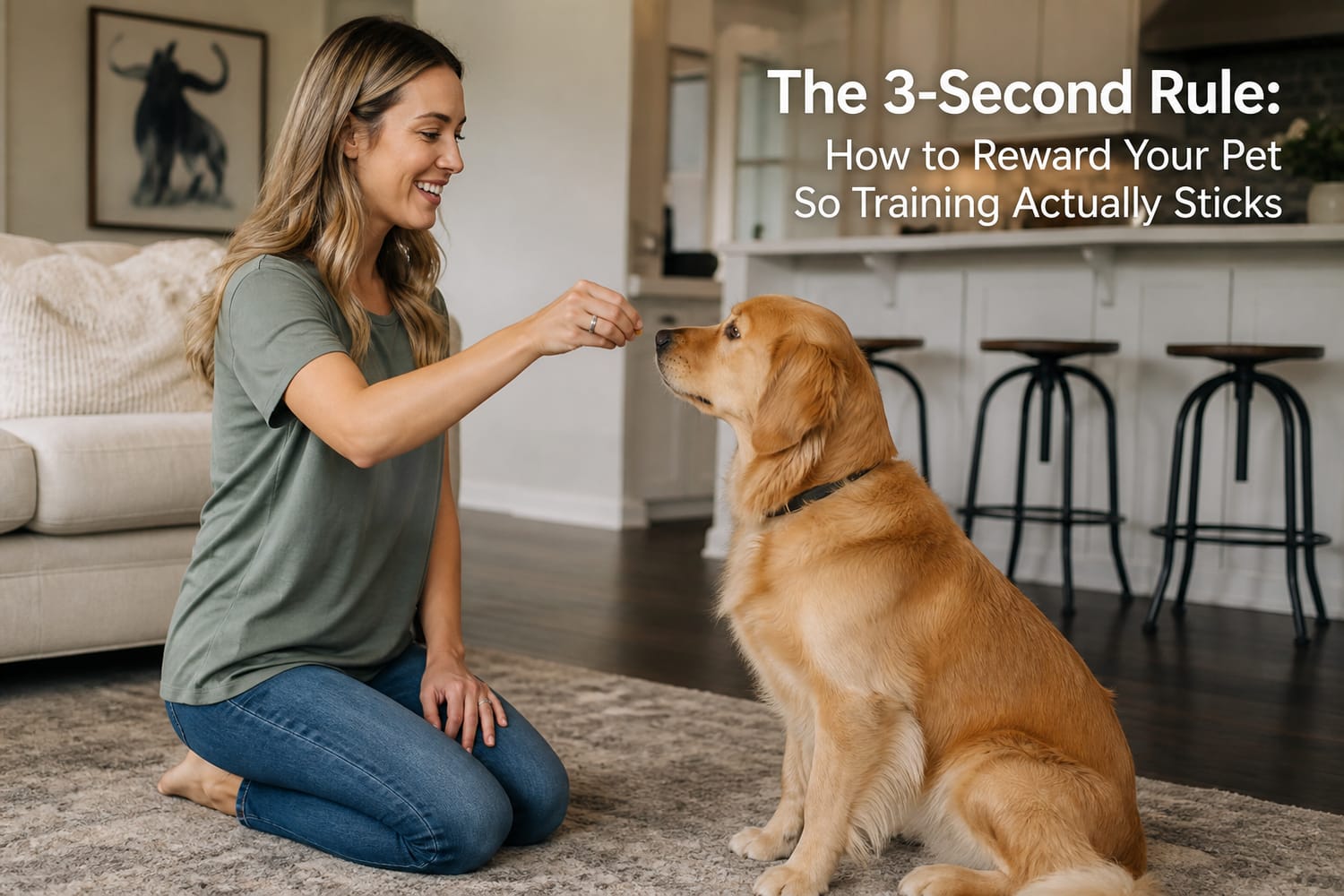
That is the heart of the 3-second rule: reward the behavior you want within three seconds so your pet can clearly understand what earned the reward.
This simple idea can transform training from confusing to joyful. It helps your pet think, “Oh! That thing I just did made the good thing happen!” Whether you are teaching a puppy to sit, a senior dog to walk calmly, a cat to come when called, or a rabbit to hop into a carrier, timing can make the difference between “almost” and “aha!”
Why Timing Matters So Much
Animals do not naturally understand our words, gestures, or household rules. They learn through patterns. If a behavior leads to something they enjoy—food, play, praise, access to the outdoors, a favorite toy—they are more likely to do it again.
But if the reward comes too late, your pet may connect it to the wrong behavior.
Imagine this: you call your dog, and they come running. Wonderful! But before you reward them, they jump up on you. If you give the treat after the jump, your dog may think, “Jumping is what earned the snack.” You meant to reward coming when called, but your timing rewarded the leap.
The same can happen with cats. If your cat touches a target stick with their nose, then turns away and meows, and the treat appears after the meow, your cat may decide that vocalizing—not touching the target—is the winning move.
This does not mean your pet is being stubborn or sneaky. It simply means they are learning from the information we provide. Better timing gives clearer information.
What Counts as a Reward?
A reward is anything your pet wants enough to work for. For many pets, treats are the easiest training reward because they are quick, clear, and motivating. But rewards come in many forms, and the “best” reward depends on the individual animal and the situation.
Common rewards include:
- Small soft treats
- Pieces of plain cooked chicken or turkey
- Kibble from your pet’s daily meals
- A favorite toy
- A game of tug or fetch
- Calm praise
- Gentle petting, if your pet enjoys it
- Permission to sniff during a walk
- Opening a door to the yard
- Access to a perch, bed, or sunny window
The important part is that your pet truly values it. Some dogs will do backflips for a bit of cheese, while others would rather chase a ball. Some cats adore crunchy treats; others prefer a wand toy. Some pets love affection, while others find touching distracting during training.
A reward is defined by your pet, not by us. If the behavior increases, the reward is probably working.
The 3-Second Rule in Action
Let’s say you are teaching your dog to sit.
- You hold a treat near their nose.
- You slowly move it upward and slightly back.
- Their bottom touches the floor.
- Within three seconds, you say “Yes!” and give the treat.
That quick reward tells your dog, “Sitting made the treat happen.”
Now imagine the same lesson with delayed timing:
- Your dog sits.
- You say, “Good dog, wait, where did I put those treats?”
- Your dog stands up.
- You give the treat.
Your dog may learn that standing up after sitting is part of the process. Not because they are trying to be difficult, but because the reward arrived after standing.
The same rule works for everyday manners. If your dog looks at you instead of barking at another dog, reward that eye contact immediately. If your cat steps into the carrier, reward while they are still in or near the carrier. If your bird steps onto your hand, reward right away before they hop off.
The clearer your timing, the clearer the lesson.
Use a Marker to “Take a Picture” of the Behavior
Sometimes it is hard to deliver a treat within three seconds. Your pet may be across the room, outside in the yard, or moving quickly. This is where a marker becomes incredibly useful.
A marker is a short signal that tells your pet, “That behavior right there is what earned the reward.”
Common markers include:
- A click from a clicker
- A word like “Yes!”
- A tongue click
- A thumbs-up signal for deaf pets
Think of the marker like taking a photo. It captures the exact moment your pet gets it right. Then the reward follows.
For example, if your dog lies down across the room, you can immediately say “Yes!” the moment their elbows hit the floor. Then you walk over and deliver the treat. The marker bridges the gap between the behavior and the reward.
To teach a marker, start simply. Say “Yes!” or click, then give a treat. Repeat several times. Your pet learns that the sound predicts something good. Once that connection is strong, you can use the marker during training.
Reward What You Want to See More Of
Training is not only about teaching tricks or commands. It is also about noticing and rewarding the good choices your pet already makes.
Did your dog settle quietly on their bed while you cooked dinner? Reward it.
Did your cat use the scratching post instead of the couch? Reward it.
Did your puppy look at you when a skateboard rolled by? Reward it.
Did your rabbit calmly accept a gentle touch? Reward it.
So often, we react when pets do something unwanted, but forget to acknowledge the many moments when they are doing well. The 3-second rule invites us to become better observers. Instead of waiting for mistakes, we can catch our pets succeeding.
This creates a happier learning environment. Your pet begins to feel confident because they are not just hearing “no.” They are receiving clear feedback about what works.
The Difference Between a Reward and a Bribe
Many pet owners worry that using treats means their pet will only behave when food is visible. That can happen if treats are used as bribes instead of rewards.
A bribe appears before the behavior: “Look, I have a treat! Now please sit.”
A reward appears after the behavior: “You sat! Great choice. Here is your treat.”
In early training, it is normal to use food to guide or lure a pet into position. But once your pet understands the behavior, begin hiding the treat in a pocket, treat pouch, or nearby container. Ask for the behavior first, then reward after they do it.
Over time, you can also vary rewards. Sometimes your pet gets a treat. Sometimes praise. Sometimes a toy. Sometimes permission to go sniff. This keeps behavior strong without making your pet dependent on seeing food first.
Think of rewards as paychecks, not bribes. They are how we say, “That was worth doing.”
Common Timing Mistakes and How to Fix Them
Even loving, dedicated pet owners make timing mistakes. The good news is that they are easy to improve once you know what to look for.
One common mistake is rewarding too late. If this happens, use a marker word or keep treats easier to reach. A treat pouch can make a huge difference.
Another mistake is rewarding the wrong behavior by accident. For example, if your dog barks at you for dinner and you immediately prepare their food, barking may become part of the dinner routine. Instead, wait for a quiet moment—even one second of silence—and reward that.
Some people repeat cues many times: “Sit, sit, sit, sit.” If the pet finally sits after the fourth repetition, they may learn that the cue is “sit-sit-sit-sit.” Try saying the cue once, then help your pet succeed with a gesture or easier setup.
Another mistake is making training sessions too long. Pets learn best in short, positive sessions. A few minutes of focused practice can be more effective than a long session that ends in frustration.
Finally, be careful not to reward only the “big” successes. Tiny steps matter. If your shy cat glances toward the carrier, that may be worth rewarding. If your excitable dog looks at you for half a second on a busy walk, celebrate it. Small wins become big progress.
Training Different Pets With the Same Principle
The 3-second rule is often discussed in dog training, but it applies to many companion animals. Cats, rabbits, birds, horses, and even small pets like rats can learn through well-timed positive reinforcement.
Cats can learn to come when called, enter carriers, sit on mats, accept nail trims, and enjoy puzzle games. The key is using rewards they actually like and keeping sessions short.
Rabbits can learn to hop into pens, approach when called, or tolerate gentle handling. Because many rabbits are sensitive, calm timing and patience are especially important.
Birds can learn step-up, stationing, recall, and cooperative care behaviors. For birds, tiny food rewards and precise markers are often very effective.
Dogs, of course, can learn everything from basic manners to advanced sports with the same principle: mark and reward the behavior you want.
No matter the species, training should feel like a conversation. Your pet offers behavior. You provide feedback. Together, you build understanding.
Make Rewards Part of Everyday Life
You do not need a formal training session to use the 3-second rule. Daily life is full of teachable moments.
Before opening the door, wait for your dog to keep four paws on the floor, then reward by opening it. Before putting down your cat’s food bowl, wait for a calm pause, then place it down. On a walk, reward your dog for checking in with you. During grooming, reward your pet for staying relaxed for one more second.
These little moments add up. They teach your pet that good choices make life better. They also strengthen your bond because your pet learns that you are consistent, fair, and worth paying attention to.
Training does not have to be strict or serious. It can be playful. It can be gentle. It can be woven into the rhythm of your home.
When Progress Feels Slow
Every pet learns at their own pace. Age, breed, species, past experiences, health, environment, and personality can all affect training. If progress feels slow, it does not mean you or your pet are failing.
Ask yourself:
- Is the reward valuable enough?
- Am I rewarding within three seconds?
- Is the environment too distracting?
- Is the behavior too difficult right now?
- Does my pet understand what I am asking?
- Are sessions short and positive?
Sometimes the best solution is to make the task easier. Train in a quieter room. Reward smaller steps. Use a better treat. Practice when your pet is not tired, overstimulated, or full.
If your pet shows fear, aggression, extreme stress, or sudden behavior changes, consider contacting a qualified positive-reinforcement trainer, veterinary behaviorist, or your veterinarian. Behavior is often connected to health and emotions, and compassionate professional support can make a world of difference.
The Magic Is in the Moment
The 3-second rule is beautifully simple: reward the behavior you want while your pet can still connect the reward to that behavior. It is not about perfection. It is about clarity, kindness, and communication.
When we reward with good timing, we help our pets succeed. We become easier to understand. Training becomes less of a command and more of a shared language.
And perhaps the most inspiring part is this: every well-timed reward tells your pet, “I see you. I noticed your good choice. Let’s keep learning together.”
That is how training sticks—not through pressure or confusion, but through trust, joy, and perfectly timed moments of connection.