
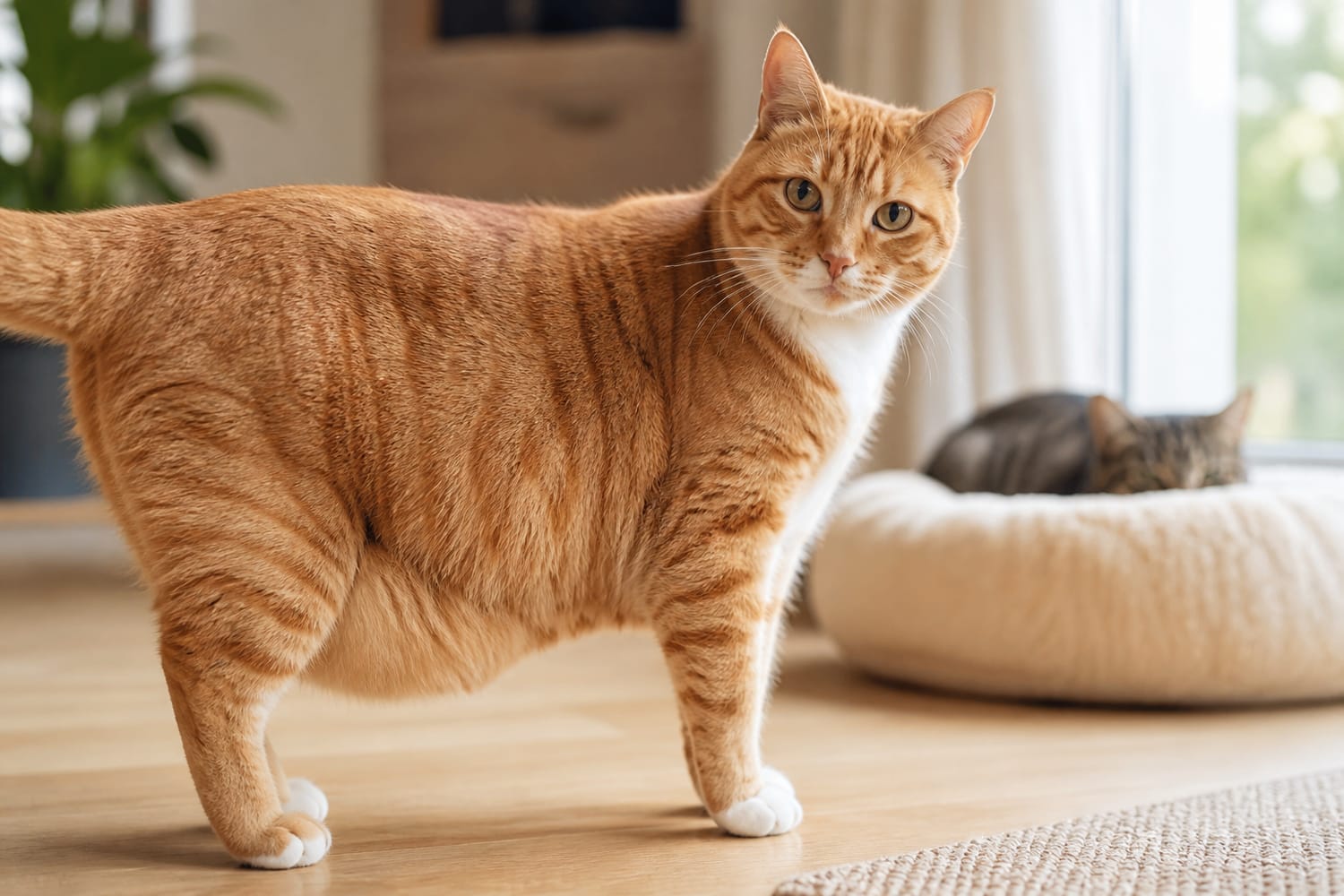
That swinging flap beneath your cat’s belly is usually a primordial pouch—a normal fold of loose skin and fatty tissue, most noticeable near the hind legs. Its exact evolutionary purpose remains uncertain, but proposed explanations include protection, flexibility, and energy storage. A visible pouch alone does not mean your cat is overweight.
If you’ve ever watched your cat trot toward dinner and wondered why their underside seems to have its own rhythm, you’re not alone. The belly pouch is an endearing feline feature with a wonderfully grand name.
But what’s actually inside it? Why do some cats have a dramatic swing while others barely show a flap? And when should a changing belly prompt a veterinary visit? Let’s unravel the mystery.
What Is a Cat’s Primordial Pouch?
Despite its name, the primordial pouch isn’t an open pocket. It’s a fur-covered fold of skin containing fatty tissue along the underside of the abdomen. It tends to hang most noticeably toward the back legs, where it can sway as a cat walks or runs. VCA Animal Hospitals’ guide to the primordial pouch describes it as a normal part of feline anatomy.
A typical pouch feels loose and floppy rather than like a distinct, firm lump. Its size varies considerably: one healthy cat may have an impressive belly curtain, while another has only a subtle fold. Genetics, breed, and age can influence its appearance.
Think of “primordial pouch” as a name for this particular feature—not a diagnosis and certainly not a criticism of your cat’s figure.
Why Do Cats Have a Belly Pouch?
Here’s where the mystery remains: experts do not know its exact evolutionary purpose. Veterinary sources describe several possible explanations, but these should be understood as theories rather than proven answers. PetMD’s veterinarian-reviewed explanation of the primordial pouch outlines several leading possibilities.
It May Offer Extra Protection
One theory is that the loose skin and fatty cushioning provide an additional barrier over the abdomen during fights or rough encounters. That could be useful when claws are involved. It is a proposed protective benefit, however—not evidence that the pouch makes a cat injury-proof.
“Belly armor” is an appealing nickname, but it’s best treated as a playful description of a hypothesis.
It May Allow Greater Flexibility
Another explanation involves movement. Extra abdominal skin may allow the body to stretch more freely during running, climbing, and hunting. Imagine a cat extending toward a toy: additional give around the belly could accommodate that changing body shape.
The important distinction is may. It’s reasonable to discuss flexibility as a possible benefit without claiming that the pouch alone explains feline athleticism.
It May Relate to Energy Storage or Large Meals
Some veterinarians suggest that fat within the pouch could have provided an energy reserve when food was scarce. Another hypothesis is that loose skin accommodates abdominal expansion after a large meal. Neither explanation is established as the pouch’s definitive purpose.
For the cat lover, the takeaway is refreshingly simple: we know what the pouch is, even if its evolutionary story still has unanswered questions.
Why Is My Cat’s Pouch So Noticeable?
Primordial pouches often become more apparent as kittens mature, commonly between about six months and one year of age. They don’t look identical on every cat, and a barely visible pouch isn’t automatically cause for concern.
Age can also change its appearance. As a cat gets older and loses muscle mass, the pouch may hang lower. A prominent flap can still occur in a cat at a healthy weight; its appearance needs to be considered alongside the rest of the body.
Does Spaying or Neutering Cause It?
No—cats do not need to be spayed or neutered to develop a primordial pouch. Cats Protection’s guide to feline belly pouches specifically addresses this common misconception.
The confusion may arise because calorie needs can decrease after neutering. If feeding stays unchanged, weight gain can make a cat’s abdomen larger, which owners may mistake for a newly developed pouch. Your veterinarian can help adjust portions when needed.
The pouch itself isn’t proof of surgery, previous pregnancy, or overfeeding.
Primordial Pouch or Extra Weight? Look Beyond the Flap
A cat can have a pouch and be lean, overweight, or somewhere in between. The pouch also contains some fat, so “pouch versus fat” isn’t a completely either-or distinction. Excess weight may enlarge the area, but a hanging fold alone cannot tell you whether weight loss is needed.
Instead, focus on overall body condition. PetMD recommends looking at the waist from above and gently assessing the ribs rather than judging the belly flap in isolation. Your veterinary team can demonstrate how to do this.
Useful questions include:
- Can you see a waist behind the ribs when looking down from above?
- Can you feel the ribs beneath a light covering of tissue without pressing hard?
- Has your veterinarian identified an appropriate weight and body condition for your cat?
For example, an obvious waist and easily felt ribs provide different information from a rounded body with ribs that are difficult to feel—even if both cats have swinging pouches. A body-condition assessment is more useful than comparing your cat with photographs online.
Petspiration’s guide to understanding your pet’s feeding portions offers a starting point for thinking about food amounts. Use individualized veterinary advice rather than changing meals simply to shrink a flap.
When a Changing Belly Needs Veterinary Attention
A familiar, floppy pouch is different from a new lump or an abdomen that is becoming swollen. Even when a cat already has an obvious pouch, a change in belly shape deserves attention rather than an automatic “that’s normal.” Other conditions can resemble or alter a hanging belly.
Arrange a veterinary examination if you notice:
- A new, distinct lump within or near the pouch.
- Swelling, bruising, or an injury to the area.
- A belly that becomes unusually firm.
- A clear change in abdominal size or shape.
Abdominal enlargement can have many causes, including weight gain, pregnancy, parasites, enlarged organs, or fluid accumulation. These cannot reliably be distinguished by appearance alone; a veterinary examination may be needed to identify the cause.
Seek emergency veterinary care for a suddenly bloated abdomen, particularly with vomiting, or for difficulty breathing or collapse. Those signs should not be dismissed as an unusually large primordial pouch.
Appreciate the Swing—and Know What’s Normal
The primordial pouch is a lovely reminder that understanding a pet doesn’t require solving every evolutionary mystery. Sometimes, the most useful knowledge is recognizing an ordinary feature, knowing what changes matter, and asking for help when something seems different.
There’s no need to judge a cat’s health by the elegance—or enthusiasm—of their belly swing. Look at the whole cat, keep veterinary checkups part of their care, and let curiosity lead to understanding rather than worry.
And the next time your feline friend trots across the room, you’ll have a name for that bouncing flap: the primordial pouch. A grand title for a charming little mystery.