
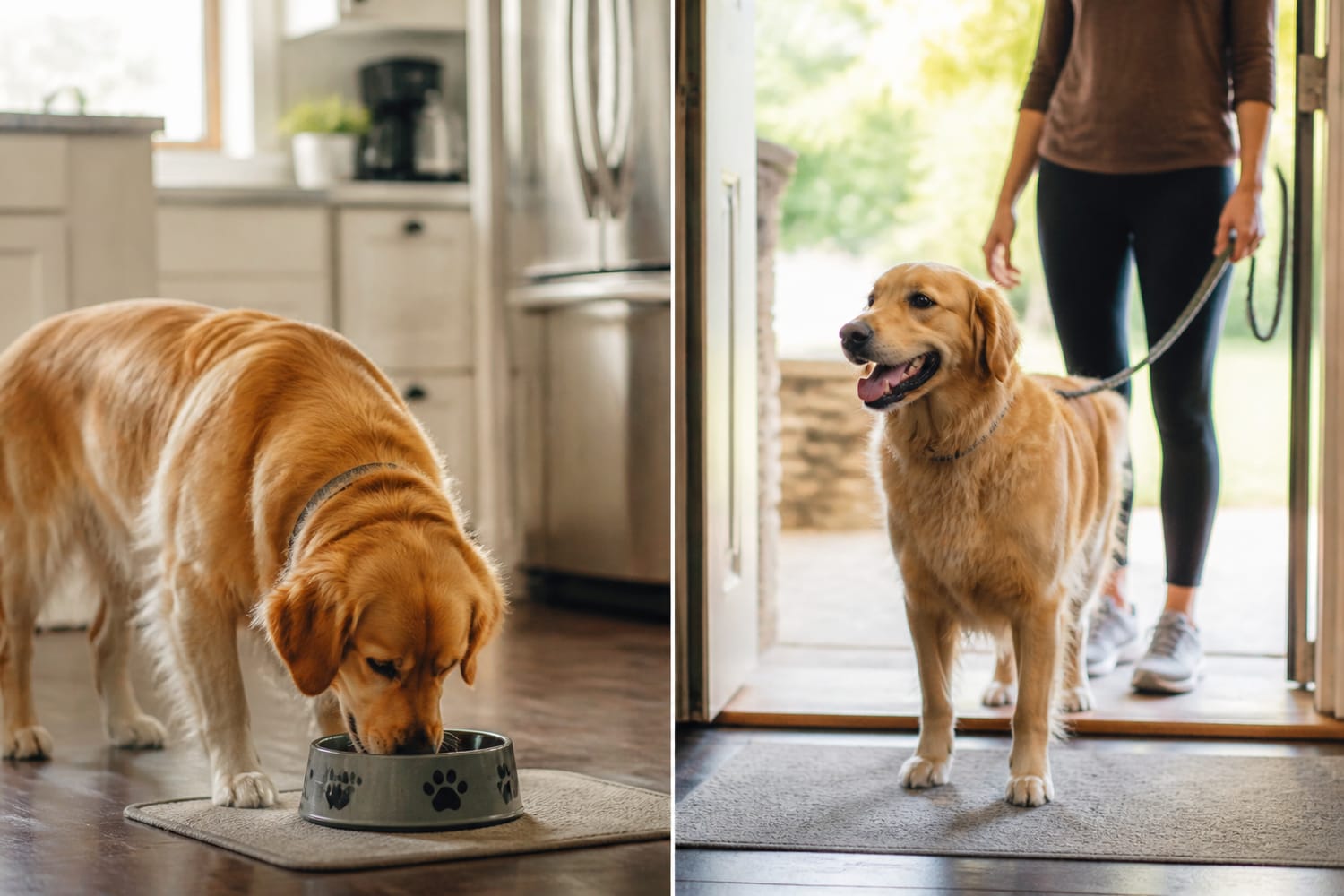
Should You Feed Your Dog Before or After a Walk?
For most healthy adult dogs, either order can work—the important thing is separating a full meal from strenuous exercise. A practical approach is to walk first, allow a calm recovery period, then feed. If your dog eats first, leave at least two hours before running or similarly vigorous activity.
Of course, “a walk” can mean anything from a gentle sniff around the yard to a hill-climbing adventure. Those activities deserve different planning. The aim isn’t a stopwatch-perfect schedule; it’s a comfortable routine that makes room for meals, movement, and well-earned snoozes.
Why Meal Timing Matters
Veterinary guidance commonly recommends limiting vigorous exercise around meals, particularly for dogs at increased risk of gastric dilatation-volvulus, or GDV. In this life-threatening condition, the stomach expands and twists, interfering with blood circulation and requiring emergency treatment.
That doesn’t mean a walk after dinner automatically causes trouble. GDV has no single known cause, and meal timing alone cannot prevent it. Breed, chest shape, family history, eating speed, and meal size are among the factors associated with risk. Think of sensible scheduling as one precaution—not a guarantee.
For everyday planning, the useful question is therefore less “Which must always come first?” and more “How can I keep energetic activity away from a full stomach?”
How Long Should You Wait Between Food and Exercise?
Different recommendations emphasize different waiting periods. One conservative framework, outlined in the American Animal Hospital Association’s guide to canine bloat, is to avoid strenuous activity for at least one hour before meals and two hours afterward. These are precautionary intervals, not a promise that every dog’s stomach is empty when the timer finishes.
If your dog eats before the walk
After a full meal, plan a quiet period before anything vigorous. Running, fetch, agility, rough play, and energetic off-leash outings belong outside that post-meal rest window. Blue Cross’s advice on running with your dog specifically recommends leaving at least two hours after a meal before running.
If breakfast comes first in your household, make the next part of the morning a relaxed one. You can pack bags, answer emails, or enjoy your own breakfast before heading out together.
If your dog walks before eating
Walking first can make it easier to separate exercise from food. After strenuous activity, allow at least an hour before feeding under the conservative framework above, and don’t treat the clock as permission to feed a dog who is still overheated or struggling to recover.
Keep the whole recovery period calm: coming home from a run and immediately starting a lively game in the yard defeats the purpose of the break.
A Potty Break Is Not a Workout
A necessary bathroom trip is different from a fitness walk. Puppies, in particular, often need to eliminate shortly after eating; VCA notes that this commonly happens within 10–15 minutes. You shouldn’t make a puppy hold on simply to satisfy a rule intended for strenuous exercise.
For those trips, aim for a brief, unhurried outing rather than a neighborhood adventure. Think toilet, gentle sniff, home—not racing, jumping, or wrestling with another dog. If your dog has a high GDV risk or specific activity restrictions, ask your veterinarian how to handle post-meal bathroom breaks.
It also helps to describe your dog’s outings accurately when seeking advice. “A walk” is vague; “ten minutes of slow sniffing” or “forty minutes of fast walking with hill climbs” gives your veterinary team something more useful to work with.
Build a Routine That Fits Your Household
Here are two illustrative schedules for a healthy adult dog. They show how to create separation, rather than prescribing the right routine for every pet.
Walk-first morning:
- Head out at 7:00 a.m.
- Return at 7:30 a.m. and begin a quiet recovery period.
- Offer breakfast at 8:30 a.m., provided your dog is comfortable and settled.
- Keep the next couple of hours free from energetic play.
Breakfast-first morning:
- Serve breakfast at 7:00 a.m.
- Keep the morning calm, with a brief bathroom trip if needed.
- Schedule the energetic outing for 9:00 a.m. or later.
Both examples build in the conservative one-hour-before and two-hours-after spacing for strenuous exercise. Adapt them with your veterinarian if your dog’s needs differ.
For help making mealtimes predictable, explore Petspiration’s guide to how feeding times affect behavior and digestion.
Meal Size and Eating Speed Matter, Too
A sensible schedule works best alongside sensible portions. Large meals, once-daily feeding, and rapid eating are associated with increased GDV risk. Veterinary recommendations for susceptible dogs commonly include dividing the daily food allowance into multiple smaller meals and keeping feeding time low-stress.
That means splitting the same daily allowance, not adding extra food. A suitable slow feeder may help a dog who bolts meals, while feeding pets separately can reduce competition. Petspiration’s guide to safe ways to slow down mealtime offers practical starting points.
What about treats on walks?
Small training rewards still count toward daily intake. You can reserve some of your dog’s usual food allowance for rewards, where appropriate, rather than treating every walk as an extra snack session. Our guide to balancing treats and meals without overfeeding explains how those little extras add up.
Keep Water Part of the Plan
Don’t confuse meal spacing with withholding water. Bring water on longer outings, offer drinking opportunities and rest breaks, and keep fresh water available at home. AAHA advises maintaining access to water while discouraging rapid consumption of very large quantities around meals; the goal is sensible hydration, not leaving a thirsty dog without a drink.
If your dog habitually gulps enormous amounts after exercise, discuss a hydration plan with your veterinarian rather than simply removing the bowl.
Some Dogs Need a Personalized Schedule
General advice needs adjusting for individual dogs:
- Puppies: Smaller, more frequent meals may suit their growing bodies better than an adult schedule.
- Dogs with diabetes: Food, insulin, and activity need a consistent, veterinarian-directed routine.
- Dogs with reflux or other medical conditions: Long gaps between meals may be inappropriate.
- Dogs at increased GDV risk: Large, deep-chested dogs and those with an affected close relative deserve an individualized prevention discussion.
For high-risk dogs, ask about preventive gastropexy, a procedure that attaches the stomach to the body wall to reduce the risk of twisting. It does not prevent the stomach from bloating. Cornell University’s explanation of GDV covers that important distinction.
Know When to Seek Emergency Help
Seek emergency veterinary care immediately if your dog develops repeated unsuccessful attempts to vomit, a swollen or painful abdomen, marked restlessness, excessive drooling, breathing difficulty, weakness, or collapse. These can be signs of GDV; don’t wait for every symptom or assume a small dog cannot be affected.
Knowing the warning signs is preparation, not a reason to fear every meal.
Make Room for Food, Fun, and Rest
You don’t have to choose “food first” or “walk first” forever. Choose the order that lets you keep full meals and strenuous activity comfortably separated, then tailor it to your dog with veterinary guidance.
A little planning leaves more room for the good stuff: interesting smells, happy companionship, satisfying meals, and a peaceful place to curl up afterward.