
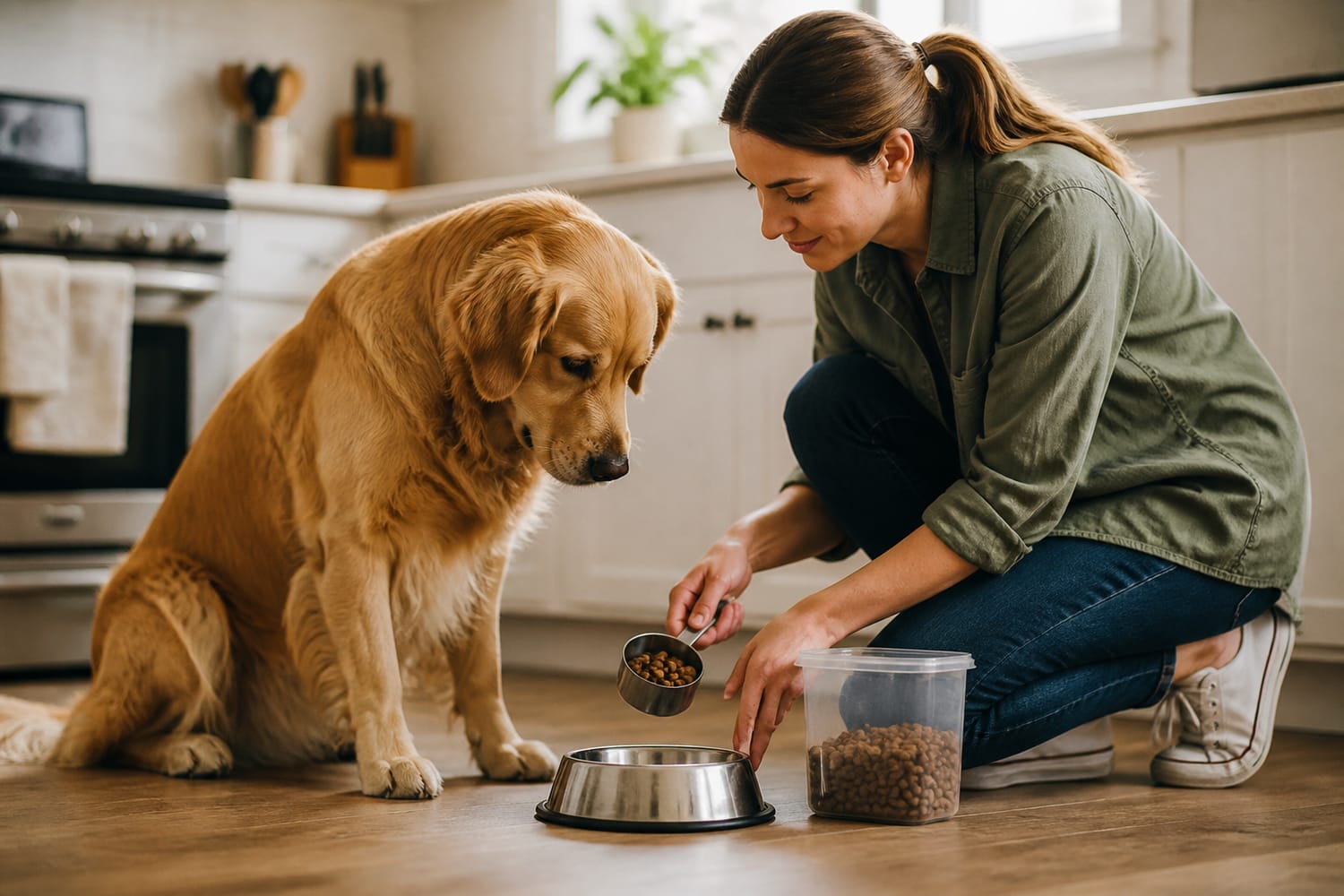
Start With Calories, Then Turn Them Into Portions
Calculating your pet’s food does not have to feel like advanced mathematics. For healthy adult dogs and cats, begin by estimating daily calorie needs, check the food label for calories per cup, can, pouch, or gram, and divide one number by the other. The result is a practical daily portion that you can adjust based on your pet’s weight and body condition.
A thoughtful feeding plan can support steady energy, comfortable movement, healthy growth, and many joyful years together. However, every pet is an individual. Calorie formulas provide a starting point—not an unchangeable prescription.
This guide focuses on healthy dogs and cats. Puppies, kittens, pregnant or nursing animals, highly athletic pets, and pets with medical conditions should have a feeding plan developed with a veterinarian.
Understanding Pet Food Calories
In pet nutrition, the word “calorie” usually refers to a kilocalorie, written as kcal. This is the same unit commonly shown as a capital-C “Calorie” on human food labels.
Pet food packaging may list energy in several ways:
- kcal per cup for dry food
- kcal per can or pouch for wet food
- kcal per treat
- kcal per kilogram of food
- Occasionally, kcal per gram
Look for a section labeled “Calorie Content.” Do not assume that two foods have similar calories simply because the portions look alike. One cup of a calorie-dense kibble might contain considerably more energy than one cup of another formula.
The World Small Animal Veterinary Association’s nutrition resources can also help pet owners understand food labels and make informed choices.
Step 1: Find Your Pet’s Weight in Kilograms
Veterinary calorie formulas generally use kilograms rather than pounds. To convert your pet’s weight, use this simple equation:
Weight in pounds ÷ 2.2 = weight in kilograms
For example, a 22-pound dog weighs approximately:
22 ÷ 2.2 = 10 kilograms
A 10-pound cat weighs approximately:
10 ÷ 2.2 = 4.5 kilograms
Use a recent, reliable weight. Holding a small pet while standing on a bathroom scale can provide a rough estimate, but a veterinary or pet scale is more precise.
If your pet is overweight, do not automatically use the current weight to create a restrictive weight-loss plan. Your veterinarian can identify an appropriate target weight and recommend a safe rate of loss.
Step 2: Calculate Resting Energy Requirement
A pet’s Resting Energy Requirement, or RER, estimates the calories needed for basic body functions at rest. It includes the energy required for processes such as breathing, circulation, temperature regulation, and digestion.
The standard formula is:
RER = 70 × body weight in kilograms^0.75
The small raised number means the weight is taken to the power of 0.75. A scientific calculator, spreadsheet, or veterinary calorie calculator can do this for you.
For pets weighing between 2 and 45 kilograms—approximately 4.4 to 99 pounds—a simplified formula may also be used:
RER = (30 × body weight in kilograms) + 70
For our 10-kilogram dog:
RER = (30 × 10) + 70
RER = 370 kcal per day
Using the more precise exponential formula gives approximately 394 kcal per day. Small differences between calculation methods are normal because both are intended to generate an initial estimate.
The Merck Veterinary Manual’s overview of small-animal nutrition explains both RER formulas and emphasizes that calorie estimates must be adjusted for the individual animal.
Step 3: Estimate Maintenance Energy Requirement
RER represents resting needs, but real pets do not spend their entire day resting quietly in a perfectly controlled environment. They play, explore, learn, exercise, and enthusiastically investigate mysterious kitchen sounds.
A Maintenance Energy Requirement, or MER, adjusts RER according to life stage, reproductive status, activity, and tendency to gain weight.
Common starting factors include:
Dogs
- Neutered healthy adult: 1.6 × RER
- Intact healthy adult: 1.8 × RER
- Obesity-prone adult: 1.4 × RER
- Puppy younger than four months: 3 × RER
- Puppy older than four months: 2 × RER
Cats
- Neutered healthy adult: 1.2 × RER
- Intact healthy adult: 1.4 × RER
- Obesity-prone adult: 1 × RER
- Kitten: approximately 2.5 × RER
Returning to our 10-kilogram neutered adult dog, and using the more precise RER of approximately 394 kcal:
394 × 1.6 = approximately 630 kcal per day
That means 630 kcal is a reasonable starting estimate—not a guarantee. Two pets of the same weight can have noticeably different calorie needs. According to the Merck Veterinary Manual, individual requirements can vary by roughly 30% above or below an estimate.
Growing animals need especially careful nutrition. Pet parents can learn more in Petspiration’s guide to life-stage nutrition for puppies and kittens.
Step 4: Convert Calories Into Food Portions
Once you have a daily calorie estimate, find the food’s calorie content and use this equation:
Daily calorie allowance ÷ calories per serving = servings per day
Suppose our example dog needs approximately 630 kcal daily and eats a dry food containing 360 kcal per cup:
630 ÷ 360 = 1.75 cups per day
If the dog eats two meals, divide the daily amount in half:
1.75 ÷ 2 = 0.875 cup per meal
In practical terms, that is about ⅞ cup at each meal. Weighing the serving in grams would make it easier to measure consistently.
For wet food, use calories per can or pouch. If a cat’s daily target is 260 kcal and each can contains 80 kcal:
260 ÷ 80 = 3.25 cans per day
When combining foods, count the calories from each one. For example, if half of a pet’s 400-calorie allowance comes from wet food, the wet portion should supply about 200 kcal. The remaining dry food should supply the other 200 kcal.
For additional practical context, see Petspiration’s portion guide for dogs and cats.
Remember Treats, Toppers, and Table Food
One of the most common feeding miscalculations is counting meals while overlooking everything offered between them. Dental chews, training rewards, food-filled toys, supplements, table scraps, and pill pockets all contribute calories.
A widely used guideline is to keep treats and other extras to no more than about 10% of daily calories. This leaves at least 90% for a complete and balanced diet that supplies essential nutrients.
For a dog receiving 630 kcal per day:
630 × 0.10 = 63 treat calories per day
Those calories can disappear quickly. Breaking treats into tiny pieces allows your pet to enjoy more rewarding moments without receiving a full treat each time.
If you use regular kibble for training, measure it from the day’s food allowance rather than adding it on top. Likewise, account for calorie-containing medications and food used in puzzle toys.
Watch the Pet, Not Just the Calculator
A successful feeding plan includes observation. Check your pet’s weight and body condition regularly, then adjust the daily amount when necessary.
At an ideal body condition, most dogs and cats should have:
- Ribs that are easy to feel beneath a light layer of fat
- A visible waist when viewed from above
- An abdominal tuck when viewed from the side
- Stable weight and healthy muscle condition
Fluffy coats can hide gradual weight gain, so use your hands as well as your eyes. Your veterinary team can show you how to assess a body condition score and explain whether your pet should gain, lose, or maintain weight.
After beginning a new portion, monitor your pet for two to four weeks. If an adult pet is gaining unwanted weight, the amount may need to be reduced slightly. If the pet is losing weight unexpectedly, constantly hungry, unusually tired, or experiencing vomiting or diarrhea, contact your veterinarian rather than making repeated large adjustments.
The AAHA guide to determining feeding amounts also highlights weight, age, activity, health, and food calorie density as important considerations.
Build a Routine You Can Maintain
Once you know the daily portion, decide how to serve it. Many adult dogs and cats do well with two or more measured meals, although individual needs vary.
A simple routine might include:
- Measure the entire day’s food each morning.
- Set aside any kibble that will be used for training.
- Divide the remaining food among scheduled meals.
- Record treats, chews, and toppers.
- Keep fresh water available.
- Recheck weight and body condition regularly.
In homes with several animals, feed separately when necessary to prevent food stealing and make intake easier to monitor. Petspiration’s guide to creating a feeding schedule for multi-pet households offers helpful strategies for keeping mealtimes peaceful and organized.
A Little Math Can Create a Healthier Future
Pet food math is ultimately an act of care. Start with a calorie estimate, translate it into a measured portion, include every treat, and pay attention to how your pet responds.
The goal is not mathematical perfection. It is a flexible, loving plan that helps your companion feel energetic, comfortable, and ready for the next walk, game, nap, or cuddle. With a calculator, a food label, and guidance from your veterinary team, every pet parent can turn a few simple numbers into a lifetime of nourishing choices.