
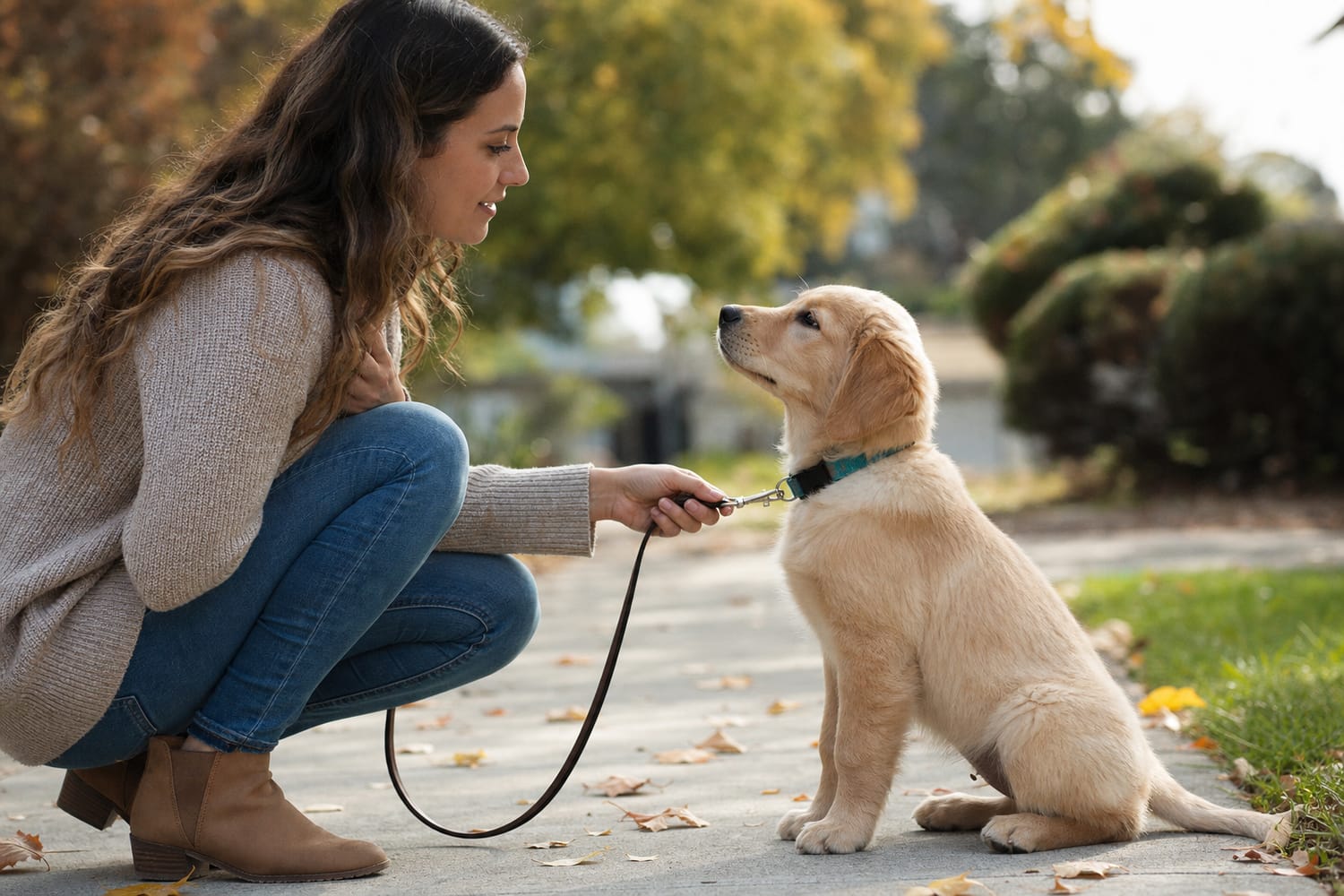
The Check-In Cue: A Small Look That Can Change Everything
Imagine walking your dog past a squirrel, inviting guests into your home, or asking your cat to move away from the kitchen counter without a chase. In that tiny moment before your pet reacts, there is an opportunity: a pause, a breath, a choice.
That is where the check-in cue shines.
A check-in cue teaches your pet to look at you before responding to something exciting, confusing, or stressful. It is not about controlling your pet through force. It is about building a communication habit: “When something happens, look to me. I’ll help you.”
For dogs, this might mean looking at you when another dog appears across the street. For cats, it may mean turning toward you when you call instead of bolting into a restricted room. For birds, rabbits, or other companion animals, it can become a gentle attention cue that helps redirect energy and prevent unwanted reactions.
At its heart, the check-in cue is a trust exercise. Your pet learns that paying attention to you is worthwhile, safe, and rewarding.
What Is a Check-In Cue?
A check-in cue is a trained behavior where your pet voluntarily makes eye contact or turns their attention toward you. It can be taught with a verbal cue such as “Look,” “Check in,” “Watch me,” or even your pet’s name.
The goal is not to demand intense staring or military-style obedience. In everyday pet life, a check-in can be as simple as:
- Your dog glancing at you before pulling toward another dog
- Your cat looking at you when you say their name
- Your puppy turning back to you when they hear a noise
- Your parrot pausing and orienting toward you before stepping away from a tempting object
This cue is especially helpful because many behavior challenges begin with a moment of emotional escalation. Your pet sees, hears, or smells something, and their brain says, “React now!” The check-in cue gently interrupts that pattern and gives them another option.
Instead of lunging, barking, chasing, jumping, swatting, or fleeing, your pet learns: “I can look at my person first.”
Why Looking at You Helps Your Pet Make Better Choices
Animals are constantly reading their environment. A dog may notice a skateboard long before you do. A cat may hear a visitor at the door before anyone knocks. A rabbit may sense a sudden movement and freeze.
When your pet checks in with you, several helpful things happen at once.
First, their focus shifts. Attention is powerful. A pet who is staring intensely at a trigger—like another animal, a moving bicycle, or a dropped piece of food—is more likely to react. When they look away from that trigger and toward you, the emotional intensity often decreases.
Second, your pet learns that you are a source of guidance. You become part of their decision-making process. This builds confidence, especially for pets who are nervous, impulsive, or easily overstimulated.
Third, the check-in creates a bridge to the next behavior. Once your pet looks at you, you can ask for something else: “Let’s go,” “Sit,” “Come,” “Touch,” or “Go to your mat.”
Finally, it strengthens your bond. Every successful check-in is a small conversation: “I noticed something.” “Thank you for telling me.” “Here’s what we’ll do next.”
Before You Begin: Set Your Pet Up for Success
The best training begins in an easy environment. If you start teaching the check-in cue in the middle of a busy dog park, a noisy street, or during a household commotion, your pet may be too distracted to learn.
Begin somewhere calm, such as:
- Your living room
- A quiet backyard
- A hallway
- A peaceful corner of the kitchen
- A familiar room with minimal distractions
Choose a reward your pet truly enjoys. For dogs, this may be soft treats, a favorite toy, praise, or a game of tug. For cats, try tiny bits of a favorite treat, a lickable snack, or a wand toy. For birds, use seeds, fruit pieces, head scratches if they enjoy them, or access to a fun activity.
The reward must matter to your individual pet. Training becomes joyful when your pet thinks, “Oh! I love this game.”
Keep sessions short. One to three minutes is enough for many pets, especially beginners. A few happy repetitions are more effective than a long session that ends in frustration.
Step One: Capture the Look
The easiest way to teach a check-in is to reward your pet when they naturally look at you.
Stand or sit near your pet with treats ready. Wait quietly. Do not repeat their name over and over. Do not wave food in their face. Just wait.
The moment your pet looks at your face, mark it with a cheerful word like “Yes!” or use a clicker if your pet is clicker trained. Then give the reward.
Repeat several times.
At first, your pet may glance at you by accident. That is perfectly fine. After a few rewards, many pets begin to figure out the pattern: “When I look at my person, good things happen.”
This is the foundation of the check-in cue. You are not forcing attention. You are making attention rewarding.
For pets who are shy or uncomfortable with direct eye contact, reward softer versions of the behavior. A head turn, ear flick, or brief glance in your direction can be enough. Some animals find staring stressful, so always respect your pet’s comfort level.
Step Two: Add a Cue
Once your pet is reliably looking at you during the game, add a cue.
Say your chosen word—such as “Look” or “Check in”—in a friendly tone. When your pet looks at you, mark the behavior and reward.
The sequence matters:
- Say the cue once.
- Wait for your pet to look.
- Mark with “Yes!” or a click.
- Reward.
Avoid repeating the cue many times. If your pet does not respond, the environment may be too distracting, the reward may not be valuable enough, or they may not fully understand yet. Simply make it easier and try again.
You can also practice using your pet’s name as a check-in cue. This is especially useful because many pet owners accidentally teach their pets to ignore their names by saying them constantly without consequence. Rebuilding name recognition with rewards can make everyday communication much clearer.
Step Three: Practice in Everyday Moments
After your pet understands the cue in a calm place, begin practicing in slightly more interesting situations.
Try asking for a check-in:
- Before opening the door
- Before putting down a food bowl
- Before tossing a toy
- During a quiet walk
- Before greeting a familiar person
- When your cat approaches a forbidden surface
- When your dog notices a bird from a distance
This teaches your pet that checking in is not just a living room trick. It is a life skill.
Be generous with rewards at this stage. You are building a habit that may later help your pet during big feelings. The stronger the reinforcement history, the more likely your pet is to choose you when the world gets exciting.
Step Four: Use the Cue Before Reactions Happen
The magic of the check-in cue is timing. It works best before your pet has fully reacted.
For example, if your dog is already barking and lunging at another dog, asking for a check-in may be too difficult. Their brain is already in reaction mode. Instead, look for the earlier signs:
- Ears forward
- Body stiffening
- Staring
- Tail changes
- Slowed movement
- Mouth closing
- Leaning toward something
- Sudden intense focus
That is your window.
Say your check-in cue while your pet is still able to think. When they look at you, reward them and create distance if needed. Distance is not failure—it is often the kindest, smartest training choice.
For cats, watch for early signs like tail twitching, crouching, fixated staring, or ears rotating. For birds, notice feather position, eye pinning, body posture, or increased vocalization. The better you become at reading your pet’s body language, the more effective your check-in cue will be.
What to Do After the Check-In
A check-in is not the end of the conversation. It is the beginning.
Once your pet looks at you, tell them what to do next. This helps prevent them from immediately returning to the trigger or temptation.
Good follow-up options include:
- “Let’s go” to move away
- “Touch” to target your hand
- “Find it” to sniff for treats on the ground
- “Sit” if your pet is comfortable doing so
- “Come” to move toward you
- “Go to mat” for indoor situations
- A toy toss or play cue to redirect energy
For nervous or reactive pets, movement away from the trigger is often more helpful than asking them to sit still. Think of the check-in as teamwork: your pet checks with you, and you help them succeed.
Common Mistakes and How to Avoid Them
One common mistake is practicing only when something difficult is happening. If your pet hears “Look” only when a scary dog, loud truck, or unwanted visitor appears, the cue may start to predict stress. Practice during happy, easy moments too.
Another mistake is holding food up to your face as a lure forever. Luring can help briefly, but the goal is for your pet to respond to the cue, not just follow food. Keep treats hidden in a pocket or pouch when possible, and reward after the look.
Some people accidentally punish the check-in by using it before something unpleasant. For example, calling your pet’s name, getting eye contact, and then immediately trimming nails or ending playtime may weaken the cue. If you need to do something your pet dislikes, balance it with plenty of positive practice.
Finally, avoid scolding your pet for failing. If they cannot check in, they are not being stubborn. They may be overwhelmed, undertrained in that environment, or too close to a trigger. Make it easier, increase distance, and reward small wins.
When to Get Extra Help
The check-in cue is powerful, but it is not a cure-all. If your pet shows serious fear, aggression, panic, or intense reactivity, consider working with a qualified positive-reinforcement trainer, certified behavior consultant, or veterinary behavior professional.
This is especially important if your pet has bitten, attacked, injured another animal, or becomes extremely distressed. Professional guidance can help you create a safe, humane plan tailored to your pet.
Training should never rely on fear, pain, intimidation, or devices used to punish behavior. Positive, science-based methods are safer and more effective for building trust and long-term behavior change.
The Bigger Lesson: “You Can Look to Me”
The check-in cue may seem small. A glance. A pause. A moment of eye contact.
But to your pet, it can mean something much bigger.
It means they do not have to face the world alone. It means that exciting things, scary things, and tempting things do not have to lead to chaos. It means they have a way to ask, “What now?” and you have a way to answer, “I’m here. Let’s do this together.”
With patience and practice, the check-in cue becomes more than a training tool. It becomes a shared language.
And one day, when your dog sees another dog and turns back to you, or your cat pauses at the doorway and looks up, or your bird shifts attention from mischief to your familiar voice, you will feel it: that beautiful spark of connection.
That is the heart of pet training—not control, not perfection, but partnership.