
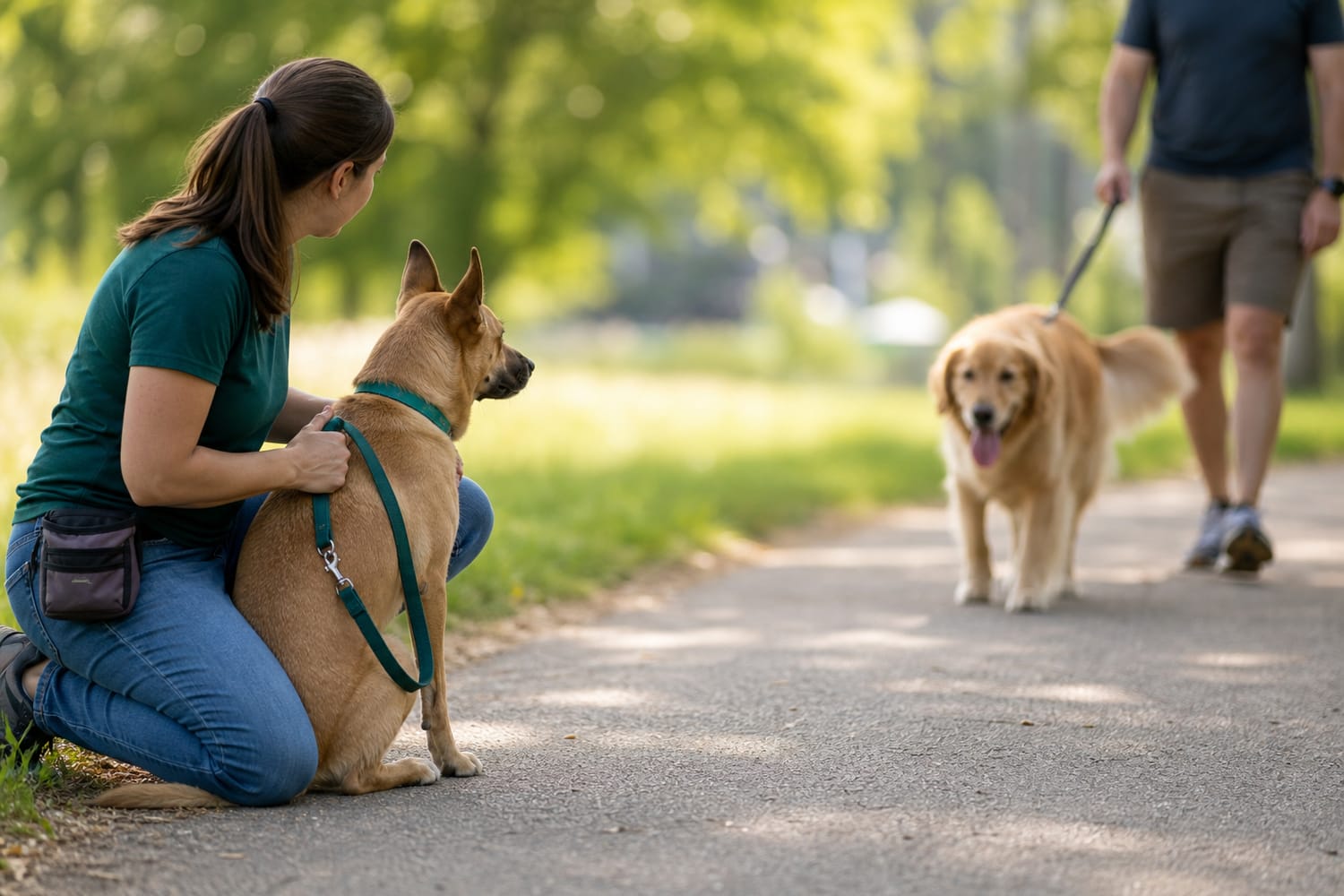
Understanding Reactivity: Your Dog Is Not “Bad”
If your dog barks, lunges, growls, spins, whines, or becomes impossible to reach when they see another dog, a jogger, a bicycle, a stranger, or even a squirrel, you may be living with a reactive dog. And if so, take a breath: you are not alone, and your dog is not “bad.”
Reactivity is an exaggerated response to something in the environment, often called a “trigger.” For some dogs, the trigger is other dogs. For others, it may be people in hats, delivery trucks, skateboards, children running, or wildlife. The behavior can look dramatic, but underneath it there is usually a dog who is overwhelmed, frustrated, frightened, overexcited, or unsure what to do.
A reactive dog is not trying to embarrass you. They are communicating in the only way they currently know how.
The good news? Calm focus can be taught. With patience, consistency, and kind training, many reactive dogs learn to notice triggers without exploding. They can learn to look back at you, take treats, move away calmly, and feel safer in the world.
This is not about “fixing” your dog’s personality. It is about helping your dog build emotional skills, just as we help people learn coping strategies when life feels too big.
What “Calm Focus” Really Means
Calm focus does not mean your dog must ignore the world completely. Dogs are curious, social, sensory-rich animals. They notice movement, smells, sounds, and body language far faster than we do.
Instead, calm focus means your dog can see a trigger and still stay connected to you. They may glance at another dog, then turn back toward you. They may notice a cyclist but keep walking. They may hear a loud truck and recover quickly instead of spiraling into panic.
Think of calm focus as a conversation:
Dog: “I see something!”
You: “Yes, I see it too. You’re safe. Let’s handle it together.”
Dog: “Okay, I can do that.”
This teamwork builds trust. Over time, your dog learns that triggers do not always predict chaos. They predict support, distance, food, movement, and safety.
Start With the Most Important Tool: Distance
Distance is your best friend when working with reactivity. Every dog has a “threshold,” which is the point where they can no longer think clearly or respond to cues. Below threshold, your dog can notice a trigger and still eat, listen, sniff, or move away. Over threshold, your dog may bark, lunge, ignore treats, pull hard, or seem unable to hear you.
Training happens below threshold.
If your dog reacts at 10 feet from another dog, start at 50 feet. If 50 feet is still too close, try 100 feet. There is no shame in needing more space. In fact, giving your dog enough distance is one of the kindest and smartest choices you can make.
A helpful way to think about distance is this: every calm glance at a trigger is a rep. Every successful moment teaches your dog, “I can see that and stay safe.” But every overwhelming encounter may reinforce the old emotional pattern.
This does not mean you must avoid the world forever. It means you are setting your dog up to succeed before gradually making things more challenging.
Learn Your Dog’s Early Warning Signs
Many people notice reactivity only when the barking starts. But dogs often show smaller signs first. Learning these subtle signals can help you intervene before your dog reaches the point of explosion.
Watch for:
- Stiff body posture
- Closed mouth after panting
- Ears forward or pinned back
- Hard staring
- Tail held high, tucked, or very still
- Slower movement or freezing
- Pulling toward or away from something
- Whining or huffing
- Refusing treats
- Sudden intense sniffing
- Scanning the environment
These signs are not “bad behavior.” They are information. Your dog is telling you, “I’m noticing something,” or “I’m getting uncomfortable.”
When you respond early, you become your dog’s trusted guide. Move away, scatter treats, change direction, or ask for an easy behavior your dog knows well. The earlier you help, the easier it is for your dog to stay calm.
Build a Foundation at Home First
Before expecting your dog to focus around triggers, practice focus where life is easy. Start at home, in the yard, or in a quiet area with few distractions.
Useful foundation skills include:
- Name recognition: Your dog turns toward you when they hear their name.
- Hand target: Your dog touches their nose to your hand.
- Find it: Your dog searches for treats tossed on the ground.
- Let’s go: Your dog turns and moves with you in another direction.
- Watch me: Your dog briefly makes eye contact.
- Mat training: Your dog relaxes on a bed or mat.
Keep sessions short and cheerful. Five minutes of successful practice is better than 30 minutes of frustration. Use treats your dog loves, especially when working around distractions. Kibble may work in the kitchen, but chicken, cheese, or soft training treats may be more motivating outdoors.
The goal is not robotic obedience. The goal is to create familiar patterns your dog can rely on when the world becomes exciting or stressful.
Use the “Look, Then Reward” Game
One of the most effective ways to help a reactive dog is to change how they feel about triggers. This is often done through counterconditioning and desensitization.
In simple terms:
- Desensitization means exposing your dog to a trigger at a low enough intensity that they can remain calm.
- Counterconditioning means pairing that trigger with something wonderful, usually food.
A beginner-friendly version is the “Look, Then Reward” game.
Here’s how it works:
- Stand far enough away from the trigger that your dog can notice it without reacting.
- The moment your dog looks at the trigger, calmly mark it with a word like “yes” or a clicker.
- Offer a treat.
- Let your dog look again.
- Mark and reward again.
At first, you are rewarding your dog simply for calmly noticing the trigger. Over time, many dogs begin to look at the trigger and then automatically turn back to their person, as if saying, “I saw it! Where’s my treat?”
That moment is gold. It means your dog is learning a new pattern.
Be careful not to wait for your dog to stare too long. A long, intense stare can quickly turn into a reaction. Mark early, reward generously, and keep the mood relaxed.
Make Walks Less Stressful With Smart Management
Training is important, but management is what keeps everyone sane while training is still in progress. Management means arranging your dog’s environment to reduce unwanted reactions and increase success.
Helpful management strategies include:
- Walking at quieter times of day
- Choosing wider paths or open spaces
- Crossing the street when needed
- Turning around before your dog reacts
- Using parked cars, bushes, or fences as visual barriers
- Avoiding narrow sidewalks if your dog struggles with close passes
- Driving to calmer walking spots
- Practicing in parking lots from a safe distance
- Using a secure harness and leash
Management is not failure. It is compassionate planning.
If your dog reacts to other dogs, you do not need to force sidewalk greetings. Many dogs do not enjoy meeting unknown dogs on leash, and that is perfectly okay. Your dog can live a rich, happy life without saying hello to every dog they see.
Teach an Emergency U-Turn
An emergency U-turn is one of the most useful skills for reactive dog guardians. It helps you quickly and happily move away from a trigger before your dog goes over threshold.
Start practicing in a quiet place.
Say a cheerful cue like “this way!” Then turn around, encourage your dog to follow, and reward them as they move with you. Make it fun. Use an upbeat voice. Treat several times as you walk away.
Practice until your dog hears the cue and happily spins with you. Then use it on walks when you spot a trigger before your dog becomes too tense.
The key is to avoid sounding panicked. If you gasp, tighten the leash, and rush away every time you see another dog, your dog may learn that triggers are scary. Instead, keep your tone light: “This way!” Then move with confidence.
Your dog does not need to know why you are turning. They only need to trust that following you pays well.
Reward the Behavior You Want More Of
It is easy to notice the barking, lunging, and chaos. But the real magic happens when you start noticing the tiny good choices.
Reward your dog when they:
- Glance at a trigger without barking
- Turn back toward you
- Sniff instead of stare
- Loosen their body
- Take a treat near a distraction
- Choose to move away
- Check in with you voluntarily
- Recover quickly after being startled
These moments may be small, but they are the building blocks of calmer behavior. Dogs repeat behaviors that work for them. If calm choices lead to safety, food, praise, and distance, your dog will be more likely to choose them again.
Remember: you are not bribing your dog. You are reinforcing emotional regulation and attention in a challenging environment.
Avoid Punishment-Based Methods
When a dog is barking or lunging, it can be tempting to use harsh corrections, leash pops, yelling, or tools designed to cause discomfort. But punishment can increase fear, frustration, and anxiety—especially if the reactivity is emotionally driven.
A dog who is punished for reacting may stop barking in the moment, but that does not mean they feel better. They may simply learn that triggers predict discomfort from both the environment and their handler. This can make the underlying emotion worse.
Positive, reward-based methods focus on changing how the dog feels and teaching them what to do instead. This approach builds trust rather than conflict.
You are not being “too soft.” You are being strategic, humane, and science-informed.
Know When to Get Professional Help
Some reactivity is mild and improves with thoughtful training. Other cases need professional support, especially if your dog has bitten, snaps, redirects onto the leash or handler, cannot recover after seeing triggers, or seems constantly anxious.
Look for a qualified force-free trainer, certified behavior consultant, or veterinary behaviorist. If anxiety is severe, a veterinarian can also discuss whether medical support may help alongside behavior modification.
Asking for help is not a sign that you have failed. It is a sign that you care deeply about your dog’s wellbeing.
Celebrate Progress, Not Perfection
Living with a reactive dog can be emotional. Some days you may feel proud and hopeful. Other days, you may take the long way home to avoid a trigger and wonder if anything is changing.
Progress is often not a straight line. Your dog may do beautifully on Monday and struggle on Tuesday. Weather, sleep, stress, hormones, pain, previous triggers, and even your own tension can affect how much your dog can handle.
So celebrate the small wins:
The first time your dog sees another dog and eats a treat.
The first calm check-in on a walk.
The first successful U-turn.
The first time they recover in seconds instead of minutes.
The first walk where you both come home relaxed.
These are not small things. They are signs of trust growing between you.
Your reactive dog is not a problem to be solved. They are a sensitive, feeling being who needs guidance, patience, and understanding. With time, you can become their safe place in a busy world.
And one day, you may find yourself walking together, noticing a trigger in the distance, feeling your dog glance up at you, and smiling because you both know what to do next.