
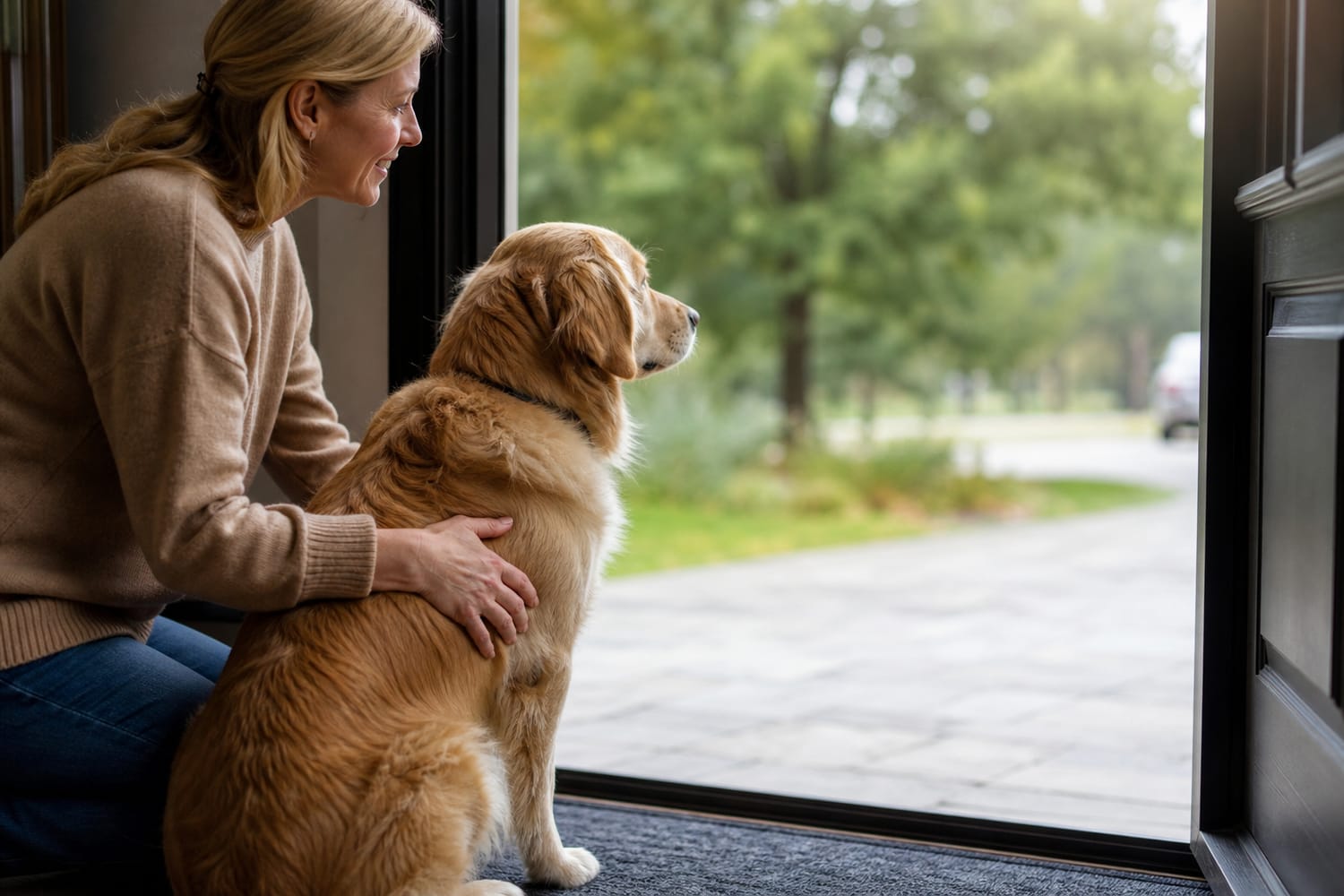
Why Door Dashing Happens
There’s a special kind of panic that hits when a dog slips through a front door, squeezes past a gate, or launches out of the car before you’re ready. One second they’re beside you, and the next they’re sprinting toward the sidewalk, driveway, neighbor’s yard, or parking lot.
Door dashing is common, and it does not mean your dog is “bad,” “stubborn,” or trying to disobey you. Most dogs dash because the world outside is exciting. There are smells to investigate, people to greet, squirrels to chase, and adventures calling their name. For some dogs, the open door itself becomes a powerful signal: “Go now!”
The good news? You can teach your dog a safer, calmer habit.
Instead of thinking of doorways, gates, and car doors as launch pads, your dog can learn that these places mean: pause, check in, and wait for permission. This skill is practical, lifesaving, and confidence-building—for both of you.
Safety Comes First: Manage Before You Train
Before training begins, it’s important to prevent rehearsals of the dashing behavior. Every time a dog successfully bolts through a doorway, the habit becomes stronger. Management is not “cheating”—it is smart, loving prevention.
Use barriers when possible, such as:
- Baby gates or exercise pens near entryways
- A leash before opening the front door
- A closed interior door before opening an exterior door
- A secure crate, harness, or seat belt in the car
- A fenced area with double-gate systems when available
If your dog has a history of bolting, clip the leash on before touching the doorknob, gate latch, or car door. If visitors are coming over, place your dog behind a gate, in another room, or on leash before the door opens.
Think of management as setting your dog up to win. You’re not relying on hope; you’re creating an environment where the safe choice is also the easy choice.
What “Wait” Really Means
“Wait” is different from “stay.” A stay usually means “hold this position until I return or release you.” Wait is more casual and practical. It means: pause here until I say you can move forward.
For doorways, gates, and cars, “wait” becomes a life skill. Your dog does not need to freeze like a statue forever. They simply need to stop moving forward and look for your next cue.
A release word tells your dog when waiting is over. Choose a word that feels natural, such as:
- “Okay”
- “Free”
- “Let’s go”
- “Release”
- “All done”
Try not to use your dog’s name as the release cue. We say our dogs’ names often, and you do not want them accidentally bursting through a door just because someone said, “Bella!”
Consistency matters. If “okay” means your dog may go through the doorway, use it the same way each time.
Start Small: Teach the Pause Indoors
Begin training in a low-distraction place inside your home. A hallway, bedroom doorway, or interior door is perfect. Starting at the front door, where excitement is high, may be too difficult at first.
Have your dog on leash and keep some small, tasty treats ready. The leash is not for pulling your dog back; it is simply a safety tool.
- Walk with your dog toward an interior doorway.
- Stop before the threshold.
- Say “wait” in a calm voice.
- If your dog pauses even briefly, mark the moment with “yes!” or a clicker.
- Give a treat.
- After a second or two, say your release cue, such as “okay,” and walk through together.
At first, reward the smallest success. If your dog stops for half a second, that counts! You can build duration later.
Keep sessions short and cheerful. Three to five minutes of focused practice is often better than one long session. Dogs learn beautifully when training feels like a game.
The Door Opens Only for Calm Choices
Once your dog understands the basic idea, you can add the door itself. This is where many dogs get excited, so move slowly.
Stand with your dog on leash near the door. Ask for “wait.” Touch the doorknob or handle. If your dog stays calm, mark and reward. If they surge forward, simply remove your hand from the knob and reset.
Next, turn the knob slightly. Reward calm behavior. Then open the door just an inch. Reward again. Gradually open it wider as your dog succeeds.
The key lesson is simple: calm waiting makes the door open; pushing forward makes the door close.
Avoid scolding or yanking the leash. Instead, let the environment teach the lesson. If your dog rushes, the exciting thing disappears. If your dog pauses, the exciting thing becomes available.
This method is kind and clear. Your dog learns, “My choices matter.”
Build Duration and Distractions Slowly
Once your dog can wait while the door opens, begin adding small challenges. You might:
- Open the door wider
- Step through first
- Pause for a few seconds before releasing
- Toss a treat behind your dog to reset
- Practice with mild outdoor sounds
- Practice when another family member walks by
Only make one part harder at a time. If you increase the time your dog waits, don’t also add a visitor at the door. If you practice near a busy street, make the wait short and easy.
Training works best when dogs are successful most of the time. If your dog keeps breaking the wait, the situation is probably too hard. Go back a step, reward generously, and rebuild.
For high-energy dogs, it can help to practice after a walk or play session. A dog with some wiggles already out of their system may find it easier to focus.
Practice at Gates and Yard Entrances
Gates are especially tempting because they often lead to the most exciting places: the yard, the park, the trail, or the world beyond the fence.
Use the same training pattern:
- Approach the gate on leash.
- Ask for “wait.”
- Touch the latch. Reward calm.
- Open the gate slightly. Reward calm.
- If your dog pushes forward, close the gate gently.
- Release your dog only when they are paused and attentive.
For safety, do not practice with an unsecured dog near an open gate. Even if your dog is usually reliable, use a leash until the behavior is strong.
If your home has a fenced yard, teach your dog that leaving the yard requires permission. This is especially useful when carrying groceries, taking out trash, greeting guests, or opening the gate for lawn care workers.
A reliable gate wait can prevent frightening escapes and gives your dog a wonderful habit: checking in with you before moving into a new space.
Teach Calm Exits from the Car
Cars add extra excitement. Many dogs love car rides, and arriving somewhere fun can make them burst with enthusiasm. But jumping out too soon can be dangerous, especially in parking lots, near roads, or in unfamiliar places.
Start by making the car a place of calm routine. Before opening the door or hatch, have your dog secured with a crate, car harness, or leash. Attach the leash before your dog has any chance to exit.
Then practice:
- Open the car door slightly.
- If your dog stays in place, reward.
- If they try to jump out, close the door safely and calmly.
- Open again when they settle.
- Give your release cue when you are ready for them to exit.
If your dog rides in a crate, ask for a wait before opening the crate door. If they use a harness seat belt, keep them clipped in until the leash is attached and you are ready.
Never let your dog leap from a high vehicle if it could strain their joints. Small dogs, senior dogs, puppies, and dogs with orthopedic concerns may need help getting in and out safely.
Make the Reward Worth It
Waiting at doors is hard for many dogs because the reward on the other side is huge. Outside smells, freedom, greetings, and adventure are powerful motivators.
Treats are helpful, especially during early training, but real-life rewards are just as important. The reward for waiting might be:
- Going outside
- Starting a walk
- Greeting a friend
- Getting into the yard
- Hopping out for a hike
- Moving forward with you
This is powerful because your dog learns that patience opens doors—literally.
Use high-value treats when distractions are high. Soft, small treats usually work well because dogs can eat them quickly and get back to learning. Praise, petting, toys, and sniffing can also be excellent rewards depending on what your dog loves.
What If Your Dog Is Too Excited to Listen?
Some dogs struggle more than others. Puppies, adolescent dogs, newly adopted dogs, herding breeds, sporting breeds, terriers, and highly social dogs may find doorways incredibly exciting. That does not mean they cannot learn—it simply means they may need more practice and better management.
If your dog is too excited, try these adjustments:
- Practice farther from the door first
- Use better treats
- Train after exercise
- Keep sessions shorter
- Reward eye contact and calm breathing
- Use a baby gate as an extra safety layer
- Lower the difficulty immediately after mistakes
If your dog barks, lunges, panics, or becomes frantic near doors, there may be anxiety, reactivity, or fear involved. In that case, consider working with a qualified positive-reinforcement trainer or veterinary behavior professional. Behavior support is not a last resort; it can be a gift to both you and your dog.
Add a “Back Up” Cue for Extra Safety
Another helpful skill is teaching your dog to move away from the door. A “back up” cue can be useful when you need space to bring in packages, welcome guests, or step through safely.
To teach it, stand facing your dog with a treat in your hand. Step gently toward them. Many dogs will naturally take a step backward. The moment they do, mark with “yes!” and reward. Add the cue “back up” once they understand the movement.
Eventually, you can ask your dog to back away from the door before you open it. Pair this with “wait” for a strong safety routine.
Create a Family Door Routine
Door training works best when everyone in the home follows the same rules. If one person asks the dog to wait but another lets them rush out, the lesson becomes confusing.
Create a simple household plan:
- Dog is leashed before exterior doors open
- Dog waits before going through doors and gates
- Dog exits the car only after the release cue
- Guests are told not to encourage rushing
- Children practice only with adult supervision
- Everyone uses the same release word
Post the release cue near the door if needed. Make it easy for the whole family to remember.
The more consistent your family is, the faster your dog will learn.
Celebrate Progress, Not Perfection
Teaching a dog to wait at doors, gates, and cars is not about controlling every move they make. It is about communication, teamwork, and safety. Your dog learns to pause and look to you. You learn to guide them with clarity and kindness.
There may be setbacks. A squirrel may appear. A visitor may knock. A car door may open at the most exciting trailhead in the world. That’s okay. Training is a journey, not a single perfect performance.
Celebrate the tiny wins:
- Your dog paused for one second
- They looked back at you
- They waited while the door opened halfway
- They stayed calm in the car
- They walked through the gate instead of blasting through
Each success builds the next.
With patience, practice, and positive reinforcement, your dog can learn that open doors are not invitations to bolt. They are moments to connect, breathe, and move forward together.
And that is the heart of great training: not just stopping an unwanted behavior, but building a safer, happier life side by side.