
Why Counter Surfing Happens
You turn your back for three seconds, and suddenly your sandwich has vanished. Your dog looks innocent, your cat is licking their whiskers, and the kitchen counter has become the scene of a tiny but memorable crime. Counter surfing and table stealing can be frustrating, but the good news is that these behaviors are not signs of “bad” pets. They are normal animal behaviors that have been rewarded—often accidentally.
For dogs and cats, counters and tables are exciting places. They smell like chicken, butter, toast, crumbs, coffee, lunchboxes, and all kinds of fascinating human things. If your pet jumps up and finds food even once, they learn a powerful lesson: “Checking high places might pay off.”
That is why counter surfing can become a habit so quickly. It works. Your pet does not need to find food every time. The occasional jackpot—a slice of pizza, a piece of toast, a dropped fork with gravy on it—is enough to keep them trying.
Positive training focuses on two goals: preventing your pet from practicing the unwanted behavior, and teaching them what to do instead. Rather than scolding, frightening, or punishing, we guide them toward choices that are safer, calmer, and easier for everyone to live with.
Start with Management: Set Your Pet Up for Success
Before training begins, management is your best friend. Management means changing the environment so your pet cannot rehearse the behavior while they are still learning. Think of it like putting guardrails on a mountain road. You are not expecting perfection right away—you are making the journey safer.
Start by clearing counters and tables whenever possible. Put food away immediately, wipe surfaces, and move tempting items like bread bags, fruit bowls, butter dishes, and dirty plates out of reach. Push chairs in so they cannot be used as stepping stones. For very determined pets, baby gates, closed doors, crate time, playpens, or a separate cozy room during meal prep can help.
This is especially important when you are not actively supervising. If your dog has access to the kitchen while you are in another room, they may be rewarded before you even know anything happened. Cats may need different management strategies, such as covering food, using cabinets with child locks, or creating vertical spaces they are allowed to explore.
Management is not “cheating.” It is part of effective training. Every time your pet does not get rewarded for counter surfing, the habit becomes weaker. Every time they are rewarded for a better behavior, the new habit becomes stronger.
Understand the Reward: Food, Attention, and Adventure
Food is usually the biggest reward behind table stealing, but it is not the only one. Some pets love the attention they get when they grab something. If every stolen napkin leads to people shouting, chasing, and laughing, the game may become very exciting.
Other pets are curious explorers. A counter may smell like a story: groceries were unpacked here, dinner was prepared here, someone spilled yogurt here this morning. Even if there is no visible food, the scent can be rewarding.
This matters because different motivations may need slightly different solutions. If food is the main reward, keep surfaces clean and teach a strong alternate behavior. If attention is part of the fun, avoid dramatic reactions and calmly trade for a treat when needed. If curiosity drives the behavior, provide legal enrichment: puzzle feeders, sniffing games, climbing shelves for cats, chew toys, lick mats, or food scatter games.
The goal is not to remove joy from your pet’s life. It is to give them better, safer ways to enjoy it.
Teach an Alternate Behavior: “Go to Your Mat”
One of the most useful behaviors for counter surfing and table stealing is “go to your mat.” This gives your pet a specific job during high-temptation moments like cooking, serving dinner, packing lunches, or clearing the table.
Choose a comfortable mat, bed, towel, or blanket. Place it somewhere your pet can see you but is not underfoot. Then begin training when there is no food on the counter and the environment is calm.
First, toss a treat onto the mat. When your pet steps on it, praise warmly. Toss another treat. Repeat until they begin moving to the mat happily. Next, wait for them to step onto the mat on their own, then reward. Gradually add a cue like “mat,” “place,” or “settle” right before they go.
Once they understand the idea, build duration. Reward them for staying on the mat for one second, then three seconds, then five. Keep it easy and cheerful. If they get up, simply guide them back or reset the exercise. No scolding needed.
After practice, start using the mat during real-life moments. While you prepare food, occasionally deliver treats to the mat. At first, reward often. Over time, you can reward less frequently, but do not be too quick to stop. Staying calmly on a mat while delicious smells fill the room is a big ask!
For dogs, a mat behavior can become a wonderful family routine. For cats, a designated perch or “station” can work similarly. Many cats enjoy learning to sit on a stool, cat tree, or shelf while you cook, especially when reinforced with small treats or praise.
Reward Four Paws on the Floor
Another simple and powerful strategy is to reward your pet for keeping their paws on the floor. Too often, we only notice when they jump up. Instead, start noticing the quiet, polite moments.
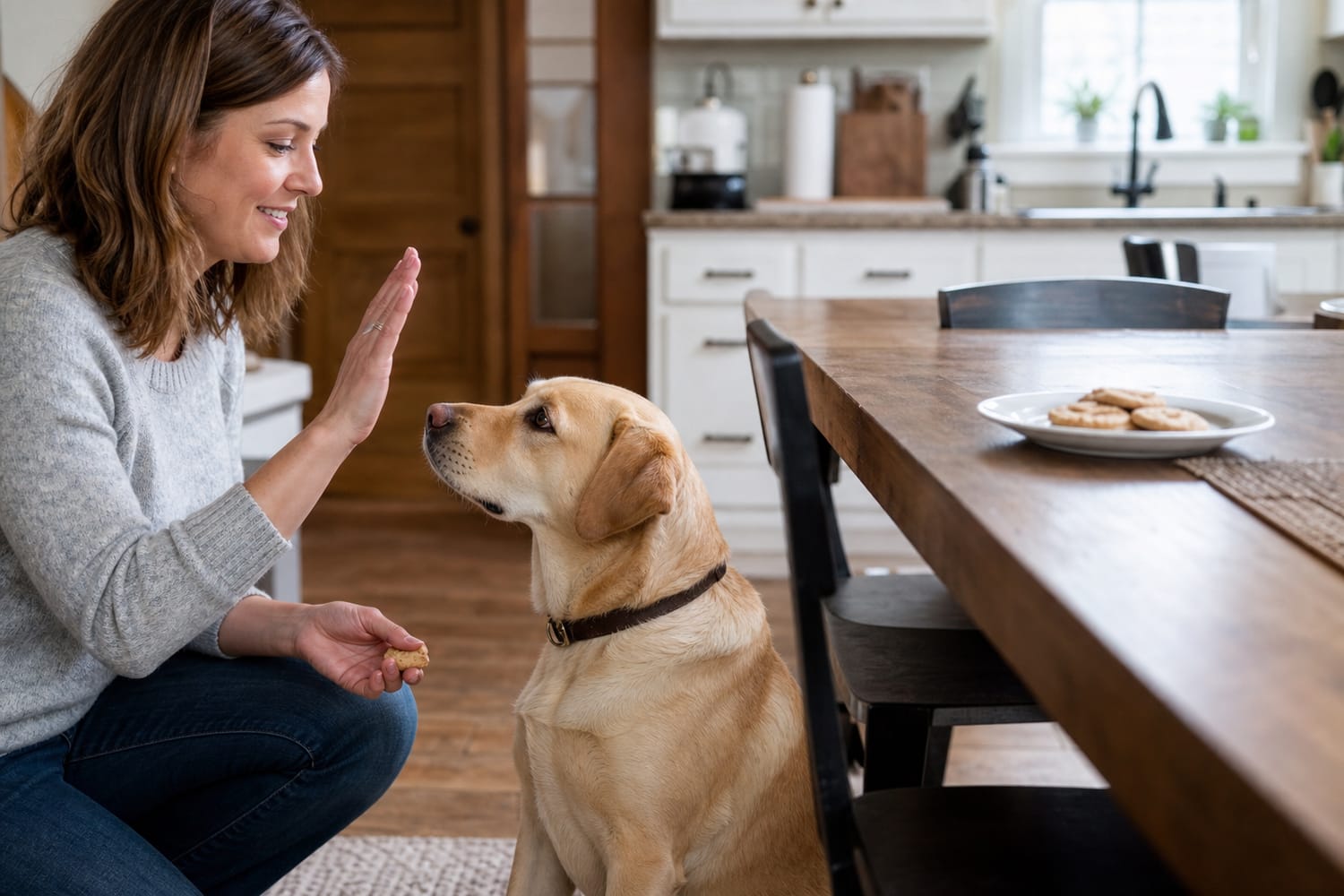
If your dog walks into the kitchen and remains on the floor, calmly say “yes” or use a clicker if they know one, then give a treat on the ground. If your cat sits near the table instead of leaping onto it, reward them in that location. The message is clear: good things happen down here.
This works best when you reward before your pet makes a mistake. If you wait until they are already thinking about jumping, you may be too late. Watch for the moment they choose calm behavior and reinforce it.
You can also scatter a few treats on the floor away from the counter while you cook. This encourages sniffing and searching, which are naturally calming behaviors for many pets. Just be sure the treats are pet-safe and appropriate for their diet.
Teach “Leave It” and “Drop It” Kindly
“Leave it” and “drop it” are helpful safety skills, especially if your pet grabs something dangerous like cooked bones, chocolate, grapes, onions, medication, or sharp packaging. These cues should be taught positively, not through intimidation.
To teach “leave it,” start with a low-value item in your closed hand. Let your pet sniff. The moment they back away or stop trying to get it, mark with “yes” and reward from your other hand. Practice until they understand that ignoring the item earns something better. Gradually work up to visible treats on the floor, then more realistic distractions.
To teach “drop it,” offer your pet a toy. When they have it in their mouth, present a tasty treat near their nose. When they release the toy, say “drop,” mark, reward, and give the toy back when appropriate. This teaches them that dropping things does not mean the fun always ends.
These cues should feel like promises, not threats. “Leave it” means, “You’ll get something better if you ignore that.” “Drop it” means, “Let go, and good things happen.” When your pet trusts the trade, they are far more likely to cooperate when it counts.
Make Mealtimes Easier for Everyone
Family meals can be one of the hardest times to prevent table stealing. Food is within reach, people are distracted, and children may accidentally drop tasty treasures. With a plan, mealtimes can become calmer.
Before you sit down, decide where your pet should be. Maybe your dog rests on a mat with a chew. Maybe your cat has a perch across the room. Maybe your pet stays behind a baby gate with a food puzzle. Choose an option that works for your household.
If you have children, include them in the training in age-appropriate ways. They can help put plates away, push in chairs, or toss treats to the dog’s mat with adult guidance. Teach children not to tease pets with food and not to pull items from a pet’s mouth. Safety and kindness go together.
It can also help to feed your pet before your meal or provide a long-lasting activity during dinner. A stuffed food toy, lick mat, snuffle mat, or appropriate chew can give them something satisfying to do while you eat.
What to Do When Stealing Happens
Even with a great plan, mistakes happen. Someone leaves a plate unattended, a guest forgets the rules, or your pet has a particularly clever moment. When stealing happens, stay calm.
If the item is not dangerous, avoid yelling or chasing. Instead, make the environment less exciting. If needed, call your pet away cheerfully and reward them when they come. If they have something you need back, trade for a high-value treat.
If the item is dangerous, act quickly but calmly. Offer a trade, block access if safe, and contact your veterinarian or an emergency vet if your pet may have eaten something toxic or harmful. Keep poison control numbers available, especially in homes with curious pets.
Afterward, think like a trainer, not a judge. Ask: How did my pet get access? What can I change next time? Do we need more mat training, better cleanup, or a baby gate during dinner?
Every mistake is information. Use it to improve the plan.
Avoid Punishment and Scare Tactics
It may be tempting to shout, spray water, rattle cans, or use shock or motion-activated punishers. These methods can sometimes suppress behavior temporarily, but they often create new problems. Pets may become anxious, afraid of the kitchen, fearful of people, or sneakier about stealing when no one is watching.
Positive training is not about letting pets “get away with it.” It is about teaching clearly, preventing rehearsal, and building trust. A pet who understands what to do instead is easier to live with than a pet who is simply afraid to make a mistake.
Punishment also does not teach your pet that counters are always off-limits. It may only teach them not to jump up when you are nearby. Management and reinforcement are more reliable because they change both the environment and the behavior.
Add Enrichment to Reduce Food-Seeking
Some counter surfing is made worse by boredom, excess energy, or unmet needs. A pet who spends the day with little to do may be more likely to invent hobbies, and “counter detective” is a very rewarding hobby.
Daily enrichment can help. Dogs often benefit from sniff walks, training games, fetch, tug, food puzzles, and safe chewing. Cats need play that mimics hunting: stalking, chasing, pouncing, and catching. Wand toys, treat hunts, puzzle feeders, climbing trees, and window perches can make a big difference.
Enrichment does not need to be complicated. Hide a few treats around a room. Let your dog sniff on walks instead of rushing. Rotate toys so they feel new. Teach a trick. Use part of your pet’s meal in a puzzle feeder.
A fulfilled pet is not automatically perfect, but they are often calmer, happier, and easier to train.
Celebrate Progress, Not Perfection
Stopping counter surfing and table stealing takes patience, consistency, and teamwork. The behavior may not disappear overnight, especially if your pet has had many delicious successes in the past. But every small win matters.
Celebrate the first time your dog stays on their mat while you butter toast. Celebrate when your cat chooses their perch instead of the counter. Celebrate when your pet responds to “drop it,” walks away from the table, or keeps four paws on the floor while dinner is served.
Training is a conversation. With positive methods, you are telling your pet, “I will help you succeed. I will show you what works. I will keep you safe.” In return, your pet learns to trust your guidance.
Counter surfing may begin with stolen snacks, but the solution can become something much bigger: better communication, calmer routines, and a stronger bond with the animal you love. With management, enrichment, and kind training, your kitchen and dining table can become peaceful places again—no sandwich security system required.