
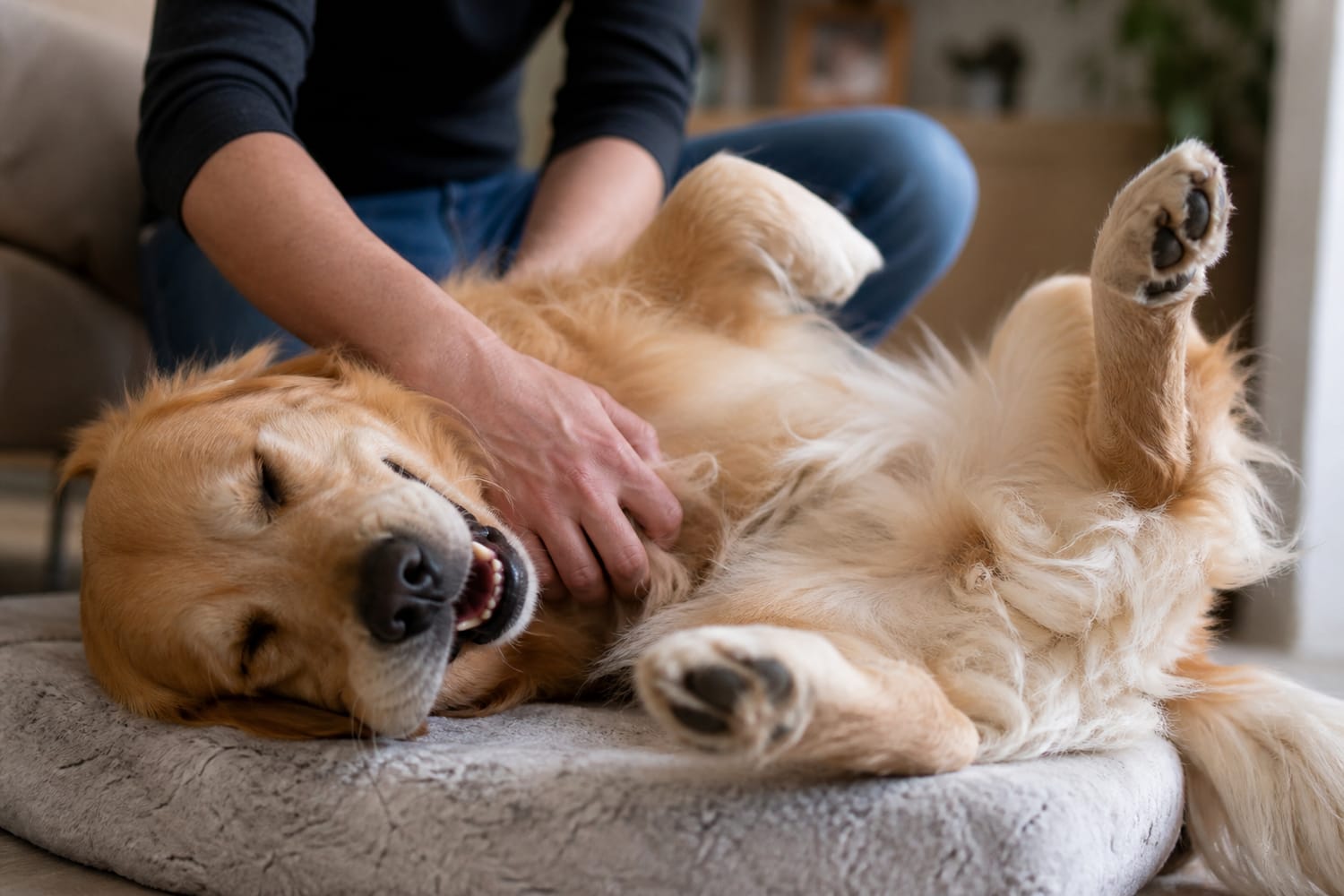
The Little Leg Kick That Makes Dog Lovers Smile
If you’ve ever found that magical patch on your dog’s belly, side, or chest and watched their back leg start thumping like a tiny drumstick, you’ve witnessed one of the most charming quirks in the canine world. Many pet parents call it the “sweet spot,” and it can look as if your dog is dancing, laughing, or saying, “Yes, right there!”
But what’s really happening when dogs kick their legs during a scratch?
The answer is a fascinating mix of biology, instinct, and the wonderfully sensitive nervous system that helps dogs navigate the world. While it may seem like a voluntary expression of joy, that rhythmic kicking is usually an automatic response known as the scratch reflex.
And yes, it’s completely normal.
Understanding this adorable behavior can help us appreciate our dogs even more. It also helps us learn the difference between a happy scratch session and a moment when our pup may actually be feeling overstimulated or uncomfortable.
What Is the Scratch Reflex?
The scratch reflex is an involuntary movement triggered when certain nerves under your dog’s skin are stimulated. These nerves send a message to the spinal cord, which then sends a message back to the muscles in the leg, causing the kicking motion.
In other words, your dog doesn’t necessarily decide to kick. Their body simply responds.
This reflex is similar to the way your own leg might jump when a doctor taps your knee with a reflex hammer. You are not consciously choosing to move your leg; your nervous system is reacting automatically.
For dogs, the scratch reflex most often happens when you rub or scratch areas such as:
- The belly
- The sides of the torso
- The chest
- The area near the ribs
- The “saddle region,” which includes parts of the back and flanks
These areas contain networks of nerves that are especially responsive to touch. When you hit just the right spot, the nerves activate the reflex, and that famous leg-kicking begins.
Why Do Dogs Have This Reflex?
The scratch reflex is not just a cute party trick. It likely developed as a protective mechanism.
In the wild, dogs and their ancestors had to deal with irritating or potentially harmful things on their skin, including insects, burrs, parasites, and other annoyances. If something tickled, bit, or crawled across a sensitive part of the body, the scratch reflex could help the animal react quickly.
That quick leg movement might dislodge a bug, scratch an itch, or draw attention to an irritated spot.
So when you scratch your dog’s sweet spot and their leg starts going, their body may be responding as if something on the skin needs to be removed. Even though your hand is loving and gentle, the nervous system is simply doing what it was designed to do.
This is one of the many ways dogs remind us that they are both beloved family members and amazing animals with instincts shaped by thousands of years of survival.
Are Dogs Ticklish?
Many people wonder if the scratch reflex means their dog is ticklish. The answer is: sort of, but not exactly in the human sense.
Humans experience tickling in two main ways. One kind is light skin stimulation, like a feather brushing your arm. The other is the laughter-producing tickling that often happens when someone pokes your ribs or feet. Dogs do react to certain touch sensations, but we can’t know whether they experience “ticklishness” the same way humans do.
When your dog kicks their leg, it doesn’t automatically mean they think it’s funny. It means a nerve pathway has been triggered.
That said, many dogs do seem to enjoy gentle scratching in their favorite spots. They may lean into your hand, wag their tail softly, relax their face, or roll over to invite more attention. Other dogs may kick their leg but show signs that they are not actually enjoying it.
The key is to read the whole dog, not just the kicking leg.
How to Tell If Your Dog Is Enjoying It
Because the scratch reflex is involuntary, the leg kick alone is not proof that your dog wants the scratching to continue. Some dogs love it. Others tolerate it. A few may find it annoying or overstimulating.
Look for relaxed, happy body language, such as:
- A loose, wiggly body
- Soft eyes
- A relaxed mouth
- Gentle tail wagging
- Leaning into your hand
- Rolling over comfortably
- Staying nearby when you pause
These signs suggest your dog is enjoying the interaction.
On the other hand, your dog may be asking you to stop if you notice:
- Stiff body posture
- Turning their head away repeatedly
- Lip licking
- Yawning when not tired
- Whale eye, where the whites of the eyes show
- Moving away
- Tucking the tail
- Growling or snapping
A loving scratch should feel good for both of you. If your dog seems unsure, stop for a moment and let them choose whether to come back for more.
One wonderful approach is the “consent test.” Scratch for a few seconds, then pause. If your dog nudges your hand, leans in, or stays relaxed, they may be asking for more. If they walk away, let them. Respecting your dog’s preferences builds trust and makes your bond even stronger.
Why Some Dogs Kick More Than Others
Not all dogs have the same reaction when scratched. Some kick wildly the moment you touch their belly. Others barely react at all. Both can be perfectly normal.
Several factors may influence how strongly a dog responds:
Individual sensitivity: Just like people, dogs vary in how sensitive they are to touch. Some have highly reactive nerve endings, while others are less responsive.
Coat type and skin thickness: Dogs with thinner coats or more exposed skin may react differently than dogs with thick double coats.
Age: Puppies may be wiggly and sensitive, while older dogs may respond less intensely. However, senior dogs can still have strong reflexes.
Breed and body shape: There is no single “leg-kicking breed,” but anatomy and sensitivity can vary among dogs.
Mood and environment: A relaxed dog may enjoy a scratch more, while a stressed or distracted dog may be less tolerant of touch.
Past experiences: Dogs who have had positive handling experiences may be more comfortable with belly rubs and scratches. Dogs with painful or frightening experiences may be more cautious.
The important thing is not whether your dog kicks dramatically, but whether they feel safe and loved during the interaction.
Is the Sweet Spot Always on the Belly?
The belly gets most of the attention, but the sweet spot can be in different places depending on the dog. Some dogs kick when scratched on the side of the ribcage. Others respond when you rub near the shoulder, chest, or flank.
The “sweet spot” is simply an area where touch stimulates the right nerves to trigger the reflex.
However, it’s worth remembering that a dog’s belly is a vulnerable area. When a dog rolls over, it does not always mean, “Please rub my belly.” Sometimes it means, “I’m being submissive,” “I’m unsure,” or “I’m trying to show I’m not a threat.”
A dog who truly wants a belly rub will usually appear loose and comfortable. A dog who rolls over stiffly, avoids eye contact, or tucks their tail may need space instead of scratches.
Pet lovers often want to shower dogs with affection, but the most loving thing we can do is listen to their body language.
When Leg Kicking Could Signal a Problem
Most of the time, leg kicking during scratching is harmless and normal. But there are situations where extra scratching, twitching, or sensitivity may point to a health issue.
You may want to check in with your veterinarian if your dog:
- Scratches, licks, or chews themselves frequently
- Has red, flaky, swollen, or irritated skin
- Has bald patches or hot spots
- Seems painful when touched
- Suddenly becomes sensitive in an area
- Has fleas, ticks, or signs of parasites
- Has a bad odor from the skin or ears
- Kicks, twitches, or spasms without being touched
- Shows changes in walking, posture, or mobility
Skin allergies, flea bites, mites, infections, dry skin, and nerve problems can all cause discomfort. Dogs are often brave and may hide pain, so small changes in behavior can be meaningful.
If your dog has always kicked when you scratch one spot, that is usually nothing to worry about. But if the reaction is new, intense, or paired with discomfort, a veterinary visit is the best way to keep your pup healthy.
The Science Behind the Snuggles
One of the loveliest things about the scratch reflex is that it shows how closely connected dogs are to their environment. Their skin, nerves, muscles, and instincts all work together to help them respond quickly to the world.
But there’s also an emotional side to scratching and petting.
Gentle touch can be calming for many dogs. It may help them relax, feel secure, and enjoy bonding time with their favorite humans. For people, petting a dog can also reduce stress, encourage mindfulness, and create a sense of companionship.
That means a simple scratch on the couch after a long day can be more than a cute moment. It can be a tiny ritual of trust.
Your dog may not understand the science behind their thumping leg, but they understand your presence. They understand your gentle hands, your familiar voice, and the comfort of being close to someone they love.
How to Give the Best Scratch Sessions
If your dog enjoys being scratched, you can make the experience even better by keeping it gentle, respectful, and relaxed.
Try these pet-friendly scratch-session tips:
- Use light to moderate pressure rather than rough rubbing.
- Watch your dog’s body language throughout.
- Avoid poking or scratching too hard.
- Pause often to see if your dog wants more.
- Keep sessions short if your dog gets overstimulated.
- Avoid sensitive or painful areas.
- Teach children to pet gently and stop when the dog moves away.
It’s also helpful to remember that every dog has unique preferences. Some love energetic scratches. Others prefer slow strokes. Some want belly rubs. Others prefer a calm hand resting on their chest.
The best pet parents become students of their own dogs. They notice the happy wiggles, the sleepy sighs, and the little signals that say, “That feels nice.”
A Small Reflex With a Big Message
Dogs kick their legs when you scratch the sweet spot because of an automatic scratch reflex controlled by the nervous system. It’s a normal, natural response that likely helps protect dogs from irritants on the skin.
But to pet lovers, it often feels like something more.
It’s one of those everyday moments that makes life with dogs so joyful: the thump-thump-thump of a back leg, the goofy expression, the shared laughter, the reminder that our companions are full of fascinating little mysteries.
As long as your dog is relaxed and enjoying the attention, that sweet-spot scratch can be a beautiful bonding experience. Just remember to watch their signals, respect their comfort, and celebrate the wonderful science behind the snuggles.
Because sometimes, the smallest kick of a paw can remind us how lucky we are to love a dog.