
Why Cats Slow-Blink at You: The Science Behind This Feline Love Signal
What Does It Mean When a Cat Slow-Blinks at You?
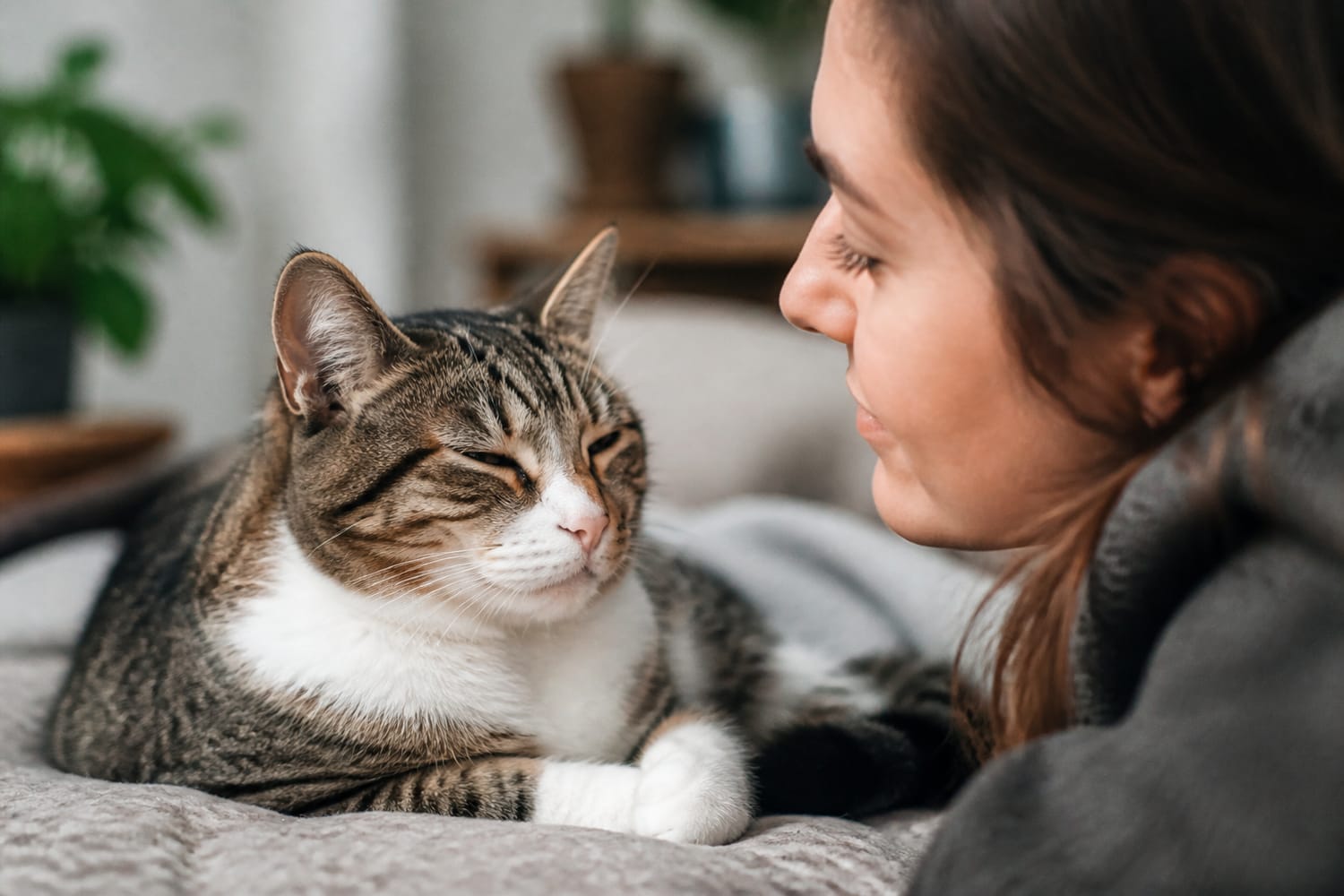
A cat’s slow blink is generally a positive social signal associated with calmness, trust, and friendly interaction. Research shows that cats often narrow their eyes in response to people who slow-blink at them and may become more willing to approach afterward. It is not a literal kiss, but it may be one of the closest feline equivalents.
Cats may not express affection as obviously as many dogs do, but that does not make their communication any less meaningful. Instead, they often speak through small movements: a raised tail, a gentle head bump, relaxed whiskers, or a peaceful narrowing of the eyes.
When your cat looks at you and slowly closes and reopens those beautiful eyes, you may be witnessing a quiet moment of connection between two species.
What a Cat Slow Blink Looks Like
A slow blink is different from an ordinary blink, which is usually quick and functional. A typical slow-blink sequence may include several half-blinks, a gradual narrowing of the eyes, and sometimes a complete eye closure lasting a brief moment.
You might notice your cat:
- Looking toward you with a soft, relaxed expression
- Partially lowering the eyelids
- Closing the eyes slowly rather than snapping them shut
- Keeping the eyes narrowed for a moment
- Reopening them gently or looking slightly away
The rest of the cat’s body is important too. A friendly slow blink commonly appears alongside a loose posture, neutral or forward-facing ears, relaxed facial muscles, and an unruffled coat.
A slow blink is therefore more than an eyelid movement. It is part of a complete expression that can suggest, “I feel comfortable right now.”
The Science Behind the Feline “Love Signal”
For years, cat lovers described slow blinks as “cat kisses.” In 2020, researchers investigated whether this familiar behavior really plays a role in communication between cats and people.
The resulting study of eye narrowing in cat-human communication involved two experiments. In the first, cats produced more half-blinks and eye-narrowing movements when their owners slow-blinked at them than when the owners were present but did not interact with them.
In the second experiment, cats responded to slow blinks from an unfamiliar researcher. Afterward, they had higher approach scores when the researcher offered a hand than they did following a neutral facial expression. This suggests that a human slow blink can help create a more positive social interaction—even when the person is not the cat’s owner.
The researchers concluded that slow-blink sequences may function as a form of positive emotional communication between people and cats. However, science has not proved that every slow blink means “I love you.” Affection is a human interpretation of a signal that more cautiously appears to communicate friendliness, relaxation, or positive intent.
Why Might Slow Blinking Feel Friendly to Cats?
Cats are both predators and potential prey animals. Their survival depends partly on carefully observing eyes, posture, movement, and attention. A fixed stare can feel intense in many situations, especially when it comes from an unfamiliar person or animal.
Slowly narrowing or briefly closing the eyes creates a very different impression. It interrupts the stare and may make the interaction seem less confrontational. Closing the eyes also temporarily reduces visual awareness, so doing it in another individual’s presence may be associated with feeling sufficiently secure to relax.
Researchers have compared the eye narrowing in a feline slow blink with the eye movements involved in a genuine human smile. That does not mean cats are smiling exactly as people do, but it offers a lovely possibility: humans and cats may both use softened eyes during positive social moments.
This subtle communication fits beautifully with other affectionate feline behaviors. A cat that slow-blinks may later rub its cheeks against you, knead a blanket, settle nearby, or approach with its tail raised. Learning about what your cat’s tail is telling you can help you understand how these signals work together.
How to Slow-Blink at Your Cat
Slow blinking is easy to try, but the goal is to offer a gentle signal—not to demand a response. Choose a time when your cat is awake, settled, and already reasonably comfortable.
Try These Simple Steps
- Sit at a respectful distance. Avoid leaning over or crowding your cat.
- Turn slightly to the side. A direct, head-on approach may feel more intense.
- Soften your expression. Relax your forehead, jaw, and shoulders.
- Look gently toward your cat. Do not hold a hard, unbroken stare.
- Slowly lower your eyelids. Close them for roughly half a second or a little longer.
- Open your eyes gradually. You can then glance slightly away.
- Pause and observe. Your cat may slow-blink back, remain relaxed, approach, or simply continue resting.
Allow the cat to make the next move. If your feline friend comes closer, offer a finger or relaxed hand to sniff rather than immediately reaching over the head. If the cat turns away, leaves, or does not respond, respect that decision.
What If Your Cat Does Not Blink Back?
Do not take it personally. Cats are individuals, and one cat’s favorite way of communicating may mean very little to another. Some cats are enthusiastic slow blinkers, while others show trust through proximity, play, vocalizations, grooming, or physical contact.
Your cat may not respond because they are:
- Distracted by a sound or movement
- Feeling playful rather than restful
- Watching something outside
- Uncertain about your position or distance
- Naturally less expressive with their eyes
- Simply not interested in interacting at that moment
A cat can feel deeply bonded to you without returning every slow blink. Look for other signs of comfort, such as choosing to sleep nearby, greeting you with an upright tail, exposing a relaxed side, or giving you an affectionate face rub. Petspiration’s guide to why cats rub their faces on people and objects explores another important piece of feline social communication.
Slow Blinking in Shelters and New Relationships
Because slow blinking does not require touching, it may be particularly useful when meeting a shy cat. Sitting quietly, angling your body away, and softening your gaze allows the animal to observe you without being pressured into physical contact.
One study found that shelter cats participated in slow-blink interactions with people and reported an association between eye closure during these interactions and quicker adoption. The researchers cautioned that more work is needed to understand the behavior fully, so slow blinking should not be viewed as a guaranteed adoption strategy. Still, it may help people notice and appreciate the subtle ways shelter cats communicate.
For newly adopted cats, patience matters more than any single technique. Slow blinking can become one gentle part of a larger trust-building routine that includes predictable care, safe hiding places, play, treats, and respect for personal space.
A Slow Blink Is Not the Same as Persistent Squinting
Context is essential because narrowed eyes are not always a social signal. Repeated squinting, holding one eye closed, excessive tearing, redness, discharge, swelling, cloudiness, or pawing at the face may indicate irritation, injury, or illness.
Eye narrowing can also appear as one part of a painful facial expression. The scientifically validated Feline Grimace Scale considers “orbital tightening” alongside changes in ear position, muzzle tension, whiskers, and head position when assessing acute pain.
A relaxed social slow blink is usually brief and occurs in a calm setting. Pain-related squinting is more likely to persist or appear with other physical and behavioral changes. Contact a veterinarian promptly if your cat suddenly begins squinting or develops any concerning eye symptoms; eye problems can worsen quickly.
A Tiny Gesture With a Beautiful Meaning
The slow blink reminds us that love and trust do not always arrive with noise or grand displays. Sometimes they appear in the quietest possible form: a cat resting across the room, meeting your gaze, and gently closing their eyes.
By slowing down enough to notice these moments, we learn to communicate on our cats’ terms. We become better listeners, more respectful companions, and more attentive pet parents.
The next time your cat offers you that soft, sleepy-looking blink, relax your face and send one back. You may not be speaking in words, but you are sharing something wonderful—a peaceful message of safety, friendship, and connection.