
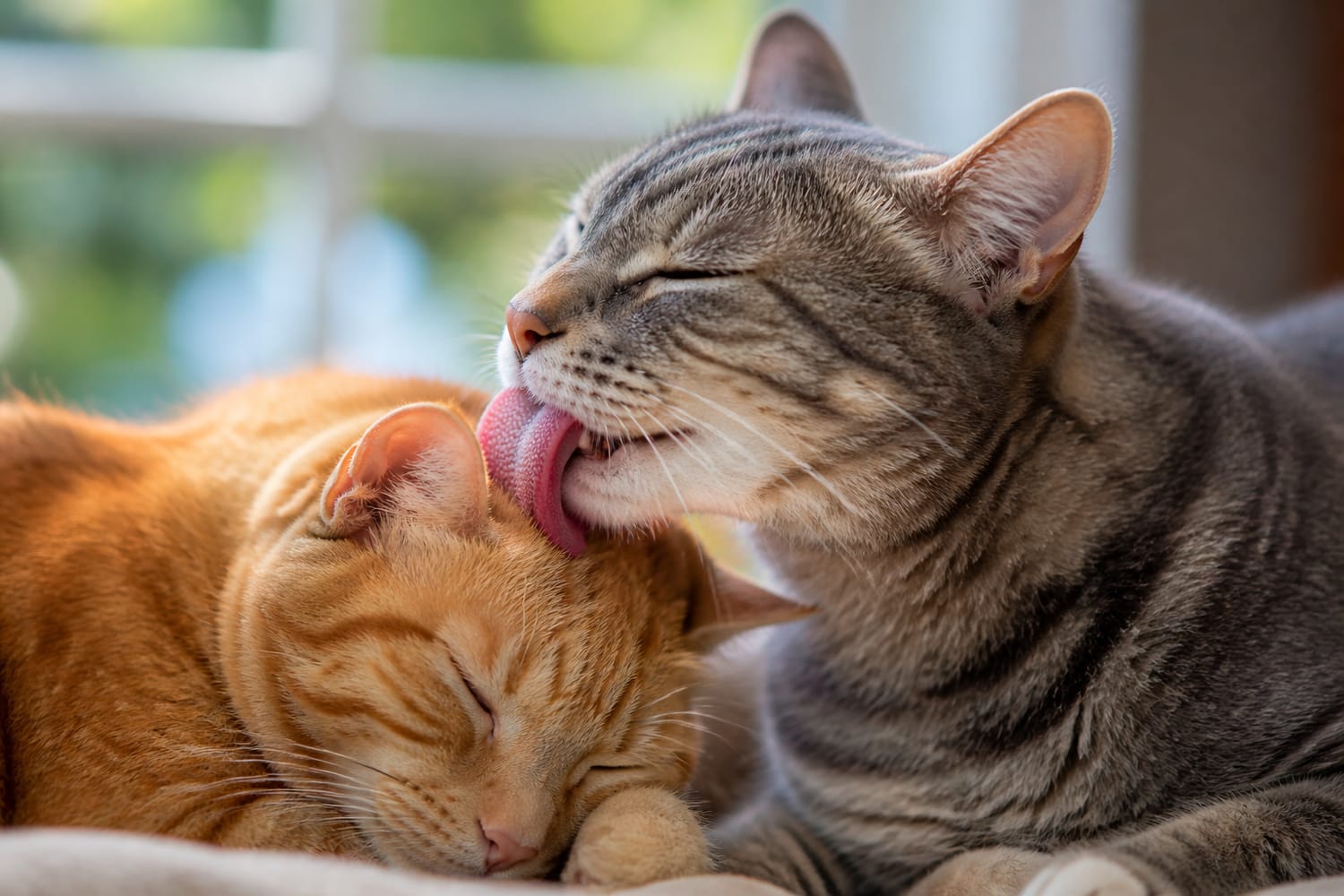
Cats have rough tongues because they are covered with tiny, backward-facing spines called filiform papillae. These firm, keratin-rich structures work like a built-in grooming brush, catching loose fur and helping clean the coat. Their scoop-shaped tips also carry saliva into the fur, supporting cleaning and cooling.
That explains the sandpapery surprise of a cat’s lick—but the full story is even more remarkable. Behind this familiar feline feature is a beautifully coordinated combination of anatomy, movement, and physics.
Let’s take a closer look at the tiny hooks that make an ordinary grooming session so extraordinary.
Meet the Tiny Hooks on Your Cat’s Tongue
Run your tongue across your teeth, and it probably feels soft and flexible. A cat’s tongue has flexible tissue, too, but its upper surface carries hundreds of stiff projections. These papillae point backward, toward the throat, rather than standing like the bristles of a toothbrush.
Their firmness comes from keratin, the same structural protein found in hair and claws. They are not tiny teeth, even if a determined lick sometimes makes them feel that way. Their hooked arrangement creates the tongue’s distinctive rasping texture.
Picture a miniature brush with curved, closely arranged bristles. That is a more useful mental image than sandpaper: a cat’s tongue does not simply rub across the coat. Its projections engage with individual hairs as the tongue moves through them.
A Built-In Brush for a Beautiful Coat
Grooming is where those little hooks really shine. As a cat draws its tongue through its coat, hairs pass between the papillae. The spines help separate strands and collect loose fur, making each lick part combing stroke and part cleaning pass. Their shared backward direction also helps move collected hair toward the mouth.
Think of a cat carefully working along one shoulder, then turning to groom its side. What looks like the same movement repeated over and over is a series of small, targeted passes through a complicated covering of hair.
The tongue is impressive, but it is not an all-purpose replacement for grooming help. Long, silky, or curly coats need regular attention to prevent tangles and mats; even short-haired cats benefit from brushing. VCA’s guide to grooming and coat care explains how those needs vary with coat type.
The Surprise Inside Each Little Scoop
For years, descriptions of cat tongues missed an important detail: the grooming spines are not simply solid cones.
In a study of how cat tongues move saliva through fur, researchers used detailed imaging and grooming experiments to investigate their structure. They found a U-shaped hollow at the tip that draws in saliva through capillary action—the same general phenomenon that helps a paper towel soak up a spill.
When the papillae contact fur, they release that liquid. Instead of leaving all the saliva on the coat’s outer surface, the tongue’s little scoops help carry it deeper into the hair. During grooming, the spines can also rotate into a more upright position, increasing their contact with the coat.
It is an elegant combination: a brush that brings its own carefully delivered moisture.
Grooming Helps Cats Cool Down, Too
Saliva has another useful role after it reaches the coat. As it evaporates, it carries heat away, helping a cat cool down. The papillae support that process by delivering moisture into the fur rather than merely wetting its outermost surface.
That does not make licking a substitute for a comfortable environment. It simply means a familiar grooming routine also contributes to temperature regulation.
For pet lovers, this is a lovely reminder that ordinary animal behaviors often do several jobs at once. A quiet grooming session can be both coat care and a little lesson in physics.
Do Lions and Tigers Have Rough Tongues?
Yes—this remarkable feature extends beyond the cat curled up on your sofa. Rough, papilla-covered tongues are characteristic of the cat family, including lions and tigers. The exact shape, size, and number of papillae can differ between species.
The rough surface also has a role at mealtimes. Papillae help cats process animal tissue, including removing flesh from bone. Zoo Atlanta’s carnivore care team describes feeding and grooming as two important uses of these structures.
Your house cat’s dinner may arrive neatly portioned in a bowl, but its tongue still shares this fascinating anatomical connection with its wild relatives.
Are Those Hooks How Cats Drink?
It is tempting to imagine the rough tongue scooping up water like a tiny sponge. Drinking, however, involves a different mechanism.
High-speed research showed that a cat lightly touches the liquid’s surface with the smooth region near its tongue tip, then quickly lifts the tongue. Water follows upward in a small column, and the cat closes its mouth around part of that column before it falls.
The key is a balance between inertia and gravity, not the hooks ladling water into the mouth. Domestic cats in the research averaged about four laps per second—far too quick for most of us to follow in detail without slow-motion footage.
For another look at commonly misunderstood feline habits, explore Petspiration’s guide to whether cats really hate water and other pet myths.
The Hairball Connection
An efficient fur-catching tongue comes with one unavoidable consequence: cats swallow some of the hair they collect.
Most swallowed hair passes through the digestive tract and leaves in the stool. Some, however, can remain in the stomach and gather into a hairball. Despite the name, a hairball brought up by a cat often looks more like a narrow, furry cylinder than a ball.
Brushing helps reduce the amount of loose fur available to swallow. But frequent hairballs or repeated vomiting should not be dismissed as proof that the tongue is doing its job. They deserve veterinary attention, especially when accompanied by appetite changes, low energy, or repeated unproductive retching. Cornell’s explanation of hairballs and their risks offers useful guidance.
How to Support Your Cat’s Grooming Routine
Understanding that remarkable tongue makes it easier to appreciate where your cat might need a helping hand:
- Brush for your cat’s coat type. Long-haired cats generally need more frequent attention than short-haired cats.
- Keep grooming comfortable. Use gentle strokes, and do not force a comb through a painful tangle.
- Get help with tight mats. Avoid cutting them out with scissors, which can accidentally injure the skin beneath.
- Notice new difficulties. Arthritis, excess weight, or illness can make self-grooming harder.
For cats learning to accept handling, Petspiration’s introduction to positive, reward-based cat training offers a useful starting point.
Too much grooming also deserves attention. Bald patches, damaged skin, or persistent licking of one spot can signal itching, pain, or another underlying problem. Stress can contribute, but medical causes should be investigated rather than assuming the behavior is simply a nervous habit.
A Little More Wonder in Every Lick
The next time your cat pauses for a grooming session, you will know there is more happening than a quick tidy-up. Those tiny hooks are part of a wonderfully specialized tool: one that handles fur, carries moisture, and supports everyday feline life.
For those of us who love cats, understanding these small details adds something special to familiar moments. Even a slightly scratchy lick can become a reminder of just how extraordinary our everyday companions are.