
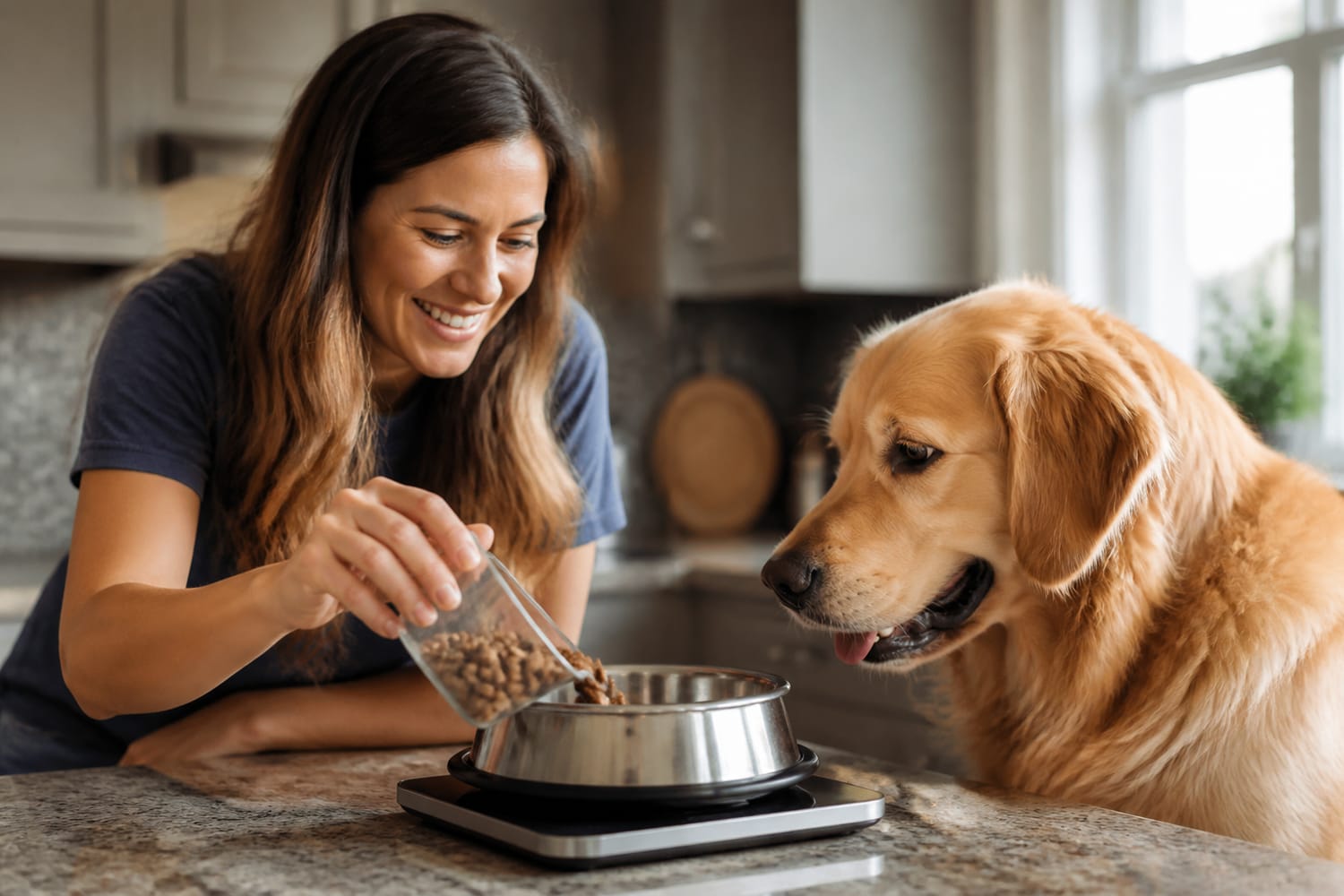
The Short Answer: Your Scoop May Be Serving More Than You Think
Yes, it is surprisingly easy to overfeed a pet—even when you carefully follow the feeding guide and use a measuring cup. Cups measure volume, not weight, so the amount of food they hold can change depending on kibble size, shape, settling and how generously the cup is filled.
A digital kitchen scale measures food in grams, providing a more consistent portion at every meal. That small upgrade can make weight management easier, improve communication with your veterinarian and help your pet enjoy a healthier life.
Why Measuring Cups Can Be Misleading
A “cup” sounds precise, but anyone who has baked knows how much technique matters. You can scoop, pour, shake, pack or heap an ingredient—and end up with a different amount each time. Pet food works the same way.
Research on dry kibble found that measuring-cup portions could range from an 18% underestimate to an 80% overestimate. The study also found that errors tended to be more significant with smaller portions, which is particularly important for cats and small dogs.
Several everyday factors can change what lands in your pet’s bowl:
- A rounded cup contains more than a level cup.
- Large or irregular kibble pieces leave more air spaces.
- Small kibble may settle more densely.
- Different household cups and scoops may not hold the same volume.
- Family members may interpret “half a cup” differently.
- An extra shake or handful can quietly add calories.
One oversized serving will not usually transform a pet’s health. The problem is repetition. A few extra pieces at breakfast and dinner can become hundreds of unplanned servings over the course of a year.
Why Weighing Pet Food Works Better
A gram is always a gram. Whether kibble pieces are round, flat, large or small, a scale measures their actual weight rather than the space they occupy.
The American Animal Hospital Association recommends weighing food with a gram scale to improve precision and accuracy compared with measuring cups. Its nutrition guidance also notes that feeding recommendations on commercial packaging may overestimate the needs of some pets.
Weighing food offers several practical advantages:
- Consistency: Your pet receives the same portion each day.
- Clarity: Everyone in the household can follow one exact number.
- Easy adjustments: You can change a serving from 80 grams to 76 grams without guessing what that looks like in a cup.
- Better monitoring: If your pet gains or loses weight, you know how much food was actually offered.
- More accurate calorie control: This is especially useful for small pets, sedentary animals and pets on weight-management plans.
A scale is not about making mealtime clinical or joyless. It simply turns an uncertain scoop into a reliable act of care.
How to Calculate a Portion in Grams
Before changing your pet’s portion, ask your veterinarian how many calories your pet should receive each day. Calorie needs vary according to species, age, ideal weight, activity, reproductive status, health conditions and individual metabolism. Puppies, kittens, pregnant animals and pets receiving therapeutic diets require particularly careful guidance.
Feeding charts are useful starting points, but they cannot account for every individual. Petspiration’s guide to determining how much to feed your pet can help you understand the factors involved, while your veterinary team can provide a personalized target.
Next, find the calorie information on the package. It may appear as:
- Kilocalories per cup
- Kilocalories per kilogram
- Kilocalories per can, pouch or tray
- Kilocalories per treat
If the label provides calories per kilogram, divide that figure by 1,000 to calculate calories per gram. Then use this formula:
Daily calorie target ÷ calories per gram = grams of food per day
For example, suppose a veterinarian recommends 320 calories per day and the food provides 3.8 calories per gram:
320 ÷ 3.8 = approximately 84 grams per day
If your pet eats two meals, that would be about 42 grams per meal. This is only an illustration—not a universal feeding recommendation.
A Simple Step-by-Step Weighing Routine
You do not need specialized veterinary equipment. An ordinary digital kitchen scale that displays grams and measures in one-gram increments is suitable for most pets.
At Each Meal
- Place the empty bowl on the scale.
- Press the tare or zero button.
- Add food until the display reaches the desired number of grams.
- Include any kibble taken from the bowl for training.
- Record changes if your veterinarian is monitoring intake.
Keep the scale on a firm, level surface and check its batteries periodically. For tiny portions, such as food for a very small animal or low-calorie treats, a more sensitive scale may be needed.
You can also prepare portions in advance. Weigh each meal into a reusable container or bag, then store it according to the food manufacturer’s directions. This can make busy mornings and multi-pet mealtimes much easier.
If several animals share your home, combine accurate portions with a thoughtful multi-pet feeding schedule. Separate rooms, supervised meals or pet-specific feeders can prevent one clever companion from eating everyone else’s calories.
Don’t Forget Treats, Toppers and “Just One Bite”
A perfectly weighed dinner can still be overshadowed by extras. Treats, dental chews, table scraps, pill pockets, supplements and food used during training may all contribute calories.
As a general guideline, treats should provide no more than 10% of a pet’s daily calories unless your veterinarian recommends otherwise. Keeping extras limited helps prevent them from displacing the nutrients supplied by a complete and balanced main diet.
Try setting aside part of your pet’s weighed daily kibble for rewards. Many pets are just as delighted by a piece of their regular food when it is paired with praise, play or an exciting training game.
Remember that the food label matters too. Petspiration’s guide to spotting misleading pet food claims explains why attractive marketing language should never replace a careful look at nutritional adequacy and feeding information.
How to Tell Whether Your Pet May Be Overfed
The number on the scale is helpful, but it does not tell the whole story. Veterinarians also use a body condition score to assess fat covering, waist shape and abdominal tuck. For many healthy dogs and cats, an ideal score is around 4 or 5 on a nine-point scale, although individual assessment is important. The World Small Animal Veterinary Association provides body condition and nutrition resources for dogs and cats.
Possible signs that warrant a closer look include:
- Ribs becoming difficult to feel under a layer of fat
- Loss of a visible waist when viewed from above
- A rounded or sagging abdomen
- Gradual, unexplained weight gain
- Reduced enthusiasm for play or exercise
- Difficulty jumping, grooming or climbing stairs
- Outgrowing a properly fitted harness
These signs do not prove that overfeeding is the cause. Weight gain, reduced activity or changes in body shape can also accompany medical conditions. Arrange a veterinary examination rather than sharply cutting food on your own.
Monitor the Pet, Not Just the Portion
Even an accurately weighed serving may need adjustment. Feeding amounts are starting points because two similar-looking pets can have different energy requirements.
Weigh your pet regularly using the same scale when possible. For a small dog or cat, you may be able to weigh yourself while holding your pet and subtract your own weight. Veterinary clinics can provide more accurate measurements and track trends over time.
Also watch body condition, muscle condition, appetite, stool quality and energy level. A pet who is losing weight unexpectedly, constantly hungry, unusually tired or experiencing digestive changes should be evaluated by a veterinarian.
Never place a pet on a crash diet. Cats are especially vulnerable to serious illness when food intake drops too quickly. Safe weight loss should be gradual, nutritionally balanced and professionally supervised.
A Small Habit With a Big Heart
Weighing food may take only a few extra seconds, but it replaces guesswork with consistency. It can reveal that a familiar scoop is larger than expected, help family members work together and give your veterinarian better information when adjustments are needed.
Most importantly, accurate feeding is not about denying your pet joy. It is about protecting the joyful years ahead—the walks, naps, games, head bumps and tail wags that make life with animals so special.
A scale cannot measure how much you love your pet. It can, however, help you put that love into every thoughtfully portioned bowl.