
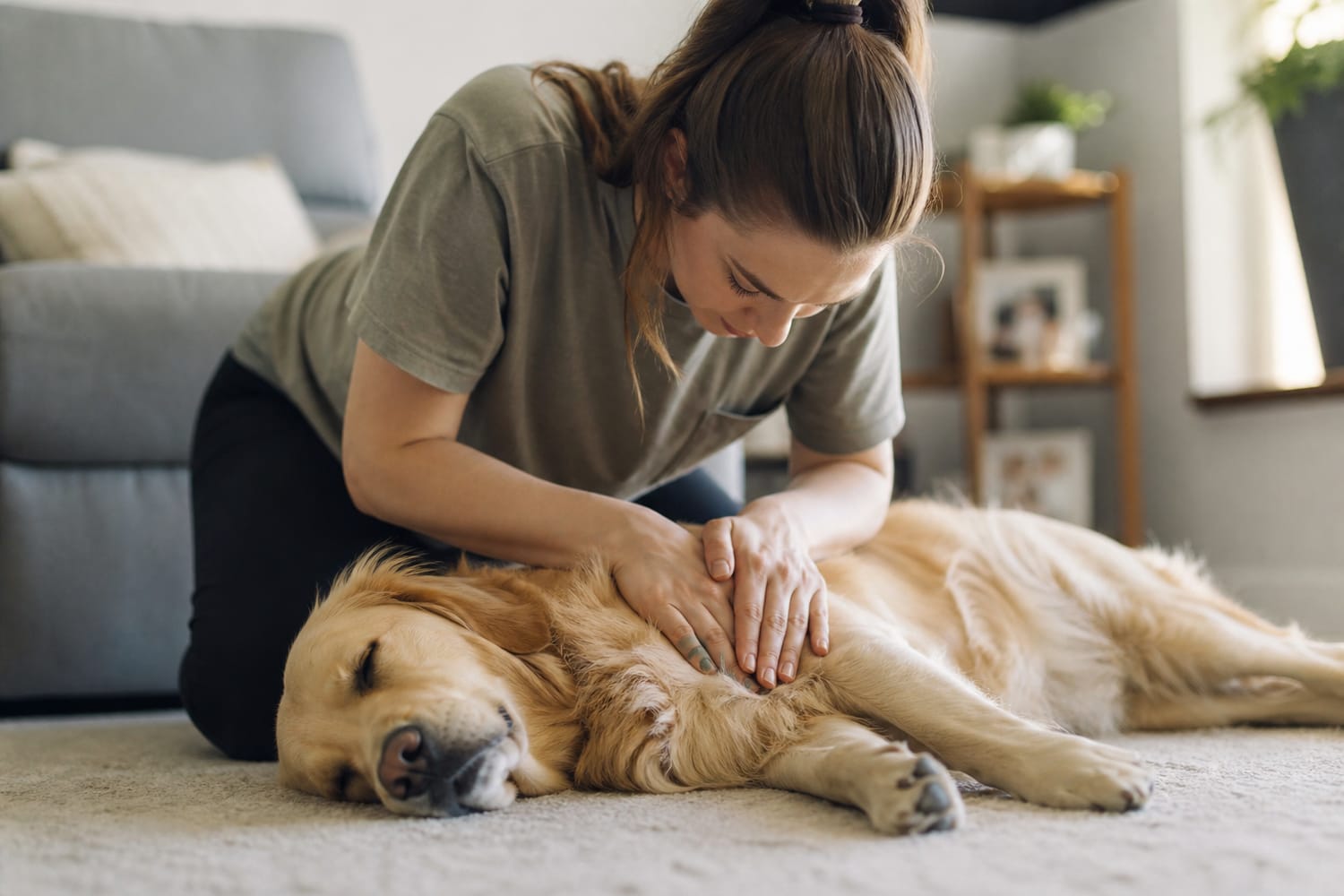
The First Five Minutes: Stay Calm, Act Fast, Love Hard
Few moments feel more frightening than seeing a beloved pet struggling to breathe, collapse, or go suddenly still. Our dogs and cats are family, and in an emergency, the first few minutes can matter enormously. The good news is that with a little preparation and a calm, clear plan, pet parents can take meaningful action while veterinary help is on the way.
Pet CPR and choking first aid are not replacements for emergency veterinary care, but they can help support your pet until professionals take over. Think of them as a bridge: your hands, your voice, and your love helping your pet reach the care they need.
If your pet is choking, unconscious, not breathing normally, or has no detectable heartbeat, treat it as an emergency. Call your veterinarian or an emergency animal hospital immediately. If possible, put the phone on speaker so you can receive guidance while helping your pet.
Know the Signs: Choking, Collapse, and Breathing Trouble
Before you act, quickly assess what is happening. Pets may cough, gag, paw at their mouth, panic, or make harsh breathing sounds when something is stuck in the airway. A choking pet may also have blue or pale gums, struggle to inhale, collapse, or become unconscious.
Choking is different from coughing. A coughing dog or cat may still be able to move air and make noise. A truly choking pet may be unable to breathe effectively, may make little sound, and may deteriorate quickly.
Signs of a life-threatening emergency can include:
- No response when you call their name or gently touch them
- No normal breathing, or only gasping
- Blue, gray, or very pale gums
- Collapse or sudden weakness
- A visible object lodged in the mouth or throat
- No detectable heartbeat or pulse
To check breathing, watch the chest for movement and listen near the nose and mouth. Do this quickly—no more than 10 seconds. Gasping is not normal breathing and should be treated as an emergency.
To check for a pulse, feel the inside of the back leg where the leg meets the body. This is the femoral artery. If you cannot find a pulse quickly and your pet is unresponsive and not breathing normally, begin CPR.
Step One: Call for Help and Make the Scene Safe
In an emergency, seconds feel like hours. Take one deep breath and remember: your calm helps your pet.
First, make sure the area is safe. If your pet collapsed near traffic, water, electrical cords, or another hazard, move them only if you can do so safely. Injured or frightened animals may bite unintentionally, even if they are normally gentle. Speak softly and avoid sudden movements.
Next, call for help. If someone else is nearby, assign them a job:
- “You call the emergency vet.”
- “You get the car ready.”
- “You time two-minute CPR cycles.”
- “You watch for breathing.”
If you are alone, call the emergency veterinary clinic on speakerphone. Give your location, describe what happened, and follow their instructions. If your pet begins breathing again or the object comes out, they still need urgent veterinary evaluation. Choking and cardiac arrest can cause hidden injuries, swelling, aspiration, and oxygen deprivation.
If Your Pet Is Choking but Still Conscious
If your dog or cat is conscious and appears to be choking, your goal is to help clear the airway without pushing the object deeper.
Start by opening the mouth carefully. Look for a visible object such as a toy piece, bone fragment, treat, string, or ball. If you can clearly see and safely grasp the object, remove it with your fingers or tweezers.
Do not perform a blind finger sweep. Reaching blindly into the throat can push an object farther down or injure delicate tissues.
If the object does not come out and your pet cannot breathe effectively, you may need to use choking first aid.
For small dogs and cats, hold them with the head slightly downward if possible. You may try firm back blows between the shoulder blades, using the heel of your hand. Use controlled force appropriate for their size.
For medium and large dogs, you can try abdominal thrusts, often compared to the Heimlich maneuver:
- Stand or kneel behind your dog.
- Place your arms around the belly, just behind the ribcage.
- Make a fist with one hand and cover it with the other.
- Give several quick, upward-and-forward thrusts.
- Check the mouth to see if the object has dislodged.
For cats and very small dogs, use gentler pressure. Their bodies are delicate, and excessive force can cause injury. You can place one hand along the back for support and use the other to apply quick inward-and-upward pressure behind the ribs.
After any attempt, check the mouth again. Remove the object only if you can see it.
If Your Pet Becomes Unconscious
If your pet collapses or becomes unresponsive while choking, lay them on their side on a firm, flat surface. Open the mouth and look for the object. Again, remove it only if visible.
Pull the tongue gently forward to help open the airway. If you can see the obstruction, remove it carefully. If your pet is not breathing normally, begin CPR.
This is the moment where preparation helps you move from panic to purpose. You are not expected to be perfect. You are simply giving your pet a chance while help is on the way.
Pet CPR Basics: Airway, Breathing, Circulation
CPR stands for cardiopulmonary resuscitation. It combines chest compressions and rescue breaths to help move oxygen through the body when the heart or breathing has stopped.
Before starting CPR, check three things quickly:
- Responsiveness: Does your pet react to their name, touch, or sound?
- Breathing: Is the chest moving normally?
- Pulse/heartbeat: Can you feel a pulse inside the back leg or feel a heartbeat?
If your pet is unresponsive, not breathing normally, and you cannot detect a pulse, start CPR immediately.
Place your pet on a firm surface. A soft bed or couch absorbs the force of compressions, making them less effective.
How to Position Your Hands for Compressions
Proper hand placement depends on your pet’s size and body shape.
For most dogs and cats, place them on their side. Put your hands over the widest part of the chest, where the ribcage is tallest. Keep your elbows straight and compress down firmly.
For deep, narrow-chested dogs—such as greyhounds, whippets, or some Dobermans—compress closer to the heart, just behind the front elbow.
For barrel-chested dogs—such as bulldogs or some pugs—chest compressions may be more effective with the dog on their back, compressing over the breastbone. However, if you are unsure, place the pet on their side and begin compressions rather than losing time.
For cats and small dogs, you may be able to use one hand, or place your fingers on one side of the chest and your thumb on the other, gently but firmly squeezing the chest.
How to Give Chest Compressions
Push hard and fast. Aim for a compression rate of 100 to 120 compressions per minute, similar to the beat of a fast song. Compress the chest about one-third to one-half of its width, allowing it to fully recoil between compressions.
Full recoil matters because the chest needs to expand again so blood can refill the heart. Try not to lean on the chest between compressions.
A simple CPR pattern for pet parents is:
- Give 30 chest compressions
- Then give 2 rescue breaths
- Continue in cycles
If another person is with you, one person can do compressions while the other gives breaths and watches for signs of life. Switch roles every two minutes if possible, because compressions are tiring and quality can drop quickly.
How to Give Rescue Breaths
To give rescue breaths, first make sure the airway is open. Gently extend the head and neck so the nose points forward, not sharply upward. Pull the tongue forward if needed.
Close your pet’s mouth and create a seal with your mouth over their nose. For small dogs and cats, your mouth may cover both the nose and mouth. Blow gently until you see the chest rise. Do not overinflate; smaller pets need much less air than people.
Give two breaths, each about one second long. Then return immediately to chest compressions.
If the chest does not rise, reposition the head and neck, check the mouth for a visible obstruction, and try again. If you suspect choking, the airway may still be blocked.
The Five-Minute Action Plan
In a crisis, a simple timeline can help you focus.
Minute 1: Assess and call.
Check responsiveness, breathing, and pulse. Call the emergency vet or have someone else call. Put the phone on speaker if you are alone.
Minute 2: Clear the airway if choking.
Look in the mouth. Remove only visible objects. If conscious and choking, try back blows or abdominal thrusts appropriate for your pet’s size.
Minute 3: Begin CPR if needed.
If your pet is unconscious, not breathing normally, and has no pulse, begin chest compressions and rescue breaths.
Minute 4: Keep going with quality.
Push hard and fast. Let the chest recoil. Give breaths that make the chest rise. Stay focused.
Minute 5: Prepare for transport.
Continue CPR while arranging immediate transport if possible. If another person can drive, continue CPR on the way only if it is safe to do so. Follow veterinary guidance.
Even if your pet starts breathing again, do not assume the danger has passed. Go to the veterinarian immediately.
What Not to Do During a Pet Breathing Emergency
Just as important as knowing what to do is knowing what to avoid.
Do not:
- Put your fingers blindly down your pet’s throat
- Shake your pet forcefully
- Delay veterinary care after “successful” first aid
- Give water, food, or medication immediately after choking
- Practice forceful CPR on a healthy pet
- Assume coughing always means choking
- Continue unsafe handling if your pet may bite from fear or pain
If your pet is breathing, conscious, and coughing strongly, they may be moving air. Call your veterinarian for advice. If breathing becomes labored, gums change color, or your pet weakens, treat it as urgent.
Prevention: The Best Emergency Is the One That Never Happens
While not every emergency can be prevented, many choking risks can be reduced with thoughtful choices.
Choose toys that are too large to swallow and durable enough for your pet’s chewing style. Avoid giving cooked bones, which can splinter. Be careful with small balls, string, ribbon, socks, corn cobs, and hard treats that can lodge in the throat. Supervise dogs with chews and cats with string-like toys.
Keep trash secured, especially if it contains bones, food wrappers, or small objects. Teach dogs “drop it” and “leave it” using positive reinforcement. These cues can be lifesaving.
For pets with known breathing issues, such as brachycephalic breeds like pugs, bulldogs, and Persian cats, be extra watchful during heat, exercise, excitement, or eating. These pets may be more vulnerable to airway distress.
Learn Before You Need It
Reading about pet CPR is a wonderful first step, but hands-on training is even better. Many veterinary clinics, shelters, pet organizations, and animal first aid programs offer pet CPR and first aid classes. Practicing on a mannequin can help you understand pressure, rhythm, and positioning in a way an article never fully can.
You can also build a pet first aid kit that includes gauze, bandage material, saline rinse, tweezers, gloves, a digital thermometer, a muzzle or soft restraint, and emergency contact information. Keep one at home and one in the car.
Courage Is Preparedness in Action
No pet lover wants to imagine an emergency. But learning what to do is an act of love. It means that if the unthinkable happens, you can meet the moment with steadier hands and a clearer heart.
Your pet does not need you to be fearless. They need you to be present. Call for help, check the airway, support breathing and circulation, and get to a veterinarian as quickly as possible.
In those first five minutes, love becomes action. And sometimes, that action can make all the difference.